Learn · Sheet Metal
Sheet Metal: Gauges, Materials, Tools
Part of Sheet Metal to TAB Certified · step 1 of 23 · next: Pattern Development and Layout
In learning paths: Sheet Metal to TAB Certified
Gauge is a thickness number and it runs backwards: the higher the number, the thinner the metal. 26 gauge is thinner than 20 gauge, and 20 is thinner than 16. Say that out loud on your first day, because reading gauge the wrong way round is the classic apprentice error and it does not announce itself until the metal is already cut.
Why it matters on the job
Everything downstream depends on getting the material right. The construction standard picks a thickness for your duct, the shear and the brake are each rated for a thickness, and the seam you form has to hold in that thickness. Read the number backwards and you build a run that flexes and drums in service, or you feed a machine metal it was never rated to cut.
Two rules about gauge
The first rule is the direction: bigger number, thinner sheet.
The second rule catches people who have already learned the first. A gauge number on its own is meaningless, because gauge is material-specific. The same number is a different thickness in galvanized steel, in stainless and in aluminum, since each material is measured on its own series. “20 gauge” is a complete answer only when you also name the metal. When you need a real decimal thickness, you read it out of the series table for that material instead of carrying one remembered number across all three.
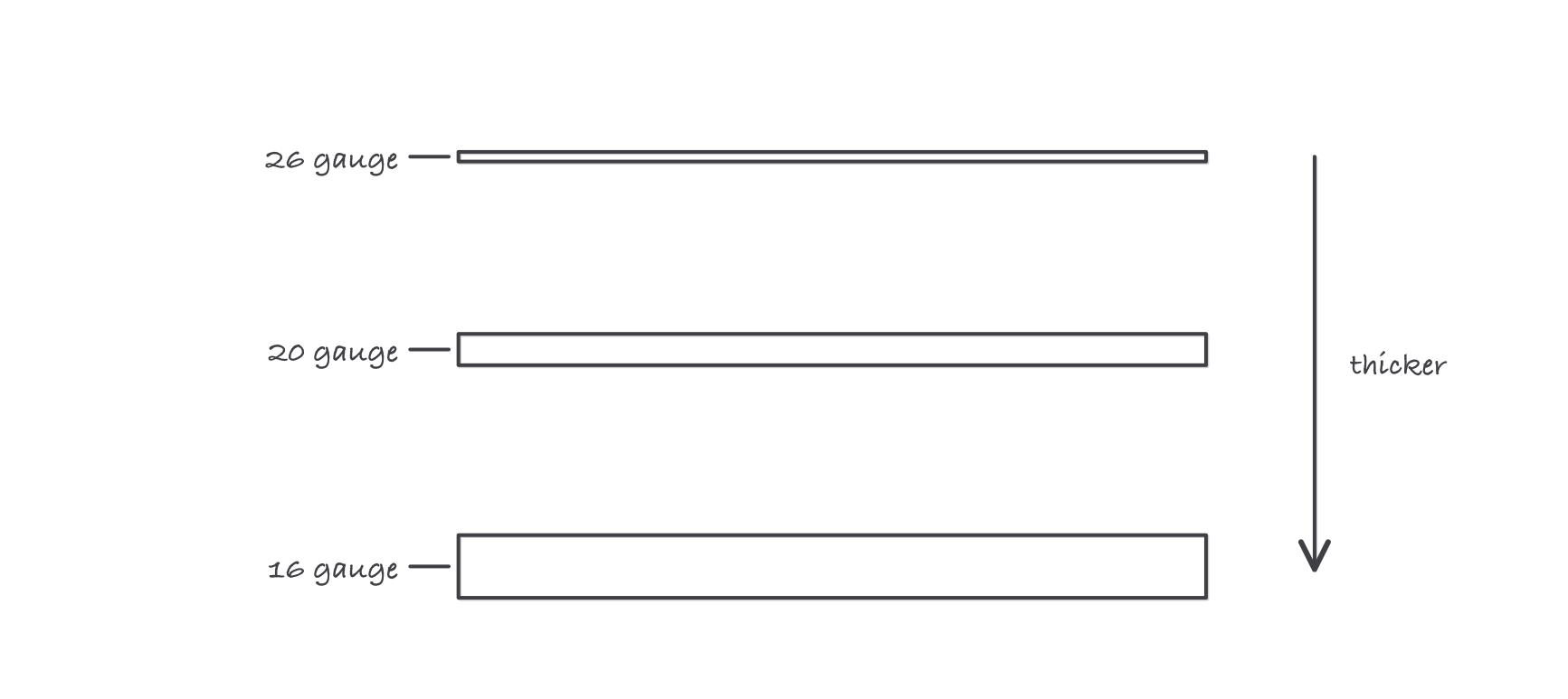
Higher gauge number, thinner metal. The order looks wrong and it is correct
Coating is not thickness
Galvanized sheet carries a coating designation such as G60 or G90. Those numbers describe the zinc coating that resists corrosion, and they say nothing whatever about the thickness of the steel underneath. Gauge is thickness; the G number is corrosion protection. A 26 gauge G90 sheet is thin steel with a heavy coating, and there is nothing contradictory about that combination.
The materials
- Galvanized steel is the default for HVAC duct: zinc-coated, formable, and priced to be the ordinary choice.
- Stainless steel goes where corrosion, washdown or hygiene rules the job (commercial kitchen exhaust, laboratories, food plants). It work-hardens as you form it, so it fights back in the brake.
- Aluminum is light and corrosion-resistant, and it is softer than steel, so it marks, creases and gouges more easily at the same gauge number.
The three machines do three different things
A shear cuts, a brake bends a straight line, a roll curves. They are not casual synonyms for “forming”, and running a part through the wrong one is not a shortcut.
- Shear: straight cuts to a line, in the flat.
- Brake: a straight bend along a line you have set, one bend at a time.
- Roll: a continuous curve, which is how flat sheet becomes round pipe.
Each machine is rated for a maximum thickness in a stated material, which is the second reason a bare gauge number is not enough information. A shear rated for 16 gauge mild steel is not thereby rated for 16 gauge stainless.
Guarding, and your hands
OSHA treats shop machinery such as shears and press brakes as machines requiring guards in two places: at the point of operation (where the metal is actually worked) and at the power transmission parts (the belts, gears and shafts that drive it). Neither guard is optional and neither is a substitute for the other.
The rest of the injury story is cuts. A freshly sheared edge is genuinely sharp, and OSHA’s hand and power tool guidance is where the laceration hazards of snips, drills and hand tools sit. Gloves, deburring and handling sheet by the folded edge rather than the raw one are the habits that keep the cuts off your record.
Worked example: cutting a nest
You need 14 blanks, each 31 inches wide, cut from stock sheets 48 inches by 120 inches.
Across the 120 inch length: 120 / 31 = 3.87, so you get 3 blanks per sheet. The drop is 120 - (3 × 31) = 120 - 93 = 27 inches of waste per sheet, and 27 inches is not wide enough for a fourth blank.
Sheets required: 14 / 3 = 4.67, so you open 5 sheets, and the fifth one supplies only the last 2 blanks.
Now suppose the detail allows a 30 inch blank instead. 120 / 30 = 4 exactly, so you get 4 blanks per sheet with no drop at all, and 14 / 4 = 3.5 means 4 sheets. One inch off the blank width saved a whole sheet out of five, which is 20 percent of the material for that job.
That arithmetic is why layout people nest before they cut, and why the shop asks whether a dimension is fixed or merely drawn.
Where it bites
- Gauge and thickness get confused with strength. Thicker metal is stiffer, but stiffness in a finished duct also comes from reinforcement and from the seam you chose. Going up a gauge is not the only answer to a panel that oil-cans.
- A gauge quoted without its material is a guess. So is a gauge quoted for a duct size without reading the construction standard’s table. Both are places where a confident-sounding number is wrong.
- G90 is not a gauge. It is a coating class, and people say “we ran it in G90” as though that answered the thickness question. It does not.
- The machine’s rating is in a specific material too. Check the plate on the machine against the metal in your hand, not against the metal you cut yesterday.