Learn · Sheet Metal
TAB Fundamentals
Part of Sheet Metal to TAB Certified · step 12 of 23 · next: Airflow Measurement Instruments
In learning paths: Sheet Metal to TAB Certified
Assumes you know: Duct Construction Standards (SMACNA)
Testing, adjusting and balancing is three verbs, and a lot of confusion in this specialty comes from hearing it as one. Testing is measuring what a system is actually doing. Adjusting is changing device settings. Balancing is proportioning the flow so every terminal gets its design share. A report full of measurements is a tested system, and a tested system is not yet a balanced one.
Why it matters on the job
Installed does not mean working. A duct system leaves the fitters’ hands with every damper wherever it happened to be, every fan running at whatever speed the drive was set to, and airflow distributing itself according to resistance rather than according to the design. TAB is the process that closes the gap between the drawing and the building, and on most commercial projects the signed TAB report is a condition of turnover.
The three verbs
Testing is measurement, done with calibrated instruments and recorded. Fan speeds, motor amps, static pressures across coils and filters, airflow at every terminal and at the air handler. Testing tells you the current state and nothing else.
Adjusting is changing settings so the system can do what it was designed to do: fan speed, sheave or drive setting, damper positions, valve settings, control setpoints. Adjusting without measuring first is guessing, and measuring without adjusting is an inspection.
Balancing is the part with a method. You proportion flow across a system so that every terminal ends up at the same fraction of its design value, and then you bring the whole system up together. That order matters and it is the subject of its own lesson.
Where TAB sits in a project
TAB happens after installation is substantially complete, because a system with open ends, missing terminals or unfinished controls cannot be balanced. It happens before the owner takes the building, because the report is the evidence that the design intent was reached.
The deliverable is the report, and the report has a signature structure. Across the three certifying bodies the shape is the same even though the titles differ: a technician performs the work and prepares the report, and a senior certified person reviews and authenticates it. NEBB states this most explicitly, in that only NEBB Certified Professionals working for certified firms may authenticate official reports and Certified Technicians work under a Certified Professional’s guidance. TABB’s quality assurance program describes reports prepared by a technician and reviewed by a supervisor. At AABC, the Test and Balance Engineer certifies the reports and supervises the technicians.
The three bodies certifying this discipline are TABB (issued through the International Certification Board), NEBB and AABC. TABB has been setting TAB certification standards since 1981. They are separate organizations with separate ladders, covered in their own lesson.
TAB and commissioning are different scopes
TAB measures and sets the systems. Building systems commissioning is a broader verification process, usually carried out independently, that confirms systems meet the owner’s requirements. A commissioning authority may witness and review TAB work without performing any of it.
The reason these get muddled is that the same organizations certify in both areas, so the same logo appears on both kinds of card. Same issuer, different discipline, different scope of work.
Worked example: right total, wrong everywhere
A trunk feeds four terminals. Each is designed for 1,000 CFM, so the system’s design total is 4,000 CFM. You traverse the trunk and read each outlet:
- Terminal 1: 1,400 CFM
- Terminal 2: 1,300 CFM
- Terminal 3: 800 CFM
- Terminal 4: 500 CFM
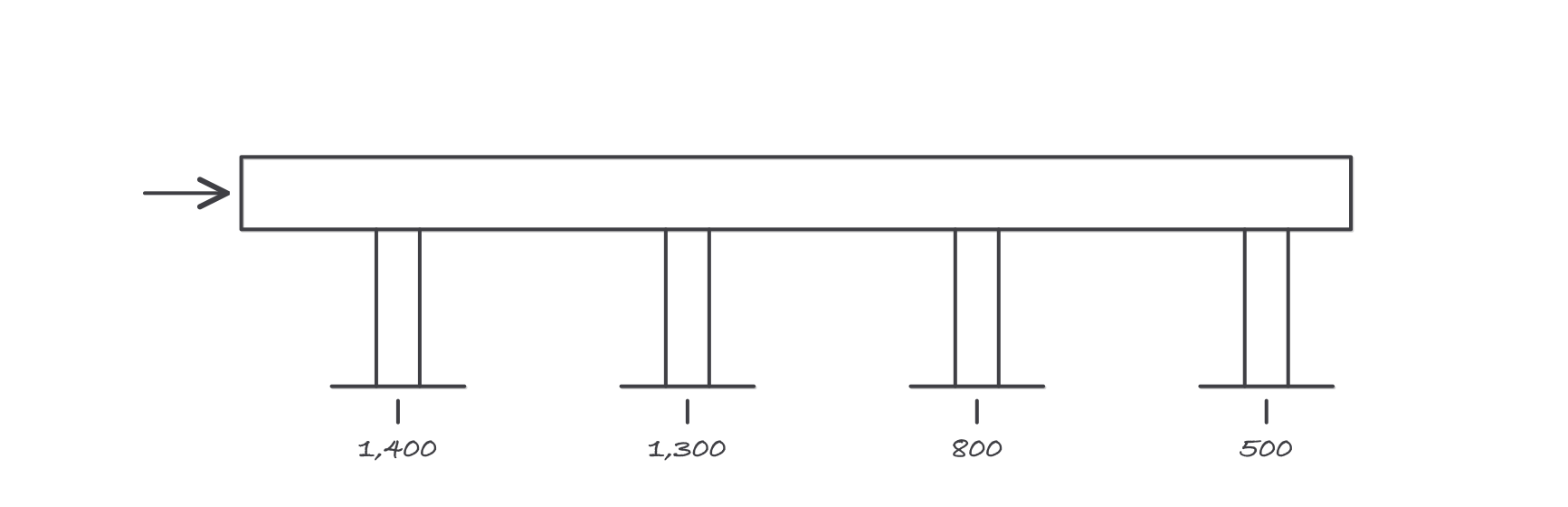
Four terminals, all designed for 1,000 CFM, adding up to exactly the right total
Add them: 1,400 + 1,300 + 800 + 500 = 4,000 CFM, precisely the design total. The fan is moving exactly the right amount of air.
Now take each terminal as a fraction of its design:
- Terminal 1: 1,400 / 1,000 = 1.40
- Terminal 2: 1,300 / 1,000 = 1.30
- Terminal 3: 800 / 1,000 = 0.80
- Terminal 4: 500 / 1,000 = 0.50
Not one of them is right. Terminal 4 gets 500 CFM against a design of 1,000, so that space is half-supplied and its occupants will complain all summer. The system is tested, the total checks out, and no balancing has happened at all.
This is why a TAB report is read terminal by terminal, and why a total at the air handler proves nothing about distribution.
Where it bites
- “The pressure in the duct” is three different quantities. Total pressure equals static pressure plus velocity pressure. Static pressure is what construction is classified against and what a manometer reads against the duct wall; velocity pressure is what a pitot traverse converts into velocity; total pressure is what a fan produces against the system. Saying which one you mean removes most of the wrong answers in this field.
- CFM and FPM measure different things. CFM is volume flow, FPM is velocity, and airflow is velocity times area. Reading a velocity off an instrument and writing it in the CFM column has skipped the area.
- Balancing dampers and life-safety dampers are different devices. A volume damper proportions airflow. Fire dampers, smoke dampers and combination units are life-safety equipment with their own inspection and testing regime, and a TAB scope does not extend to adjusting them.
- A system that cannot be balanced is a design or installation problem. When a terminal will not reach design with its damper wide open, the answer is upstream, and the honest report says so rather than burying it.
Exam relevance
Every TAB certification exam is built on this vocabulary, so the definitions here are worth more than they look. Expect the three verbs to be tested as distinct activities, the three pressures to be tested against each other, and the CFM-versus-velocity relationship to appear inside larger calculation questions. Nothing here is exotic; it is the language the rest of the exam is written in. Requirements and content are set by each certifying body, so confirm them at the source before you plan around them.