Learn · Sheet Metal
Pressure Class, Seal Class and Leakage Class
Part of Sheet Metal to TAB Certified · step 10 of 23 · next: Running a Duct Leakage Test
In learning paths: Sheet Metal to TAB Certified
Assumes you know: Duct Construction Standards (SMACNA)
Three separate selections govern a run of duct, and they get collapsed into one idea constantly. Pressure class drives how heavy the metal is and how it is stiffened and joined. Seal class says which seams, joints and penetrations must be sealed. Leakage class is the allowable leakage the finished duct is measured against. You choose all three, you choose them independently, and one of them does not hand you the other two.
Why it matters on the job
The collapse happens in a predictable direction: somebody assumes that building to a given pressure class automatically delivers a particular seal and a particular leakage result. It does not. The duct then passes a construction inspection and fails a leakage test, and the argument that follows is about who was supposed to seal what.
Reading a schedule correctly means finding three answers, not one. If the specification gives you only one of the three, that is a question for the engineer before the metal is cut.
Pressure class
Pressure class is a static pressure rating, expressed in inches water gauge. It is the pressure the duct must be built to withstand, and in the construction standard it drives metal thickness, the reinforcement (size and spacing of the stiffeners) and which joint types are permitted.
Two things about the word “pressure” here.
It is static pressure, not total pressure and not velocity pressure. Static pressure is what a manometer reads against the duct wall, and it is the quantity duct construction is classified against. Confusing it with total pressure is a routine source of wrong answers here.
And it applies to negative pressure too. Return and exhaust duct is routinely dismissed as low pressure so it “does not matter.” The construction standards address negative pressure explicitly. The failure mode inverts: positive-pressure duct bursts and negative-pressure duct collapses inward, which is why a return that was never given a pressure class can suck itself flat on startup.
Seal class
Seal class answers a different question: which of the openings in this duct get sealed. Transverse joints, longitudinal seams and wall penetrations are three separate populations, and a seal class names which of them are in scope.
That is a scope statement, not a performance statement. It tells the installer where the sealant goes. It does not, on its own, tell anybody how much air the finished system is allowed to lose.
Leakage class
Leakage class is the performance statement. It is the allowable leakage rate that the built system is measured against when it is tested, and it is the number the test has to beat.
SMACNA publishes this side of the subject as its own American National Standard, the HVAC Air Duct Leakage Test Manual (ANSI/SMACNA 016-2012), which covers the leakage criteria, the test procedures, the apparatus and setup, and a sample leakage analysis. It also carries updates to the expected leakage rates for ductwork constructed to the HVAC Duct Construction Standards (Metal and Flexible).
Note what that last point implies. The construction standard and the leakage expectations are related and they are still published apart, with the leakage document holding the criteria. A separate document is a strong hint that this is a separate selection.
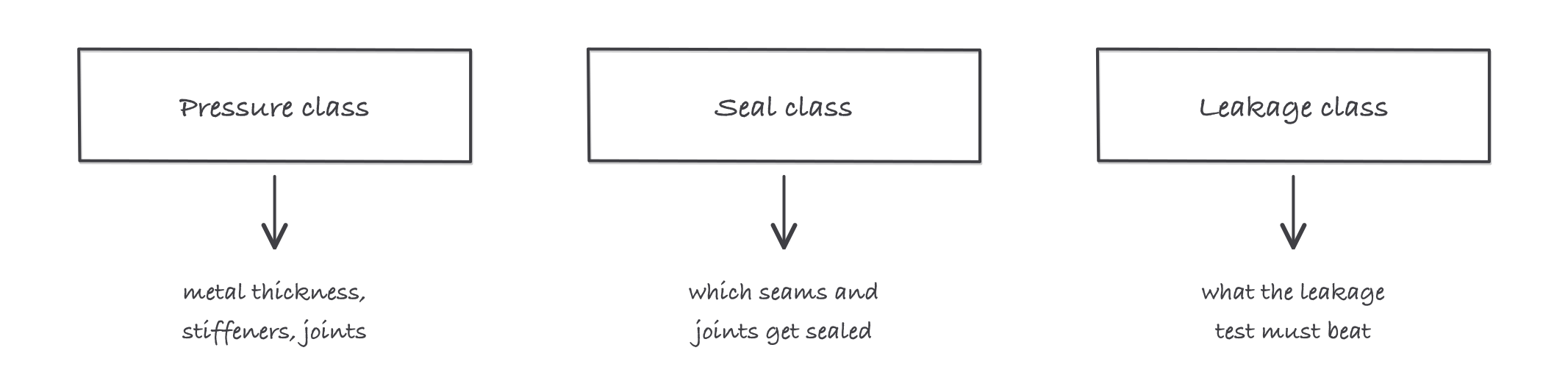
Three independent choices with three different consequences, made from the schedule and not from each other
Worked example: the part of the leakage number you can compute
Allowable leakage is written against duct surface area, so before you can compare a test result to an allowance you need the area of what you tested. That part is geometry and you can do it on the tailgate.
Take a test section made of two runs.
Run A: 40 ft of 24 in by 12 in rectangular duct. Perimeter = 2 × (24 + 12) = 72 in, and 72 / 12 = 6 ft. Surface area = 6 ft × 40 ft = 240 sq ft.
Run B: 30 ft of 30 in by 10 in rectangular duct. Perimeter = 2 × (30 + 10) = 80 in, and 80 / 12 = 6.667 ft. Surface area = (80 / 12) × 30 = 200 sq ft exactly.
Total tested surface = 240 + 200 = 440 sq ft.
Allowable leakage is then that area multiplied by the allowable rate per unit area at the test pressure, and the rate and the test pressure both come out of the leakage manual for the class the specification named. Note what changed and what did not: Run B has the larger perimeter per foot of duct and still contributes the smaller allowance, because it is the shorter run. Length and shape both move the number, which is why the area is calculated rather than estimated from the linear footage.
Also note what the pressure class did not do here. It set the metal thickness and the joints for both runs. It did not produce the 440 sq ft, and it did not produce the allowable rate.
Where it bites
- A pressure class is not a leakage class. Building to a pressure class satisfies a construction requirement. It makes no promise about the test result, and it is not a defense when the test fails.
- A seal class is not a leakage class either. Sealing everything the seal class names is doing the specified work. Whether the finished system leaks less than its allowance is a separate, measured fact.
- “It is only return air” is not a pressure class. Negative pressure duct is classified too, and the consequence of ignoring it is collapse rather than a leak.
- The values live in the purchased standards. Thickness, reinforcement, permitted joints and the allowable leakage rates all come out of tables you buy. Never carry a remembered number from the last job onto this one, and never take one from a search result.
- Test the area you actually tested. Allowances scale with surface area, so a test section that includes more duct than the specification intended will be compared against the wrong allowance in your favor, which an alert engineer will catch.