Learn · Sheet Metal
Seams and Connections
Part of Sheet Metal to TAB Certified · step 4 of 23 · next: Sheet Metal Hazards: Machines, Edges, Fumes, Heights
In learning paths: Sheet Metal to TAB Certified
Assumes you know: Sheet Metal: Gauges, Materials, Tools
A seam runs along the length of a duct and a joint connects one section to the next. Keeping those two words apart is the first step, because they are chosen for different reasons and they fail in different ways. Pittsburgh locks, standing seams, drive cleats and S-slips are not four spellings of the same idea; they are distinct joint families with distinct jobs.
Why it matters on the job
The seam is what holds the duct’s shape against pressure, and the joint is what keeps a 40 foot run from becoming a row of unconnected boxes. Both also decide how much sealing work follows: a joint with a long, tortuous path leaks less to begin with than a joint that is two pieces of metal touching. Choosing badly means either a duct that flexes and drums or a crew sealing far more linear feet than it needed to.
Longitudinal seams
These run parallel to the airflow, along the corner or the length of a duct section.
- Pittsburgh lock is the workhorse corner seam on rectangular duct. One edge is folded into a pocket, the mating edge slides in, and the pocket’s outer lip is folded over to lock it. It is mechanically strong and it closes tightly, which is why so much rectangular duct uses it.
- Snap lock family seams use a formed profile that snaps together by hand, trading some strength for speed on lighter work.
- Standing seam leaves a raised, doubled rib standing proud of the surface. The rib adds stiffness where you want it and gives you something to grip, which is why it shows up on larger panels.
- Grooved seam is the flat, interlocked seam used on round pipe, hammered down so it finishes nearly flush.
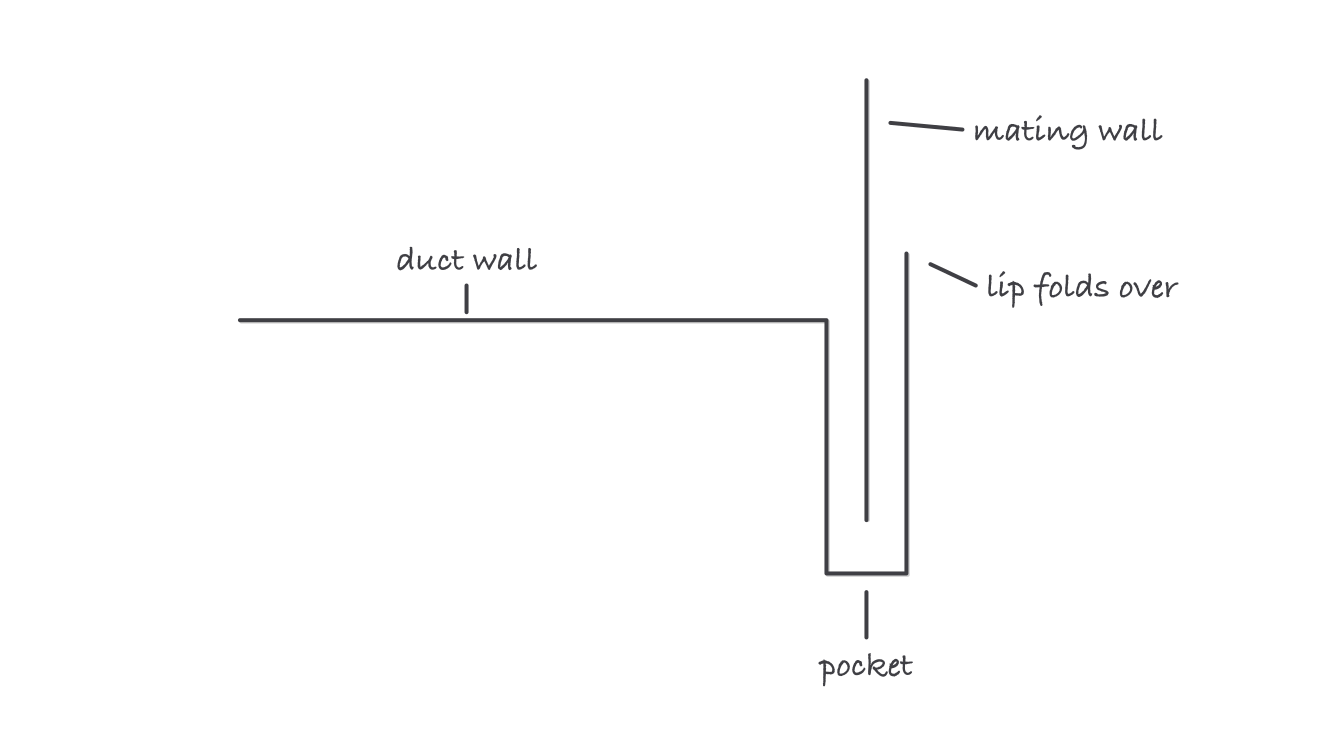
The Pittsburgh lock in section: pocket, mating edge, and the lip that closes it
Transverse joints
These run around the duct and connect section to section.
- Drive cleat and S-slip are used as a pair on a rectangular joint. S-slips take one opposing pair of sides and drive cleats slide onto the other pair, with the drive ends bent over at the corners to lock the whole thing together. It is fast and cheap, and it is the standard connection on the lower-pressure end of the work.
- Flanged connections put a flange around the whole end of each section, with a gasket between and corner pieces clipping or bolting the two flanges together. They are stiffer, they seal better, and they cost more in both material and time.
Which one you are allowed to use is not a shop preference. The construction standard ties joint selection to the duct’s pressure class and its dimensions, so the answer comes out of a table before it comes out of a habit.
Worked example: what the seams cost you in metal
You are making a 20 by 10 inch duct section from two L-shaped blanks, joined by two Pittsburgh locks at diagonally opposite corners.
Finished girth: 2 × (20 + 10) = 60 inches all the way round.
Each blank carries half of that, so 30 inches of finished girth per blank (one 20 inch face plus one 10 inch face).
Each of the two seams pairs one pocket edge with one mating edge, so each blank needs one of each. Take your shop’s own allowances (confirm them against your machine, since they follow the roll former, not this page). Say the pocket takes 1 inch of metal and the mating flange takes 1/2 inch:
Blank width = 30 + 1 + 0.5 = 31.5 inches, and you cut two of them.
Total sheet consumed: 2 × 31.5 = 63 inches, against 60 inches of finished girth. The two seams eat 3 inches, which is 3 / 60 = 5 percent of the metal in that section.
That 5 percent is why allowances belong in the cut list rather than in someone’s head, and it is why the blank width, not the duct size, is the number you nest against. Out of a 120 inch sheet: 120 / 31.5 = 3.81, so 3 blanks per sheet with 120 - 94.5 = 25.5 inches of drop.
Where it bites
- “Pittsburgh” is not a generic word for a longitudinal seam. Calling every corner seam a Pittsburgh hides the reason one seam was specified over another, and it hides the fact that they take different allowances at the brake.
- Allowances are machine-specific. The number your former produces is the number to use. Borrowing an allowance from another shop, another machine or a textbook is how a blank ends up 1/4 inch short all the way round.
- A joint that assembles is not necessarily a joint that seals. The seal class tells you what has to be sealed regardless of how tight the connection feels in your hands.
- Drive cleats are directional at the corners. The bent-over ends are the lock. A joint slid together and left unbent looks finished from six feet away and pulls apart under pressure.