Learn · Sheet Metal
Duct Sealing and Leakage Testing
Part of Sheet Metal to TAB Certified · step 8 of 23 · next: Which SMACNA Standard Governs What
In learning paths: Sheet Metal to TAB Certified
Assumes you know: Duct Installation and Support
Sealing is a thing you do to the ductwork. Leakage class is a number the finished system gets measured against. They are related the way sanding is related to a flatness tolerance, and treating them as one idea is how a crew ends up sealing everything, testing nothing, and still failing.
Why it matters on the job
Air that leaks out of a supply duct was heated or cooled, moved by a fan, and then delivered to a ceiling void. It costs the owner money every hour the system runs, and it costs the occupants comfort, because the terminal at the end of a leaky run never gets its design flow no matter how the balancer sets the damper. On projects with a leakage specification, the test is a hold point: the ceiling does not close until the duct passes.
Three selections, not one
Pressure class, seal class and leakage class are chosen independently and they answer different questions.
- Pressure class (in inches water gauge) is a construction input. It drives metal thickness, reinforcement and joint selection.
- Seal class says which parts of the duct must be sealed: transverse joints only, or joints plus longitudinal seams, or all of that plus every penetration of the duct wall.
- Leakage class is the performance the finished duct is measured against, expressed as a leakage rate per unit of duct surface area at a stated test pressure.
The fact that SMACNA publishes the testing side as its own American National Standard (ANSI/SMACNA 016-2012, the HVAC Air Duct Leakage Test Manual) rather than as a chapter of the construction standard is the signal that construction and leakage are two topics. The leakage criteria and the test procedures live in that manual.
Read all three off the specification. Do not infer two of them from the third.
Sealing that holds
The sealant is the easy part; the surface is the hard part.
- Clean, dry metal. Mill oil, shop dust and condensation all defeat adhesion. A joint wiped before sealing outlasts a joint given twice as much mastic.
- Mastic gets worked into the joint, not spread over it. A skin bridging a gap tears the first time the duct flexes under pressure.
- Tapes are a system, not a category. The tape, the surface preparation and the application pressure are specified together, and a tape applied cold, dirty or unrolled without pressure will let go.
- Cure time is real. Sealants have a temperature range and a cure period, and testing before cure gives you a failure you then chase for a day.
- Seal what you can still reach. Every joint that will be behind insulation, above a hard ceiling or inside a shaft gets sealed and inspected before it disappears.
None of this rescues loose construction. A duct assembled with sloppy joints and then buried in mastic still moves, and the mastic cracks where the movement is.
Worked example: leakage is a rate, not a quantity
You have 100 feet of 24 by 12 inch duct on the test.
Step 1, find the surface area. Perimeter = 2 × (24 + 12) = 72 inches = 6 feet, so each foot of duct has 6 square feet of surface. Over 100 feet: 6 × 100 = 600 square feet.
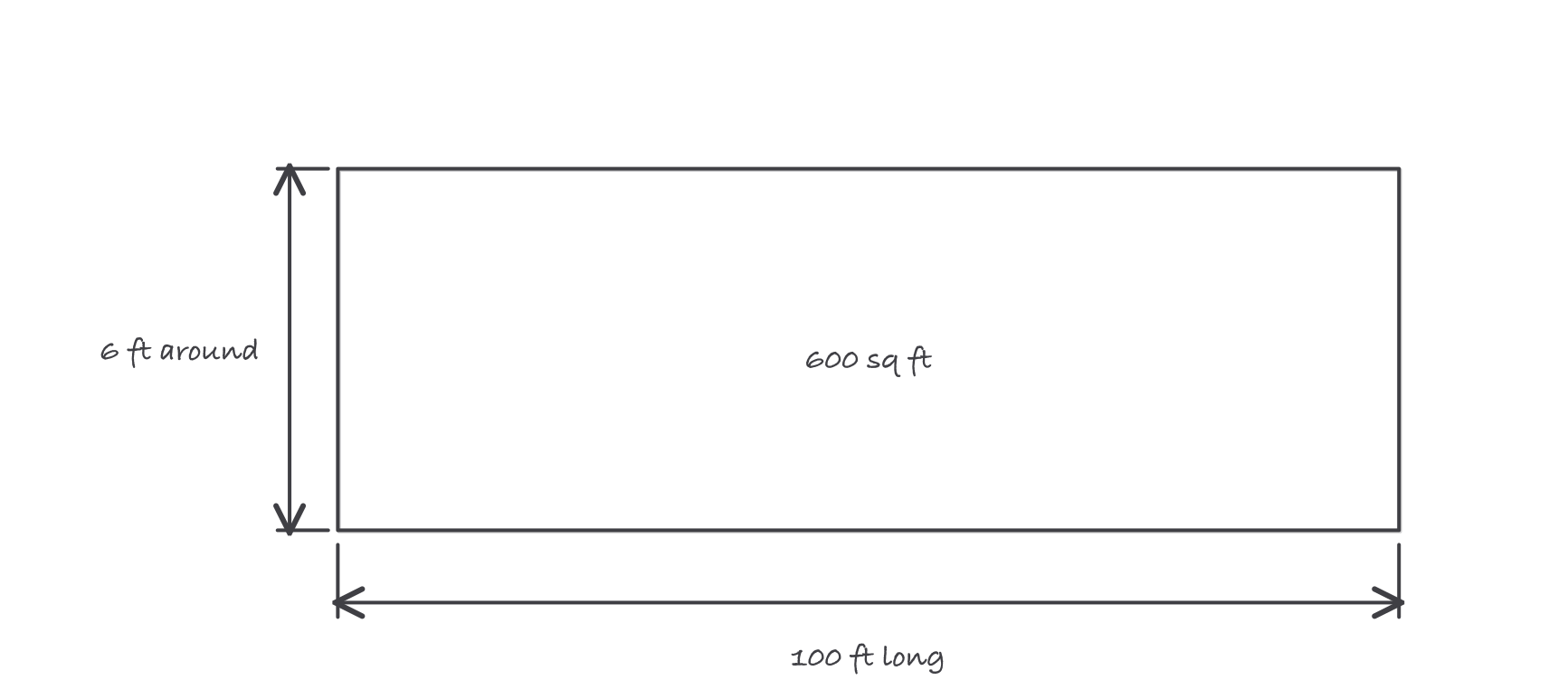
Unroll the duct and its surface area is one multiplication: girth times length
Step 2, normalize the measurement. The test rig reads 18 CFM of leakage at the specified test pressure. Leakage allowances are written per 100 square feet, and you have 600 / 100 = 6 units of that. So your rate is 18 / 6 = 3.0 CFM per 100 square feet.
Step 3, compare. That rate, and only that rate, is what you check against the leakage class in the specification. The allowable value comes out of the standard, not out of anyone’s memory.
Now see why the raw number is useless on its own. Measure the same 18 CFM on a 200 foot run of the same duct: surface area is 6 × 200 = 1,200 square feet, so the rate is 18 / 12 = 1.5 CFM per 100 square feet, half of the first result. Identical leakage, half the number, possibly a different verdict. Anyone quoting “we were only leaking 18 CFM” has not finished the calculation.
Where it bites
- A duct leakage test is not a blower door test. Duct testing pressurizes the ductwork and measures what escapes the duct. Building envelope testing pressurizes the building and measures what escapes the envelope. Different apparatus, different standards, different technicians.
- Leaks are not where the air noise is. A whistle tells you there is a leak; it does not tell you it is the biggest one. Systematic testing of a section beats chasing sounds.
- The test section has to be closed. Open ends, missing caps and unconnected taps produce spectacular failures that are not construction defects. Verify the boundary before you blame the metal.
- Test early and in sections. A whole-system test that fails gives you a number and no location. Sectional tests as the work goes up give you a leak you can still walk up to.