Qualifications · Sheet Metal
TAB Certification (TABB, NEBB, AABC)
Part of Sheet Metal to TAB Certified · step 15 of 23 · next: TAB and Commissioning Are Not the Same Scope
In learning paths: Sheet Metal to TAB Certified
Assumes you know: Balancing Procedures
Three independent organizations certify people to do testing, adjusting and balancing in the United States: TABB, NEBB and AABC. Each runs its own two-tier ladder and sets its own requirements, and none of them recognizes another’s card. Choosing between them is a real decision, and for one of the three it is not entirely yours to make.
*Learn the Trades is a free study resource. We are not a licensing body, an authorized training provider, or an exam administrator. Reading this page does not award any card, license, or certification. Always verify requirements with the issuing authority linked in the sources.*Why it matters on the job
Specifications name bodies. A project that requires TAB work by an AABC member agency, or a report authenticated by a NEBB Certified Professional, has narrowed the field before anyone bids it. On the individual side, the card decides whether you are the person taking readings or the person signing for them, and that is a pay grade and a scope of responsibility, not a title.
The shape all three share
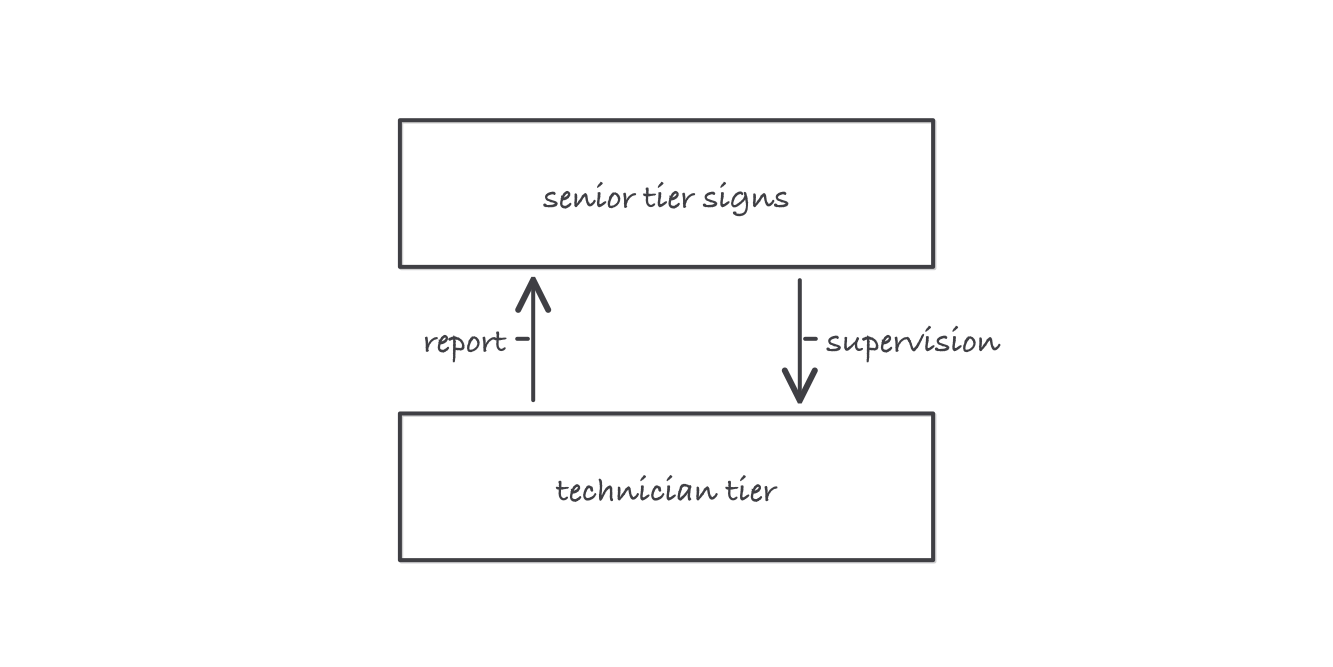
Every one of the three bodies runs this structure: TABB Technician under TABB Supervisor, NEBB CT under NEBB CP, AABC TBT under AABC TBE
Underneath the different names, the architecture is the same. A junior tier does the field work and prepares the report. A senior tier supervises that person and reviews or authenticates the report. The requirements to reach each tier, and the words used for them, differ sharply. The structure does not.
What does not exist is any bridge between the ladders. Holding a senior card from one body does not convert into another body’s card, and time served under one is not automatically credited by another. Treat them as three separate careers that happen to do the same work.
TABB, issued through ICB
TABB has set TAB certification standards since 1981. The certifications themselves are issued by the International Certification Board, which is a personnel certification body accredited to ISO/IEC 17024 by ANAB. The TABB name sits inside a wider ICB family that also includes Fire and Smoke Damper, Duct Air Leakage Testing, Indoor Air Quality, Smoke Control, Building Envelope, Mechanical Acceptance Test and Total Building Energy Audit certifications, alongside TABB Technician, TABB Supervisor, TABB Commissioning Supervisor, TABB Sound and Vibration Supervisor and TABB Fume Hood Performance Testing Technician.
The two TAB tiers are TABB Technician and TABB Supervisor. Per TABB’s own FAQs, the technician route involves a written exam plus an 8-hour hands-on practical exam taken in a certified TABB lab, which is unusual in this field and worth knowing about before you plan a testing day. The supervisor route asks a candidate to qualify against eligibility criteria and then pass a rigorous exam. TABB’s quality assurance program sets out those eligibility criteria and testing procedures, and it ties renewal to continuing education and continuous compliance rather than to a single event. It also describes the report structure directly: reports are prepared by a technician and reviewed by a supervisor.
One distinction that trips people: TABB contractor status is an acknowledgement of program responsibilities. It is not an ISO 17024 personnel certification, and it is not a substitute for one.
NEBB
NEBB certifies firms and individuals as two separate things, and says so on both sides. Firm Certification, in NEBB’s words, “provides tangible proof that Firms are qualified in the proper methods and procedures for each NEBB discipline and that they have the correct calibrated equipment.” Personnel Certification proves the individual.
The two are linked in a specific way. A firm must employ a NEBB Certified Professional in the discipline it wants firm certification in, and only Certified Professionals working for certified firms may authenticate official reports. Certified Technicians work under the guidance of a Certified Professional. So on a NEBB job, the authority to sign a report requires both the card and the employer.
Individual certification spans eight NEBB disciplines: Testing, Adjusting and Balancing; Cleanroom Performance Testing; Building Systems Commissioning; Sound Measurement; Vibration Measurement; Building Enclosure Testing; Fume Hood Testing; and Retro-Commissioning. Each has its own tier structure, and Certified Professionals undertake further education for recertification. The numeric prerequisites for candidacy are published per discipline by NEBB rather than as one shared list, so read the prerequisite document for the exact discipline you want.
AABC
AABC has the most explicit published requirements of the three, and the most restrictive access.
Read that employment gate carefully, because it inverts the usual order. With most credentials you earn the card and then take it to an employer. With AABC, the employer comes first: the company must be an independent, approved member company before its employees are eligible at all.
Worked example: which route is actually open
Three sheet metal workers, all with the same field experience, ask which TAB certification to pursue. The honest answer differs for each, and the difference is their employer.
Ali works for a mechanical contractor that self-performs its own TAB. The TABB ladder through ICB fits: TABB Technician first, with the written exam and the 8-hour hands-on practical in a certified TABB lab, then TABB Supervisor later once the eligibility criteria are met. Nothing about his employer blocks the route.
Bea works for an independent balancing agency that is an approved AABC member company. The AABC ladder is open to her precisely because of who employs her. She would need 3 years of experience plus 12 months at an AABC agency for the TBT. The TBE is a much longer horizon at 8 years, reduced to 4 credited years if she finishes an engineering degree, followed by the 8-hour written exam. If she left for a company outside AABC membership, that route would close.
Cal works for a firm that holds NEBB firm certification in TAB. His path is the NEBB Certified Technician tier, working under a Certified Professional, with the CP tier later. His firm’s certification depends on employing at least one CP in the discipline, so there is a career opening above him by design.
None of the three can shortcut into another’s ladder, and none of them chose freely. That is the real shape of this decision. You pick within what your employment makes available, so “which certification should I get?” is usually answered by asking who you work for and what your projects specify.
Where it bites
- There is no such thing as being SMACNA certified. SMACNA develops consensus standards; it does not certify people or firms. Work is built to a SMACNA standard. Anyone claiming a SMACNA certification has misunderstood the organization.
- A spec that names a certified firm means the firm. One employee’s card does not satisfy it, and the reverse is equally true: a company logo does not satisfy a requirement for a certified individual.
- The senior tiers are not interchangeable ranks in three costumes. TABB Supervisor, NEBB Certified Professional and AABC TBE sit at similar heights and are reached by different requirements, with no reciprocity between them.
- TAB certification and commissioning certification are separate disciplines from the same issuers. NEBB runs TAB and Building Systems Commissioning as different disciplines, and ICB lists TABB Commissioning Supervisor alongside TABB Technician. Same card issuer, different scope of work.
- Renewal is continuous, not occasional. All three attach ongoing obligations (continuing education, annual renewal, or continuous compliance) to keeping a card current.
Exam relevance
AABC publishes its written exam content most openly, and the syllabus listed above is a reasonable study map for the discipline generally, even if you test with a different body. TABB’s technician route adds a hands-on practical component in a certified TABB lab, so instrument technique is tested by doing rather than only by describing. Each body sets its own current requirements and content, so verify with the body you intend to test under rather than with any summary, including this one.
Verified requirements
| Where | Expires | Renewal | Continuing education |
|---|---|---|---|
| United States (federal) | Yes | Confirm with issuer | Confirm with issuer |
| United States (federal) | Yes | Confirm with issuer | Confirm with issuer |
| United States (federal) | Yes | Confirm with issuer | Confirm with issuer |
| United States (federal) | Yes | Confirm with issuer | Confirm with issuer |
| United States (federal) | Yes | 1 year | 30 points of technical continuing education credit every 3 years |
| United States (federal) | Yes | 1 year | 60 points of technical continuing education credit every 3 years |
Information comes from issuing-authority sources. Confirm current rules, fees and eligibility with the authority before acting.