Learn · Sheet Metal
TAB and Commissioning Are Not the Same Scope
Part of Sheet Metal to TAB Certified · step 16 of 23 · next: Firm Certification vs Individual Certification
In learning paths: Sheet Metal to TAB Certified
Assumes you know: TAB Fundamentals
Testing, adjusting and balancing is a scope of work: measure what the air and water systems are doing, change the device settings, and proportion the flow so every terminal gets its design share. Building systems commissioning is a verification process: confirm, usually independently, that the finished systems do what the owner asked for. One sets the systems. The other checks that the building delivers. They are separate scopes performed by separate parties, and mixing them up costs somebody money on nearly every job it happens on.
*Learn the Trades is a free study resource. We are not a licensing body, an authorized training provider, or an exam administrator. Reading this page does not award any card, license, or certification. Always verify requirements with the issuing authority linked in the sources.*Why it matters on the job
Scope confusion here is expensive in two directions. A contractor who assumed the commissioning authority would balance the system has priced no balancing. A commissioning authority who assumed the TAB agency’s report was the verification has verified nothing independent. Both mistakes surface late, when the building is supposed to be handed over.
There is also a conflict-of-interest reason. Verification means little if the party being verified is doing the verifying, which is why commissioning is normally an independent role and why a commissioning authority witnesses TAB work rather than performing it.
What TAB actually covers
Three verbs, not one activity with three names.
Testing is measurement: what is this fan moving, what is the pressure at this point, what is this terminal delivering right now.
Adjusting is changing device settings: dampers, valves, sheaves, speeds.
Balancing is proportioning the flow across the system so that each branch and terminal gets its designed share, then documenting the result.
What commissioning covers
Commissioning is broader and it starts earlier. It asks whether the installed and started systems meet the owner’s project requirements, and it works across design intent, installation, functional performance and documentation rather than across airflow alone. The commissioning authority reviews, witnesses, tests functionally and reports on whether the building performs as specified.
TAB results are an input to that. The commissioning authority will normally review the TAB report, witness some portion of the readings being retaken, and use both to judge whether the system meets requirements. Witnessing your work and doing your work are different jobs.
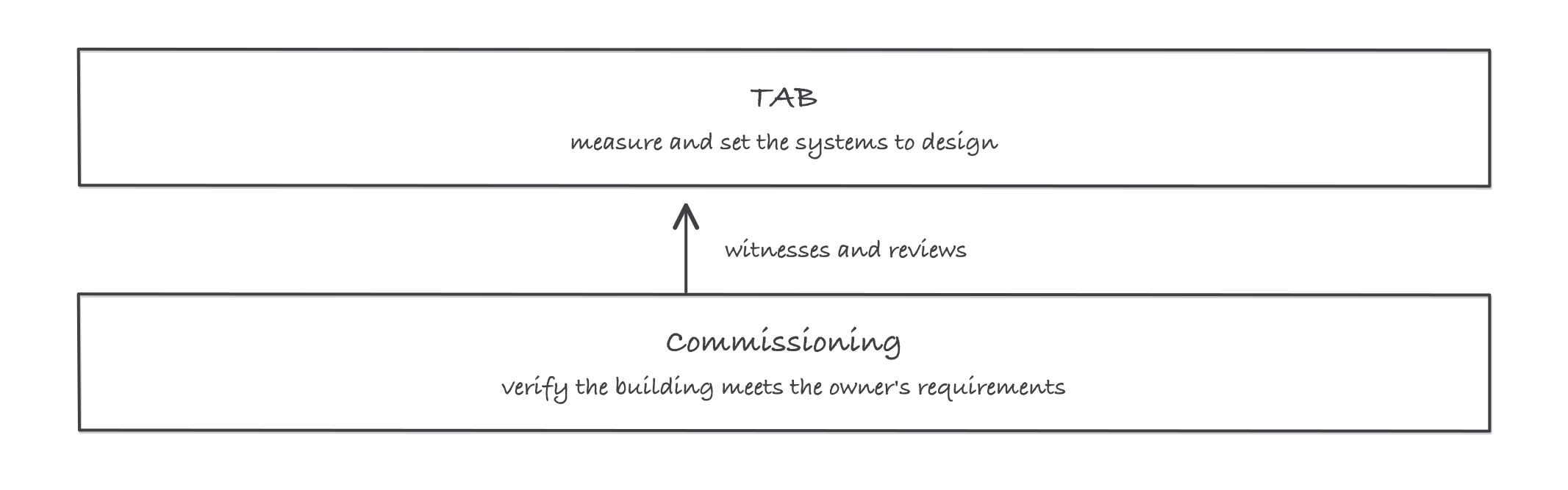
Separate scopes and separate parties: commissioning observes the TAB work and does not perform it
Why the confusion is understandable
The same certifying bodies certify in both, so the same logo appears over both kinds of work.
That is the practical test when you are reading a submittal. Do not stop at “NEBB certified” or “TABB certified” and assume it covers whatever is in front of you. Find the discipline named on the certification and match it to the scope in the specification.
Reading one real job
A commercial fit-out with a specification that names both scopes.
- The mechanical contractor installs and starts the systems.
- The TAB agency measures, adjusts and balances the air and water systems to the design values, then issues a TAB report.
- The commissioning authority reviews that report, selects a sample of readings, and witnesses them being retaken. Disagreement between the sample and the report is a finding against the TAB work.
- The commissioning authority also runs functional tests that TAB never covered: sequences of operation, alarm and failure modes, control responses.
- The commissioning report speaks to whether the building meets the owner’s requirements. The TAB report speaks to whether the systems are at their design flows.
Notice step 4. Those functional tests are the part of commissioning that has no TAB equivalent at all, and they are the clearest evidence that the two scopes are not the same list of tasks with different paperwork.
Where it bites
- A balanced system is not a commissioned building. Design flows achieved is one requirement among many. Controls, sequences and documentation are outside the balancing scope entirely.
- Balancing dampers and life-safety dampers are different devices. Adjusting a volume damper is balancing. Fire and smoke dampers carry their own inspection and testing regime, reflected in their own separate certifications, and a TAB scope does not extend to that work.
- “NEBB certified” or “TABB certified” alone does not name a scope. Both bodies certify in multiple disciplines. The discipline is the fact you need.
- Retro-commissioning is another discipline again. NEBB lists it separately from commissioning, because commissioning an existing building already in service is a different exercise from commissioning a new one.
Exam relevance
Certification questions in this area test whether you can keep the scopes and the disciplines apart. Expect to be asked what distinguishes testing from adjusting from balancing, whether the commissioning authority performs the balancing (no), and which party may authenticate a TAB report. Requirements and discipline lists come from each body and they change, so verify with the certifying body itself before you rely on any of it.