Learn · Sheet Metal
Airflow Measurement Instruments
Part of Sheet Metal to TAB Certified · step 13 of 23 · next: Balancing Procedures
In learning paths: Sheet Metal to TAB Certified
Assumes you know: TAB Fundamentals
No instrument in your bag reads CFM out of a duct. A manometer reads a pressure, a pitot tube converts a pressure difference into velocity, an anemometer reads velocity at a point, and a flow hood reads volume at a face. Everything else is arithmetic you do, and knowing which quantity is in your hand is the difference between a number and a guess.
Why it matters on the job
The whole TAB report rests on measurements. If the reading is taken with the wrong instrument, in the wrong place, or averaged the wrong way, every conclusion drawn from it is wrong too, including the balance you set and the fan speed you leave the building with. Instrument technique decides whether the rest of the specialty means anything.
The instruments and what each one reads
- Manometer (digital, inclined, or a U-tube) reads a pressure difference. Connected to a tap in the duct wall, it reads static pressure, which is the quantity duct construction is classified against.
- Pitot tube has two separate passages, and it reads two pressures at once. The tip faces upstream and receives total pressure; small holes around the side of the tube sense static pressure. Connect both to a manometer and the difference it displays is velocity pressure.
- Rotating vane and thermal anemometers read velocity directly at a point, in feet per minute. Useful at grilles and open faces, and dependent on holding the instrument square to the flow.
- Flow hood (also called a capture hood or balometer) sits over a diffuser or grille and reads volume flow directly. It is the fastest terminal reading you can take, and it is only as good as the seal around the face.
- Tachometer for fan speed and a clamp meter for motor current round out the kit, because a fan’s electrical draw is one of the checks that a measured airflow is plausible.
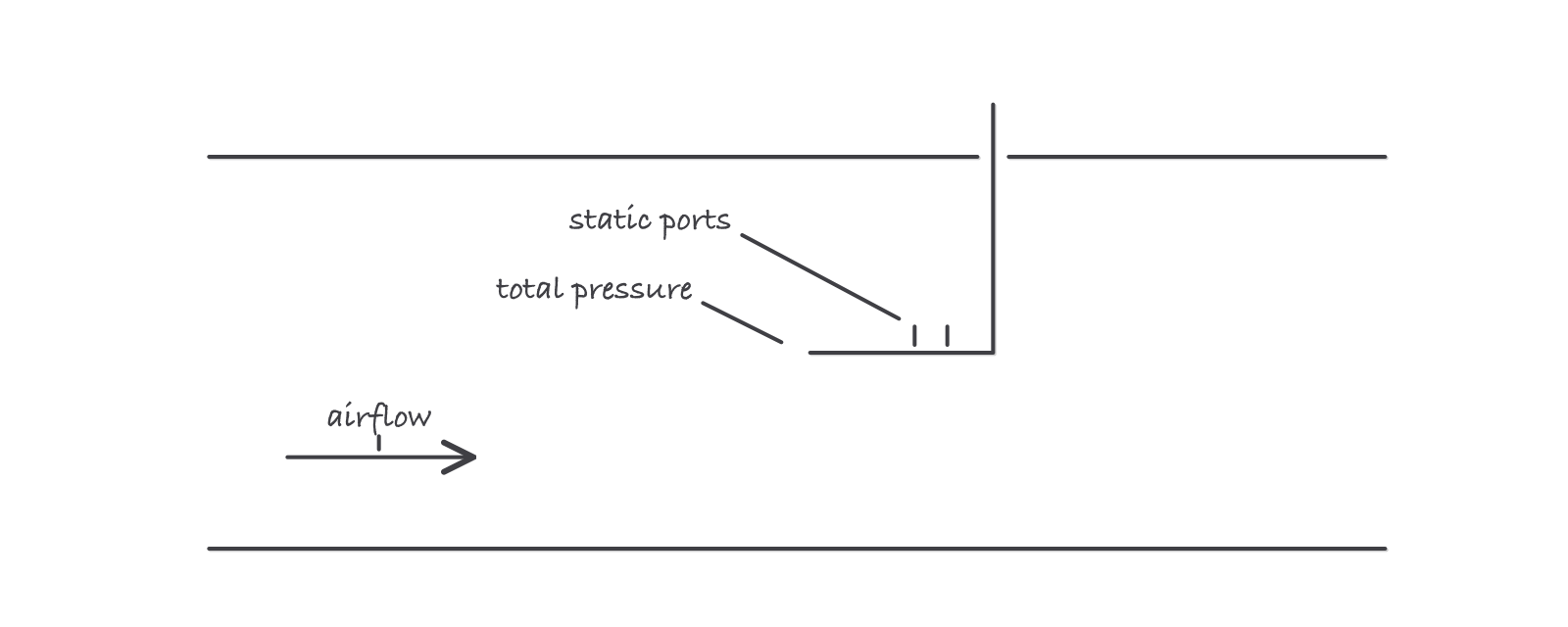
The pitot tube reads two pressures in one probe, and the difference between them is velocity pressure
The three pressures, kept straight
Total pressure = static pressure + velocity pressure. Each answers a different question.
- Static pressure is the pressure pushing outward on the duct wall. Duct construction is classified against it.
- Velocity pressure exists only because the air is moving, and it is what converts into velocity.
- Total pressure is what a fan actually produces against the system.
Saying “the pressure in the duct” without naming which one is a reliable source of wrong answers, on the job and on the exam.
Velocity from velocity pressure
For air at standard density (0.075 pounds per cubic foot):
V = 4005 × √VP
with V in feet per minute and VP in inches of water gauge. The constant is baked from standard air, so hot air, cold air and altitude all require a density correction. Using 4005 in a 900 degree kitchen exhaust or at 6,000 feet gives you a confident wrong answer.
The traverse
Velocity is not uniform across a duct. It is fastest near the center and slower at the walls, so a single reading anywhere is not the average. A traverse measures at a grid of points chosen so each point represents an equal share of the cross-sectional area, and the readings are then averaged.
Two rules about where:
- Traverse in developed flow. Elbows, takeoffs, dampers and transitions all distort the profile, so the traverse plane needs a straight run upstream of it and some straight run downstream. Traversing right after an elbow measures the elbow.
- Traverse square to the duct. A pitot tube held at an angle reads low, and it reads low in a way that looks like a plausible number.
Worked example: from pressures to CFM
A 20 by 14 inch duct. Take a traverse (a real one has many more points, this one has two so the arithmetic stays visible) and read velocity pressures of 0.16 and 0.36 inches water gauge.
Step 1, convert each reading to a velocity.
- V₁ = 4005 × √0.16 = 4005 × 0.40 = 1,602 FPM
- V₂ = 4005 × √0.36 = 4005 × 0.60 = 2,403 FPM
Step 2, average the velocities.
(1,602 + 2,403) / 2 = 2,002.5 FPM
Step 3, find the duct area in square feet.
20 × 14 = 280 square inches, and 280 / 144 = 1.9444 sq ft
Step 4, multiply.
CFM = 2,002.5 × 1.9444 = 3,894 CFM
Now do it the wrong way, which is a common traverse error. Average the velocity pressures first:
(0.16 + 0.36) / 2 = 0.26, and 4005 × √0.26 = 4005 × 0.5099 = 2,042 FPM
That gives 2,042 × 1.9444 = 3,971 CFM, which is 77 CFM high, about 2 percent. The error comes from the square root: velocity is proportional to the square root of velocity pressure, so averaging the pressures and then taking one root is not the same operation as taking the roots and then averaging. Convert every point to velocity first, then average. Always.
Where it bites
- CFM and FPM are different quantities. Velocity times area equals volume, and skipping the area is how a velocity ends up in the CFM column of a report.
- Instruments drift. Calibration is a condition of the certification programs for a reason, and an uncalibrated manometer produces a report that is wrong everywhere in the same direction, which is the hardest kind of error to spot.
- A flow hood changes what it measures. Putting a hood on a diffuser adds resistance to that path, and on some terminals the correction matters. Know your hood.
- A negative reading is information, not a fault. Return and exhaust duct is under negative static pressure, and the sign tells you which side of the fan you are on.
Exam relevance
Instrumentation is named explicitly in AABC’s published written exam content, and TABB’s technician route tests instrument technique by hand as well as on paper, through a practical exam taken in a certified TABB lab. Expect the pressure relationships and the velocity-pressure conversion to appear both directly and buried inside longer questions. Requirements and content come from the certifying bodies themselves, so confirm the current scope with the body you are testing under.