Learn · Sheet Metal
Fabricating Fittings and Transitions
Part of Sheet Metal to TAB Certified · step 3 of 23 · next: Seams and Connections
In learning paths: Sheet Metal to TAB Certified
Assumes you know: Pattern Development and Layout
A fitting changes the direction, the size or the shape of a duct, and every one of those changes costs pressure. Elbows, offsets, tees and square-to-round transitions are where a duct system spends most of its fan energy, so the geometry you lay out in the shop is doing thermal and electrical work long after the metal is hung.
Why it matters on the job
Straight duct is nearly free to move air through. Fittings are not. A tight-throat elbow, an abrupt transition or a badly formed tap adds resistance the fan has to overcome for the life of the building, and no amount of balancing later recovers it. The shop that lays out fittings well is quietly making the system cheaper to run.
Elbows: throat, heel, and how many pieces
An elbow’s inside curve is the throat and the outside curve is the heel. A generous throat radius turns air smoothly; a tight one makes it separate from the wall and churn.
Round elbows are built from pieces. Count the joints, not the pieces: an elbow made of n pieces has n - 1 joints, the total turn is divided equally among them, and each individual cut is half the turn at that joint.
- 2-piece 90 degree elbow: 1 joint, turning the full 90 degrees, so each cut is at 45 degrees.
- 3-piece 90 degree elbow: 2 joints, 45 degrees each, so each cut is at 22.5 degrees.
- 5-piece 90 degree elbow: 4 joints, 22.5 degrees each, so each cut is at 11.25 degrees.
More pieces means a smoother turn and more labor. The design decides which one you build; your job is to lay out the gores so the cuts actually add up to 90 degrees.
Rectangular elbows turn the corner differently. A radius elbow curves both walls. A mitered (square) elbow turns sharply and relies on turning vanes inside to guide the air. Vanes are part of the fitting’s performance, so a mitered elbow delivered without them is an incomplete fitting rather than a cheaper one.
Offsets
An offset moves a duct sideways without changing its size, using two equal bends. The geometry is one right triangle: for an offset distance O made at angle θ, the travel (the length of the sloped piece) is O / sin θ and the run consumed along the duct is O / tan θ.
At the common 45 degree offset, sin 45 and tan 45 make this easy: travel = O × 1.414 and run = O. A 10 inch offset at 45 degrees therefore needs 14.14 inches of sloped duct and eats 10 inches of straight run. Check the run against the space you actually have before you cut, because the offset that fits on paper often does not fit past a beam.
Transitions and why triangulation is unavoidable
A transition connects two different shapes or sizes. Because its surface has neither parallel elements nor a single apex, you develop it by triangulation, and the reason comes down to one fact: the distance you measure on the plan view is not the distance on the metal.
Take a concentric square-to-round: a 20 by 20 inch square at the bottom, a 14 inch round at the top, 12 inches of vertical height. Divide the circle into 12 and take the corner element, which runs from the square’s corner to the circle point on the 45 degree diagonal.
In plan, the square corner sits 10 inches out on each axis. The circle point sits 7 × cos 45 = 4.95 inches out on each axis. So the plan offsets are 10 - 4.95 = 5.05 inches in each direction, and the plan distance is 5.05 × √2 = 7.14 inches.
That is not the length of metal. The element also climbs 12 inches, so its true length is:
√(7.14² + 12²) = √(51.01 + 144) = √195.01 = 13.96 inches
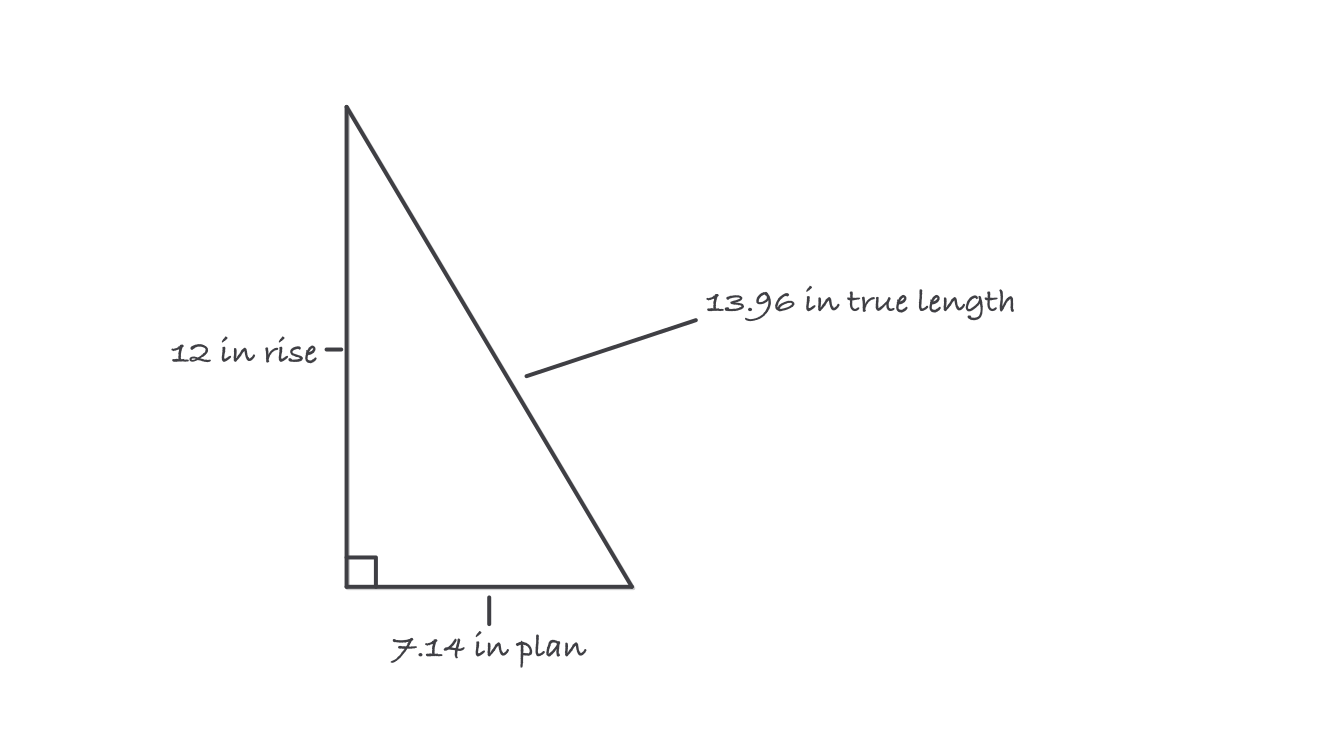
The true-length triangle: the plan view gives you one leg, never the hypotenuse
Now the next element round, from the same corner to the circle point at 75 degrees. That point sits 7 cos 75 = 1.81 inches and 7 sin 75 = 6.76 inches from center, so the plan offsets are 8.19 and 3.24 inches, giving a plan distance of √(67.05 + 10.49) = √77.54 = 8.81 inches, and a true length of √(77.54 + 144) = √221.54 = 14.88 inches.
Two elements, two different true lengths, and this is the whole argument for triangulation. Notice also that the two plan distances differ by 1.67 inches while the true lengths differ by only 0.92 inches: the rise flattens the differences, which is exactly why guessing from the plan view produces a pattern that is wrong in a way that looks nearly right.
Where it bites
- Equivalent round is equivalent by friction, not by area. When a table converts a rectangular duct to a round one, it gives you the round duct with the same friction loss at the same airflow. Reach for equal cross-sectional area instead and you will pick the wrong pipe every time.
- Concentric and eccentric transitions are not swappable. An eccentric transition keeps one face flat, which is what lets it sit tight to a ceiling or line up with a coil. Building the concentric version because it is easier to lay out moves the duct.
- A mitered elbow without its vanes is a different fitting. So is a radius elbow built with a tighter throat than detailed. Both changes are invisible on the hanger and permanent in the fan power bill.
- Necking down hard costs more than necking down long. How abruptly a transition may change section is set by the construction standard and the design, so read it rather than taking the shortest piece of metal that connects the two ends.