Learn · Sheet Metal
Which SMACNA Standard Governs What
Part of Sheet Metal to TAB Certified · step 9 of 23 · next: Pressure Class, Seal Class and Leakage Class
In learning paths: Sheet Metal to TAB Certified
Assumes you know: Duct Construction Standards (SMACNA)
SMACNA does not publish a book. It publishes a shelf. Duct construction, air duct leakage testing, fibrous glass duct, seismic restraint, duct systems inspection, sound and vibration, and the residential documents are all separate publications with separate scopes, and a spec that says “per SMACNA” without naming one has told you nothing. Learning which document answers which question is worth a day of your life exactly once.
Why it matters on the job
The wrong document costs you the same as no document. You look for a leakage criterion in the construction standard, you look for a hanger requirement in the leakage manual, and you find nothing in either because neither one covers it. Then you either guess or you call somebody, and both of those are worse than knowing the shelf.
What SMACNA is, and what it is not
The Sheet Metal and Air Conditioning Contractors’ National Association is a contractors’ association that develops consensus standards. Its own technical standards page states it is accredited by the American National Standards Institute and describes itself as an authority in establishing and setting industry standards.
Three things follow from that sentence, and all three are routinely got wrong.
SMACNA is a standards developer, not a code body. It writes documents that a code or a specification may adopt by reference. Writing the standard and writing the code are different relationships to the same page of requirements, and adoption is a decision made by the code or the specification, not by SMACNA.
SMACNA does not certify people. “SMACNA certified” is not a status a technician, a foreman or a company can hold. Work is built to a SMACNA standard; nobody is certified by SMACNA.
And ANSI accreditation applies to how the standards are developed, not to individuals who read them. An accredited developer follows a consensus process. That is what the accreditation means and it is the whole of what it means.
The shelf
The documents SMACNA lists on its technical standards page include the HVAC Duct Construction Standards (Metal and Flexible), the Fibrous Glass Duct Construction Standards, the HVAC Duct Systems Inspection Guide and the HVAC Sound and Vibration Manual. Named elsewhere on SMACNA’s own pages are the Seismic Restraint Manual (Guidelines for Mechanical Systems), the Residential Sheet Metal Guidelines, the Residential Comfort Systems Installation Standards Manual and HVAC Systems Duct Design.
Separately, and this is the one people miss, leakage lives in its own American National Standard: the HVAC Air Duct Leakage Test Manual, designated ANSI/SMACNA 016-2012. It covers revised leakage criteria, the test procedures, the apparatus, the test setup and a sample leakage analysis, and it carries updates to the expected leakage rates for ductwork constructed to the HVAC Duct Construction Standards (Metal and Flexible).
That last sentence is the whole argument for why leakage is a separate document. Construction and leakage are related but they are not the same selection, and SMACNA publishes them apart. The lesson on pressure class, seal class and leakage class works through what that separation means when you are choosing.
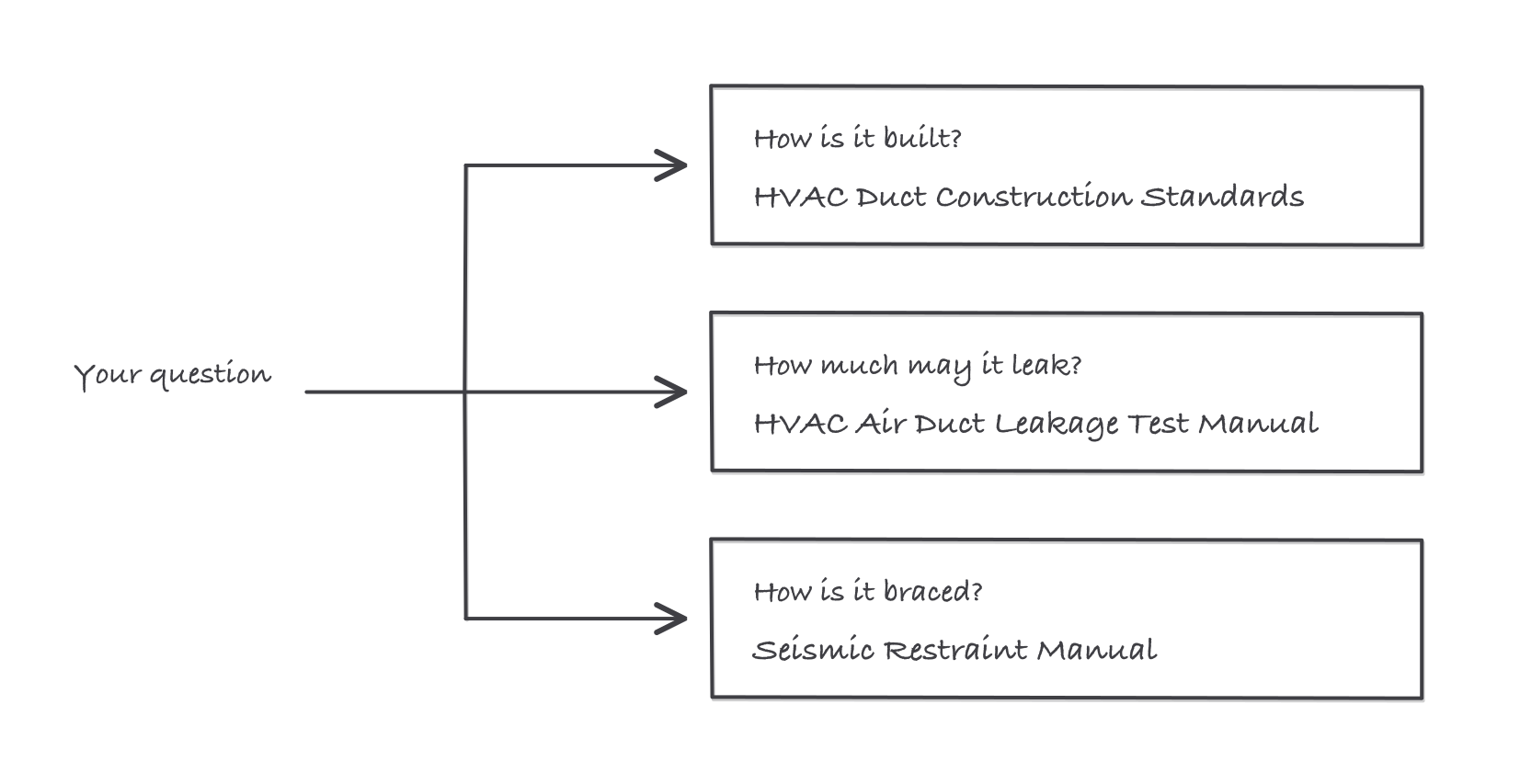
Route the question to the document, not to the association
Routing a real spec line
A mechanical specification section reads, in part: rectangular supply ductwork shall be constructed to SMACNA standards for the scheduled pressure class, tested for leakage, and seismically braced.
Three requirements, three documents, and the fastest way to see it is to ask what each clause is asking for.
- “Constructed to SMACNA standards for the scheduled pressure class.” That is metal thickness, reinforcement and joint selection against a pressure class, which lives in the HVAC Duct Construction Standards (Metal and Flexible). The pressure class itself comes from the schedule on the drawings, not from SMACNA.
- “Tested for leakage.” That is the HVAC Air Duct Leakage Test Manual, ANSI/SMACNA 016-2012. Procedure, apparatus, setup and analysis all sit there, and so do the expected leakage rates for duct built to the construction standard.
- “Seismically braced.” Neither of the above. That is the Seismic Restraint Manual, and if your bid assumed bracing was covered by the construction standard, your bid is short.
One spec sentence, three purchases, and the estimator who knew that priced the job correctly.
Where it bites
- “Per SMACNA” is an incomplete reference. Ask which document and which edition the specification means. Editions change and the answers in them change with them, so check SMACNA’s current listing rather than the copy on the shop shelf.
- The construction standard is a purchased document and its contents are not published openly. Values for thickness, reinforcement spacing and joint types come out of its tables. Never quote a number for those from memory, from a blog, or from another job.
- Fibrous glass duct has its own construction standard. Metal and fibrous glass are not two chapters of one book, so a fibrous glass scope needs the fibrous glass document.
- Residential is a separate shelf again. The residential guidelines and the residential comfort systems manual exist because residential practice differs from commercial, and reaching for the commercial construction standard on a house is the wrong document in the other direction.
- An inspection guide is not a construction standard. The HVAC Duct Systems Inspection Guide supports checking installed work. It does not tell you how to build it.