Qualifications · Plumbing
Plumbing License Requirements by State
Part of Journeyman Plumber Exam Prep · step 30 of 31 · next: Where to Take the Journeyman Plumber Exam
In learning paths: Journeyman Plumber Exam Prep
Assumes you know: The Journeyman Plumber License
Plumbing licensing in the United States has no national license. Every state sets its own rules, several states delegate to counties and cities, and the differences are large enough to change your career planning: hours required, exams, reciprocity, and even whether the state licenses plumbers at all at state level.
*Learn the Trades is a free study resource. We are not a licensing body, an authorized training provider, or an exam administrator. Reading this page does not award any card, license, or certification. Always verify requirements with the issuing authority linked in the sources.*The landscape in one view
Three structural patterns cover the country:
- State-licensed. A state board licenses apprentice, journeyman and master plumbers statewide. The most common pattern.
- Locally delegated. The state sets a framework but counties or cities run licensing. Your city hall, not the state capitol, holds your file.
- Contractor-only states. A few states license plumbing contractors but not individual journeymen at state level; competency is enforced through the contractor and local jurisdictions.
Layered on all three: the code split. States adopt either the Uniform Plumbing Code or the International Plumbing Code, in different editions, with amendments. Your license, your exam and your inspections all follow that adoption.
What varies, concretely
- Hours. Apprenticeship requirements in the broad region of 4 to 5 years and thousands of supervised hours, but the exact figure and how classroom time counts is state law.
- Exams. Different vendors, different open-book rules, different code editions.
- Renewal and CE. Cycles from 1 to 3 years; continuing education mandatory in many states, tied to code updates.
- Reciprocity. Exists in pockets, usually by explicit agreement between specific states. Never assume portability; verify with the destination board before you move.
How to use this page
This overview teaches the pattern. For your jurisdiction, the sequence is always the same: find the issuing authority (state board, or city or county office), read the current candidate bulletin, and verify hours, exam, code edition and renewal directly. Requirements change on legislative and board schedules, so anything not read from the authority’s own current publication should be treated as a lead, not a fact.
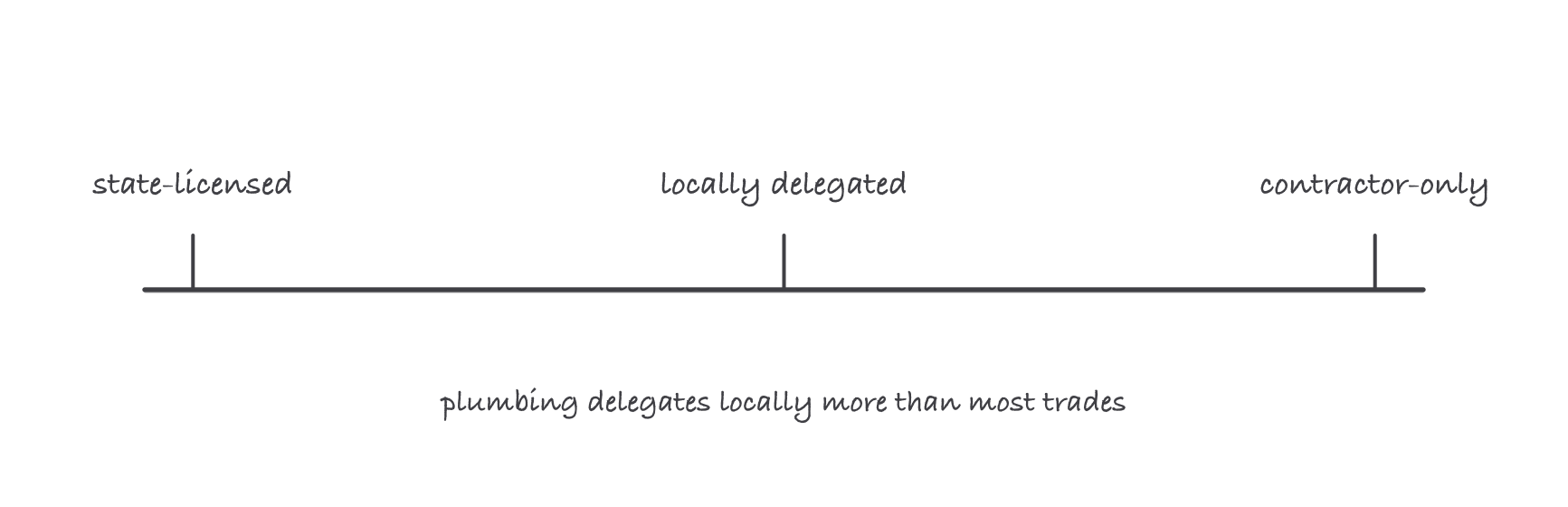
Three structures cover the country; your county may be the issuer
Where it bites
- Moving states can mean re-examination. Plan interstate moves around reciprocity agreements, not hopes.
- Local delegation surprises people. In delegated states the state website may say little; the county’s site is authoritative.
Verified requirements
| Where | Expires | Renewal | Continuing education |
|---|---|---|---|
| Texas | Confirm with issuer | Confirm with issuer | Confirm with issuer |
| Texas | Confirm with issuer | Confirm with issuer | Confirm with issuer |
| Illinois | Confirm with issuer | Confirm with issuer | Confirm with issuer |
Information comes from issuing-authority sources. Confirm current rules, fees and eligibility with the authority before acting.