Qualifications · Plumbing
Backflow Tester Certification
Assumes you know: Cross-Connections and Backflow
Backflow tester certification is the credential that lets a plumber test backflow prevention assemblies and sign the test reports water purveyors rely on. The technical standard behind most programs is ASSE 5110, the professional qualification standard for backflow prevention assembly testers, part of ASSE International’s 5000 series. It is a working credential layered on top of a plumbing career: the licensed plumber installs the assembly, the certified tester proves it works.
*Learn the Trades is a free study resource. We are not a licensing body, an authorized training provider, or an exam administrator. Reading this page does not award any card, license, or certification. Always verify requirements with the issuing authority linked in the sources.*What the credential is for
Cross-Connections and Backflow covered the mechanism: testable assemblies (double check assemblies, pressure vacuum breakers, and reduced pressure zone assemblies) protect the potable system only while their internal checks and relief valves actually work, so codes and water purveyors require each assembly to be tested periodically, typically on an annual cycle, and after installation or repair. Those tests must be performed by a certified tester using a calibrated differential pressure gauge, following the test procedures for each assembly type, with results reported to the authority that tracks the assembly.
That recurring, mandated test is the work the certification unlocks. For a service plumber it is steady, schedulable revenue attached to every RPZ and PVB in the territory; for an employer it is a capability the company can advertise.
What getting certified involves
Programs built on ASSE 5110 pair classroom instruction with hands-on work in a wet lab: rigged assemblies with deliberately induced failures that the candidate must diagnose with the gauge. Expect a written examination on cross-connection theory, hydraulics, and code, plus a practical examination testing assemblies against the pass criteria for each type. Certification is time-limited: recertification on a fixed cycle, with the specifics, cycle length, continuing education, gauge calibration records, set by the certifying program and the local authority.
Prerequisites vary by program and jurisdiction, many expect plumbing experience or licensure, and the knowledge in the water supply track, especially Cross-Connections and Backflow and Water Pressure and Flow, is assumed throughout.
What the work looks like
A tester’s visit is a defined procedure, not exploratory service work: identify the assembly and its hazard rating, notify the occupants, isolate flow, connect the differential gauge in the prescribed hookups, run each check and relief test in sequence, record readings against the minimum values for that assembly type, tag the assembly, and file the report with the purveyor. A failed test converts to repair work, followed by a retest.
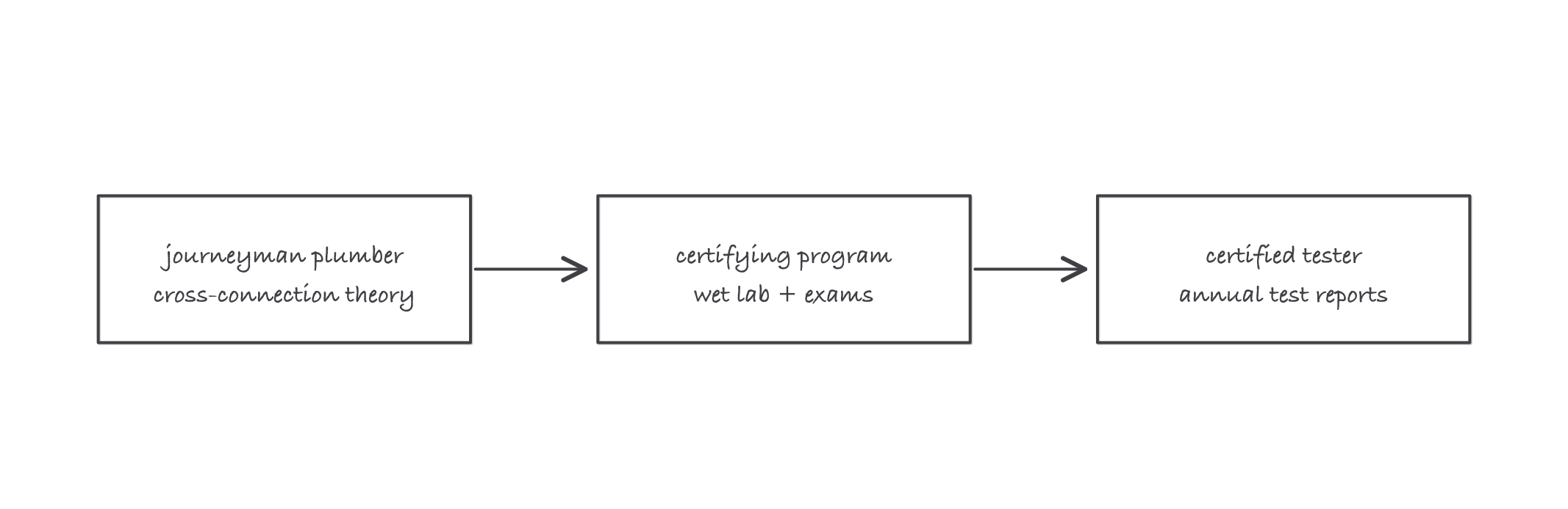
The route runs through a certifying program and its wet lab, then into recurring annual test work
Where it bites
- Certification is jurisdiction-shaped. A card that satisfies one purveyor may mean nothing to the next one, and testers working across a metro area may need more than one recognition. Verify acceptance where you plan to file reports, before training.
- The gauge is part of the credential in practice. Test reports are only as good as the differential gauge’s calibration record, and programs and purveyors expect current calibration documentation with your results.
- Testing is not repairing. The certification qualifies you to test and report. Repairing the assembly is plumbing work under your plumbing license, and rebuilding an RPZ then signing your own retest is a conflict some jurisdictions regulate. Know the local rule.
- A plain check valve is never a substitute, the lesson from Cross-Connections and Backflow carries straight into the exam and the field: only listed, testable assemblies get tested and tagged.
Exam relevance
Backflow tester examinations test the theory from Cross-Connections and Backflow, backpressure versus backsiphonage, degree of hazard, device selection, plus assembly anatomy and gauge procedure: which test proves which check, in what order, and what minimum readings pass. The practical exam in the wet lab is where candidates fail: drilling the physical test sequences on each assembly type matters more than memorizing definitions.
Verified requirements
| Where | Expires | Renewal | Continuing education |
|---|---|---|---|
| United States (federal) | Yes | 3 years | Recertification requires a class of 2 to 12 hours depending on the program plus a written exam of 25 to 100 questions; some programs also require a hands-on practical. Recertification may be taken up to six months early without losing time on the certification. |
| United States (federal) | Confirm with issuer | 3 years | Minimum 8 hour recertification class plus a 50 question written exam plus a hands-on practical exam. |
Information comes from issuing-authority sources. Confirm current rules, fees and eligibility with the authority before acting.