Learn · Heavy Equipment
Crane Hand Signals and Communication
Part of CCO Crane Operator Prep · step 12 of 21 · next: Qualified Riggers and Signal Persons: Rules and Certifications
In learning paths: CCO Crane Operator Prep
Assumes you know: Crane Types and Configurations
Crane signaling is a standardized language, and OSHA treats it that way: when hand signals are used on a construction crane, they must be the Standard Method signals, the nationally uniform set published with OSHA’s crane rules. The person giving them must be qualified, and everyone on the lift must know which single person that is.
Why it matters on the job
The operator often cannot see the load, the landing zone, or the people near either one. The signal person is the operator’s eyes, and a misread signal moves thousands of pounds the wrong way. A shared, exact signal vocabulary is what lets a crane work blind safely, and it is why OSHA standardized the language instead of letting every crew invent its own.
When a signal person is required
Not on every lift. OSHA’s signaling rules require a signal person in specific situations: when the point of operation is not in the operator’s full view, when the operator’s view is obstructed in the direction the equipment is traveling, or when site-specific safety concerns make one necessary. In practice that covers a large share of real crane work, blind picks behind structures above all.
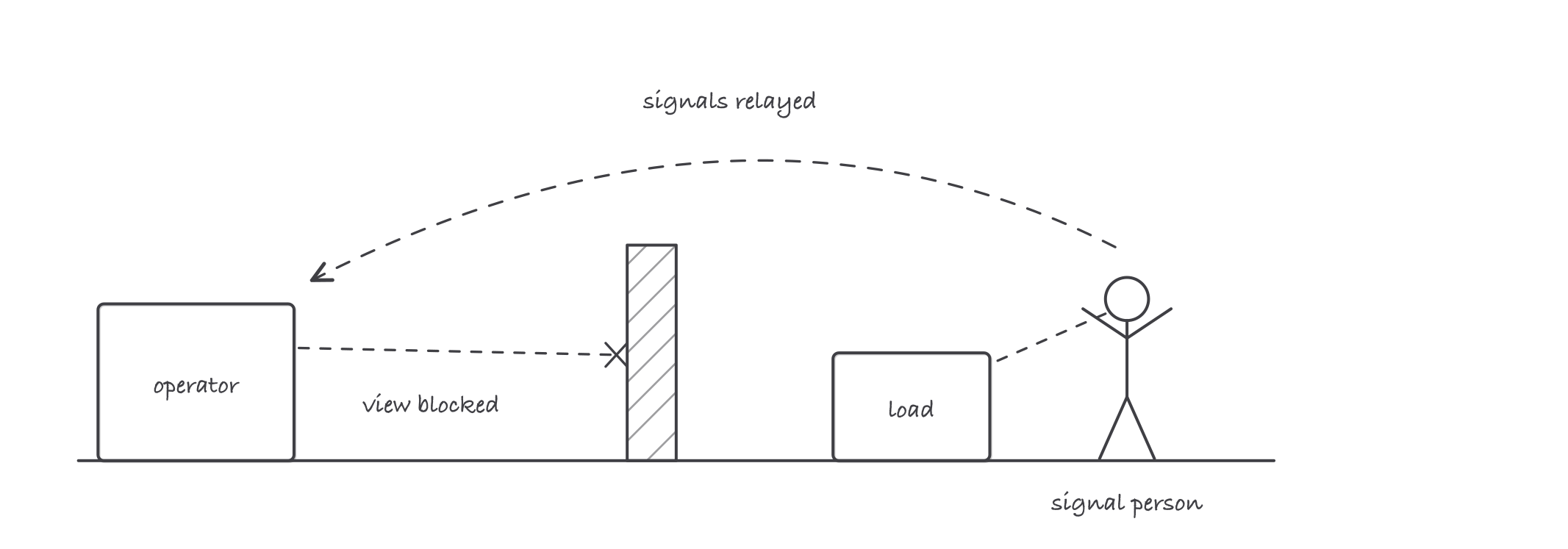
The classic case: the operator cannot see the load, so a signal person who can see both directs the lift
One person signals at a time. The operator obeys signals only from the designated signal person, with one exception drilled into every crew: a stop signal from anyone must be obeyed.
The Standard Method signals
The core vocabulary, given with one hand unless noted:
- Hoist: forearm vertical, index finger pointing up, hand moving in small horizontal circles.
- Lower: arm extended downward, index finger pointing down, hand moving in small circles.
- Stop: arm extended horizontally, palm down, arm swinging back and forth.
- Emergency stop: both arms extended, palms down, swinging back and forth.
- Boom up / boom down: arm extended, thumb pointing up or down with fist closed.
- Swing: arm extended, index finger pointing the direction of swing.
- Dog everything: hands clasped in front of the body, pause all movement.
Speed control rides on top: signals given slowly mean move slowly. Learn the set exactly as published; a personal variation of a standard signal is how loads end up in the wrong place.
Voice and radio signals
Hand signals fail over distance, around corners and at night, so voice signals over radio are common and fully accepted. The discipline transfers. Signals must be agreed and understood before the lift, and the channel must be dedicated enough that the operator is not parsing crosstalk. Each command follows a consistent order (function and direction, then distance or speed, then stop), repeated continuously for continuous motion, because radio silence is ambiguous in a way a held hand signal is not.
The qualification behind the signals
The signal person must be qualified, and OSHA (29 CFR 1926.1428) accepts two routes: assessment by a third-party qualified evaluator, or by the employer’s own qualified evaluator. Either way the person is tested on the signals and crane operation basics through an oral or written test plus a practical demonstration, and documentation of the qualification must be available at the worksite. The CCO Signalperson certification is a widely used third-party route; the rigger and signal person guide in this subject covers how qualification and certification relate.
Where it bites
- “Signal person” is not “anyone free that minute.” The role carries a documented qualification and a designation for the lift. An unqualified spotter waving a crane around is a violation and a hazard.
- Two people signaling. One designated signal person; everyone else’s signals, except stop, do not exist.
- Radio habits from other trades. Casual truck-spotting chatter does not transfer. Crane radio work is formatted, continuous and exclusive.
Exam relevance
The CCO Signalperson exams test exactly this material: the Standard Method signals one by one, voice signal procedure, and when a signal person is required. Operators are tested on signals too; the written exams expect you to read a described hand signal and name the commanded motion.
Verified requirements
| Where | Expires | Renewal | Continuing education |
|---|---|---|---|
| United States (federal) | Yes | 5 years | Confirm with issuer |
Information comes from issuing-authority sources. Confirm current rules, fees and eligibility with the authority before acting.