Qualifications · Heavy Equipment
NCCCO Certification: The Federal Gate
Part of CCO Crane Operator Prep · step 15 of 21 · next: State Crane Licensing on Top of NCCCO
In learning paths: CCO Crane Operator Prep
Assumes you know: Reading Load Charts
CCO Mobile Crane Operator certification is the credential nearly every US construction crane operator uses to satisfy federal law. OSHA requires crane operators on construction sites to be certified (29 CFR 1926.1427), and testing through an accredited body is the path almost the whole industry takes. NCCCO is the National Commission for the Certification of Crane Operators, the body; CCO is the certification it administers. Job ads use the two names interchangeably.
*Learn the Trades is a free study resource. We are not a licensing body, an authorized training provider, or an exam administrator. Reading this page does not award any card, license, or certification. Always verify requirements with the issuing authority linked in the sources.*Why it matters on the job
Certification is the gate between running an excavator and running a crane. It is exam-gated rather than time-gated: there is no federal hour requirement, but you must pass written and practical exams that assume real seat time and real load chart fluency. Because CCO certification comes from an accredited testing organization, it travels with you between employers, which is exactly what an in-house employer program cannot offer.
The exam structure
The Mobile Crane Operator program is built from three pieces:
- The Core written exam. One exam covering the knowledge every mobile crane operator needs, load charts above all.
- At least one specialty written exam. The specialty sets which machines your certification covers.
- A practical exam per designation. You demonstrate control of the machine, not knowledge about it.
You choose specialties by the equipment you actually run. The four designations:
- LBC: lattice boom crawler cranes
- LBT: lattice boom truck cranes
- TLL: telescopic boom cranes with a swing cab
- TSS: telescopic boom cranes with a fixed cab
The cab distinction in the telescopic designations is the definition, not a tonnage line. TSS covers the fixed cab machines (boom trucks and similar carry deck configurations); TLL covers machines where the cab swings with the upperworks.
On the practical side, one lattice boom practical exam covers both LBC and LBT; TLL and TSS each have their own.
The 12-month window
Every exam you need (Core, specialty written, and practical) must be passed within 12 months of each other. Pass Core in March and you have until the following March to finish the rest, or passed exams start falling out of the window.
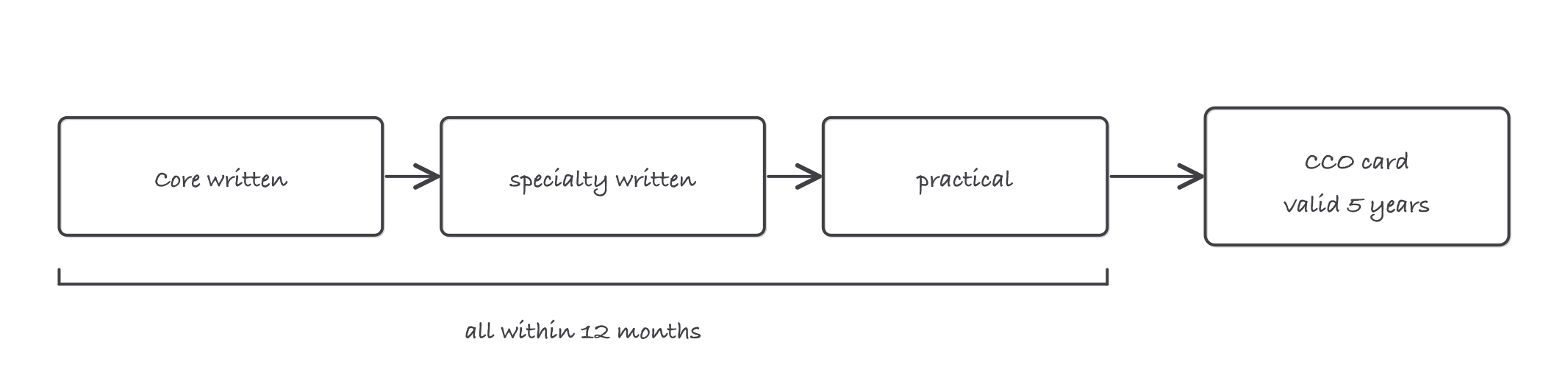
Core, specialty and practical inside one 12 month window; the certification then runs 5 years
A concrete plan: an operator who runs both a rough terrain crane (swing cab, so TLL) and a boom truck (fixed cab, so TSS) sits Core plus the TLL and TSS written exams, then passes the TLL and TSS practical exams, all inside 12 months. The result is one certification with two designations.
The 5-year cycle
Certification is valid for 5 years, and the 5-year cycle is not an NCCCO invention: OSHA’s rule itself makes certifications valid for a maximum of 5 years, so recertification is a legal requirement of staying a crane operator, not an optional refresher. Plan recertification before expiry; an expired certificate means you are no longer certified under 1926.1427.
Where it bites
- Certification is by type. Adding a machine type later means adding the specialty written and practical for it. Check the designation list against the iron you expect to run before you book exams.
- The 12-month clock is unforgiving. Candidates who pass Core and delay the practical are the classic casualty. Book the practical exam site early; access to a test crane is often the bottleneck.
- Older references still say “type and capacity.” Before the 2018 rule change, certification had to match both type and capacity. The current rule accepts certification by type alone, or by type and capacity. Study materials written before 2018 state the stricter version.
- The card does not replace the employer evaluation. Expect a documented evaluation on each make, model and configuration class you run for a new employer, even with a valid CCO card in your wallet.
Exam relevance
This lesson describes the exams themselves, so treat the structure as the study map: the Core exam leans hard on load chart use, which is why the load chart lesson is the prerequisite here. The specialty writtens test the configuration and chart details of their machine family, and the practical is scored on precise, controlled operation. NCCCO publishes a dated candidate handbook for the program with exam outlines and domain weights; study from the current edition.
Verified requirements
| Where | Expires | Renewal | Continuing education |
|---|---|---|---|
| United States (federal) | Yes | 5 years | Confirm with issuer |
| California | Yes | 5 years | Confirm with issuer |
| Washington | Yes | 5 years | Confirm with issuer |
Information comes from issuing-authority sources. Confirm current rules, fees and eligibility with the authority before acting.