Learn · Heavy Equipment
Excavator Operation
Part of CCO Crane Operator Prep · step 2 of 21 · next: Dozer and Grader Operation
In learning paths: CCO Crane Operator Prep
Assumes you know: Equipment Types and Applications
Excavator work is one cycle repeated well: dig, swing, dump, return. Everything that separates a good operator from a rough one (machine position, bucket technique, swing discipline) exists to make that cycle smoother, shorter, and safer.
Why it matters on the job
An excavator is usually the production heart of the crew: the trench advances, the trucks fill, and everyone else works at the pace you set. Shaving seconds off a cycle you repeat hundreds of times a day is worth more than any burst of speed, and the habits that make cycles fast (short swings, full buckets, a well-planned bench) are the same habits that keep people around the machine alive.
Know your two sticks
Excavators run on two joysticks controlling four functions: swing, stick (the arm), boom, and bucket. Two control patterns dominate in the US. In the ISO pattern (often called “excavator” or “Cat” pattern) the left stick controls swing and stick, the right stick controls boom and bucket. The SAE pattern (“backhoe” pattern) swaps boom and stick between hands. Many machines have a changeover valve. None of this matters until the day you climb into a machine set to the pattern you did not expect. Make checking the pattern part of mounting any unfamiliar machine, and prove it with small movements before the first real dig.
Set the machine up to dig
Dig over the idlers. Position the tracks so the drive sprockets are at the rear and you are digging over the front idlers. The undercarriage is your foundation: digging over the ends of the tracks is more stable than digging over the side, because the machine’s tipping line is longest in that direction.
Build a bench. Keep the machine on a flat, compacted platform slightly above the work. Digging from grade you control beats digging from spoil or slope.
Plan the swing before the first pass. Spot trucks and spoil so the swing is short and never carries the bucket over the cab of a truck or over people on foot. The swing radius, including the counterweight behind you, is a struck-by zone the whole shift.
The cycle itself: crowd the stick toward you while curling the bucket to fill it in one smooth pass, boom up as you finish the curl, swing while the bucket rises, dump, and swing back flat and low. Fill the bucket completely: a half bucket costs a full cycle.
Worked example: what a short swing is worth
A 1.25 yd³ bucket at a 90 percent fill factor moves 1.25 × 0.90 = 1.125 yd³ per cycle.
At a 20-second cycle (a tight 45-degree swing), you make 3 cycles a minute: 3 × 60 = 180 cycles an hour, so 180 × 1.125 = 202.5 yd³ per hour of theoretical production. At a realistic 50-minute working hour that is 202.5 × 50/60 = 168.75, call it 169 yd³.
Let the swing grow to 180 degrees and the cycle stretches to about 30 seconds: 2 cycles a minute, 120 × 1.125 = 135 yd³ theoretical, and 135 × 50/60 = 112.5 yd³ in the same working hour. Same machine, same bucket, same operator effort: the truck spotting decision alone is worth about a third of your production.
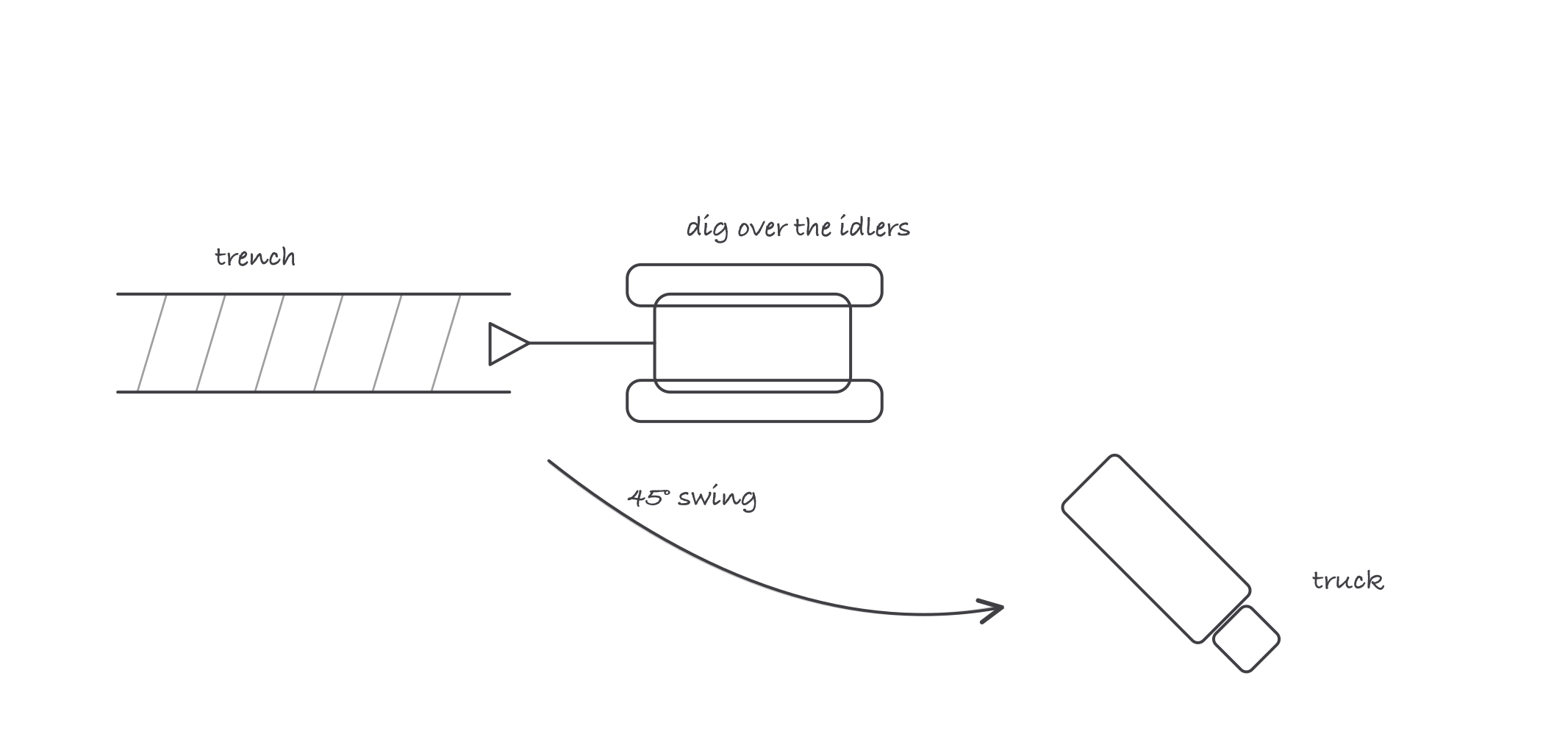
Spot the truck so the swing stays short: the arc is where production and safety are won
Where it bites
- Never dig under your own tracks. Undercutting the bench you sit on is how machines end up in the trench. Keep the near edge of the cut in front of the idlers.
- The counterweight swings too. New operators watch the bucket and forget the rear of the house sweeps a circle behind them. People and obstacles in that circle get struck or crushed.
- Locate utilities before the first pass. Every dig starts with the locate tickets, and hand exposure where the marks say so. An excavator finds gas lines the hard way in one bite.
- A quick coupler is only as good as its pins. After every attachment change, prove the bucket is locked with a curl-and-shake at ground level, not over someone’s head.
- Slopes change the rules. Working across a slope moves the tipping line under you fast. Work up and down where you can, bench where you cannot.