Learn · Heavy Equipment
Loader and Backhoe Operation
Part of CCO Crane Operator Prep · step 4 of 21 · next: Compaction Equipment
In learning paths: CCO Crane Operator Prep
Assumes you know: Equipment Types and Applications
A loader lifts and carries with a bucket on arms in front of the machine. A backhoe loader is two machines on one frame: that loader on the front, a small excavator on the back, and a seat that swivels between them. Together they are where many operators log their first serious hours.
Why it matters on the job
Wheel loaders feed every truck, hopper, and stockpile on a production site, and the backhoe loader is the standard machine of utility work: dig the trench off the back, backfill and load off the front, drive itself to the next job on its own wheels. Run these two well and you are useful to almost any crew in the trade.
Loading: fill the bucket, spare the tires
Good loader work is pile technique:
- Attack square and low. Approach the pile straight on with the bucket flat on the ground. An angled attack loads one side of the bucket and twists the machine.
- Crowd, then curl. Drive in until the machine starts to work, then curl the bucket back as you lift. The curl does the filling; more throttle mostly spins tires and buys tire bills.
- Carry low. Travel with the bucket a few inches above the ground, arms down. A raised loaded bucket puts the combined center of gravity high and forward, and turning like that is how loaders end up on their side.
- Load the truck over the side, never over the cab, and wait for the driver’s signal if anyone is in or near the truck.
The V-pattern
Production loading is choreography between pile, loader, and truck. Spot the truck at roughly 45 degrees to the pile face, close enough that the loader makes one short reverse from the pile, one turn, and one short forward run to the truck: a V shape. Each cycle is two short legs instead of a long haul, and the truck never moves until it is full.
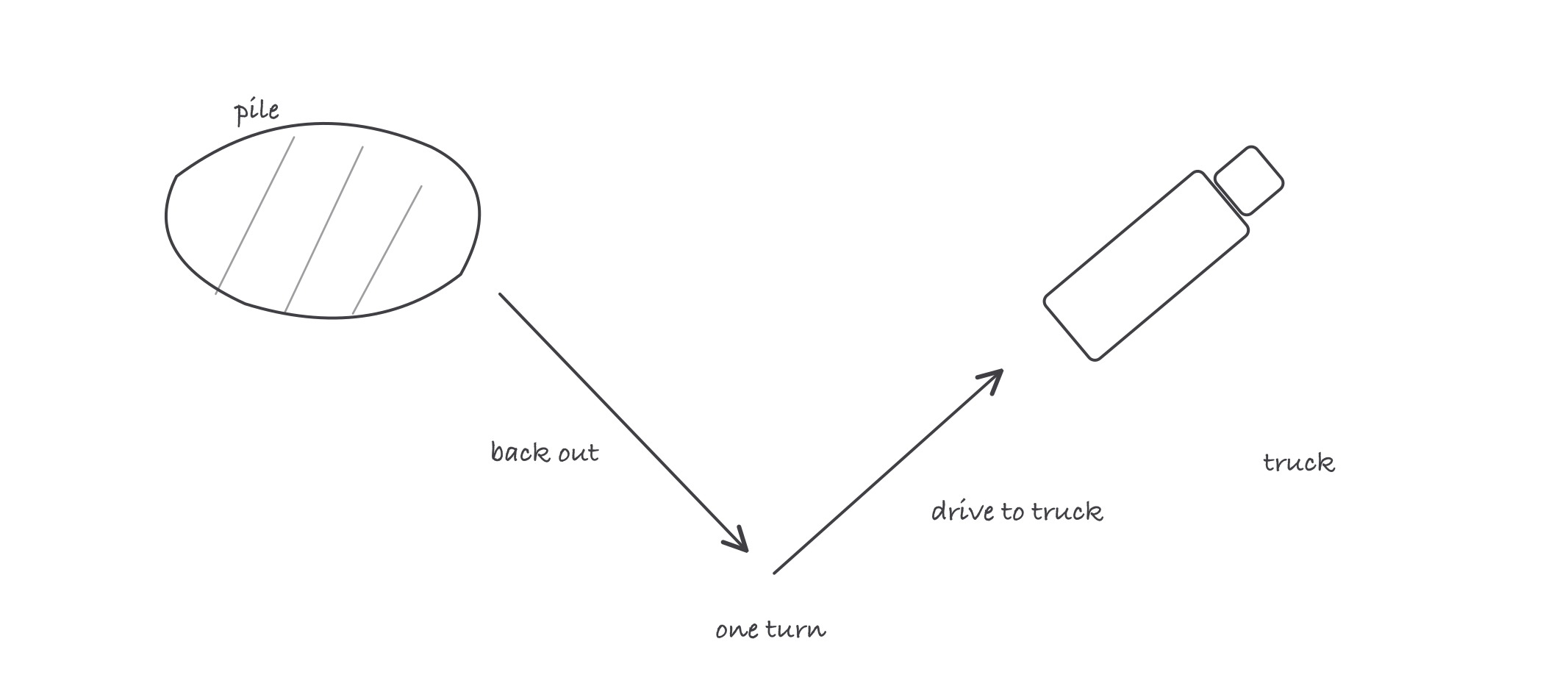
Two short legs, one turn: the V keeps every cycle tight and the truck stationary
Backhoe work starts with the stabilizers
Before the rear bucket moves: stabilizers down until they carry the machine, front bucket flat on the ground, machine level. The backhoe digs like a small excavator (boom, dipper stick, bucket) but it sits on rubber tires, so its stability comes entirely from that three-point setup. Then swing spoil to one side, keep the swing short, and remember the machine cannot reposition without lifting everything again, so plan each set carefully.
Worked example: matching bucket to truck
A 2.5 yd³ loader bucket at a 95 percent fill factor moves 2.5 × 0.95 = 2.375 yd³ per pass.
Loading a 10 yd³ truck: 10 / 2.375 = 4.21 passes. You cannot make a fifth full pass without overloading, so the practical answer is 4 passes, putting 4 × 2.375 = 9.5 yd³ in the truck.
That 0.5 yd³ shortfall every truck is the argument for matching equipment: a truck sized at a whole number of your buckets (4 to 6 passes is the usual target) loads faster and fuller than any amount of operator hustle can fix.
Where it bites
- A backhoe digging without stabilizers set is a rollover in progress. Tires flex, the machine rocks, and a loaded swing does the rest.
- Do not dig beside your own stabilizer feet. Undermining the ground that carries the machine ends with the stabilizer in your trench.
- The loader bucket is not a work platform. Nobody rides in or works from the bucket, ever.
- Watch the articulation point. On articulated loaders the machine hinges in the middle; anyone standing in that pinch zone when the wheel turns can be crushed. It is a struck-by zone like the excavator’s counterweight.
- Full throttle into the pile is not technique. If the tires spin, you are polishing rubber, not filling the bucket. Lower the bucket pressure, curl earlier.