Qualifications · Heavy Equipment
Qualified Riggers and Signal Persons: Rules and Certifications
Part of CCO Crane Operator Prep · step 13 of 21 · next: OSHA's Crane Operator Rule: Certified, Evaluated, Documented
In learning paths: CCO Crane Operator Prep
Assumes you know: Crane Hand Signals and Communication
OSHA draws a line through the crane crew that the industry constantly blurs: the operator must be certified, through an accredited body, but riggers and signal persons must be qualified, which is a documented evaluation, not an accredited certification. Getting this distinction right changes what you spend money on, what an employer must keep on file, and which job ads are asking for more than the law does.
*Learn the Trades is a free study resource. We are not a licensing body, an authorized training provider, or an exam administrator. Reading this page does not award any card, license, or certification. Always verify requirements with the issuing authority linked in the sources.*Why it matters on the job
Rigging failures drop loads, and signal failures put loads on people, so OSHA regulates both roles. But it regulates them through the employer: the company must be able to show, on paper, that the person rigging or signaling was evaluated and qualified for it. As the person in the role, your leverage is making that qualification easy to prove and easy to carry.
Where OSHA requires a qualified rigger
Two places in the crane rules call for a qualified rigger by name:
- Assembly and disassembly (29 CFR 1926.1404): rigging work during crane assembly or disassembly must be done by a qualified rigger.
- Hoisting materials (29 CFR 1926.1425): when workers are within the fall zone hooking, unhooking or guiding a load, the materials must be rigged by a qualified rigger.
Qualified means the person has demonstrated, through credentials or through knowledge, training and experience, the ability to solve rigging problems at the level of the work, and the employer stands behind that judgment. It is task-scoped: someone can be qualified for basic sling work and not for an engineered multi-crane pick.
Where OSHA requires a qualified signal person
Whenever a signal person is required for the lift (blind picks, obstructed travel, site-specific concerns, covered in the crane signals lesson), that person must be qualified under 29 CFR 1926.1428. The rule gives two routes: assessment by a third-party qualified evaluator, or by the employer’s own qualified evaluator. The person is tested on the Standard Method signals and basic crane knowledge through an oral or written test plus a practical test, and documentation of the qualification must be available at the worksite.
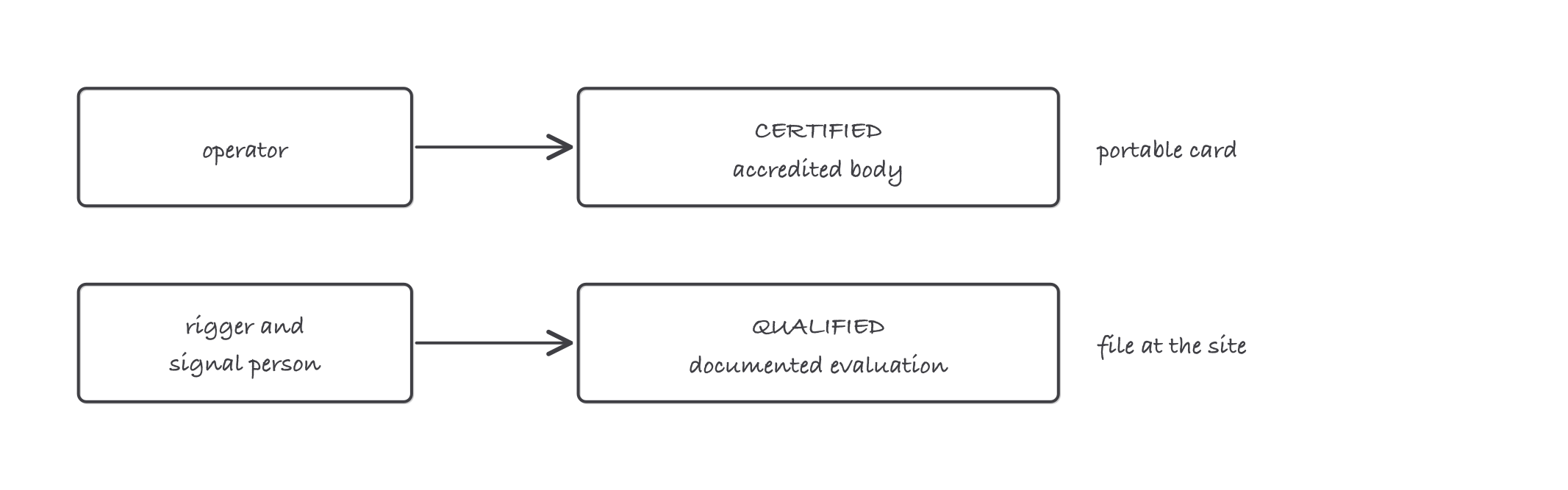
One crew, two legal standards: certification for the seat, documented qualification for the ground crew
Where the CCO certifications fit
NCCCO offers CCO Rigger Level I, Rigger Level II and Signalperson certifications: written plus practical exams, each valid for 5 years. For a signal person, CCO certification works as the third-party evaluator route. For riggers, it is strong portable evidence of qualification that a new employer can accept instead of running its own evaluation from scratch.
Recertification has teeth: requirements are completed in the final 12 months before expiry, there is no grace period, and for riggers holding multiple designations, all designations expire on the same date. A lapsed certificate means retesting as a new candidate.
A concrete example: a rigger certified CCO Rigger Level I on 2026-08-23 holds certification to 2031-08-23 and must complete recertification between 2030-08-23 and the expiry date. Miss the window by a week and the certification is gone, not late.
Where it bites
- Paying for certification you were told is mandatory. It is not, federally. It may still be worth holding: portable, instantly recognized, and increasingly demanded by contract even where the law asks less.
- Assuming qualification transfers by itself. Without a third-party certificate, your qualification lives in one employer’s files. Change companies and the evaluation typically happens again.
- Qualified for everything, evaluated for one thing. Qualification is scoped to the rigging or signaling actually being done. A basic evaluation does not cover engineered lifts.
- Jurisdictions and contracts can exceed OSHA. Some owners, sites and jurisdictions require certified riggers by policy or local law. The federal floor is the minimum: verify what governs your site.
Exam relevance
The CCO Rigger exams test sling angles, hitch capacities, hardware inspection and load control; the Signalperson exams test the Standard Method vocabulary and crane basics. If you pursue them, treat the current NCCCO candidate handbook for each program as the syllabus. If you do not, the same knowledge is still what an employer’s evaluator must see you demonstrate.
Verified requirements
| Where | Expires | Renewal | Continuing education |
|---|---|---|---|
| United States (federal) | Yes | 5 years | Confirm with issuer |
| United States (federal) | Yes | 5 years | Confirm with issuer |
| United States (federal) | Yes | 5 years | Confirm with issuer |
Information comes from issuing-authority sources. Confirm current rules, fees and eligibility with the authority before acting.