Learn · Heavy Equipment
Reading Grade Stakes and Plans
Part of CCO Crane Operator Prep · step 6 of 21 · next: GPS Machine Control
In learning paths: CCO Crane Operator Prep
Assumes you know: Equipment Types and Applications
Grade stakes are the plan translated into marks you can work to: cut means the ground comes down, fill means it comes up, and every number is measured from a reference at the stake. Reading them correctly is what turns machine hours into finished grade instead of rework.
Why it matters on the job
The surveyor sets the stakes; the operator makes the dirt match them. Between those two people, the stake markings are the entire contract. An operator who misreads one cut stake can bury a day of grading in the wrong direction, and the operators trusted with finish work are exactly the ones who read stakes without a second glance.
The stake and its reference
A typical grade point has two parts. The hub is a short stake driven flush, and its top is the surveyed reference elevation. Beside it stands the lath (or guard stake), the tall marked stick that tells you what to do relative to that reference:
- C 2.5 means cut: finished grade is 2.5 ft below the reference.
- F 1.0 means fill: finished grade is 1.0 ft above the reference.
- On finishing work, blue tops are hubs driven so their tops sit exactly at finished grade: no arithmetic, match the hub.
The direction is always relative to the reference at the stake, never to where your machine happens to sit. A machine standing in a low spot next to a C 2.5 stake may already be below the finish surface at its own location; the stake still means what it says at its own point.
Offsets: the stake is not the work
Stakes set on the work line would be destroyed by the first pass, so they are set to one side with an offset note such as O/S 10: the point this stake describes is 10 ft away, on the work line. The cut or fill applies there. Digging at the stake itself is a classic rookie error, and so is grading through a stake line that was protecting the only elevation references on the job.
Slope stakes extend the same idea to cut and fill slopes: set at the catch point where the new slope meets existing ground, marked with the slope ratio (such as 2:1, horizontal to vertical) and the cut or fill to the toe or top.
Feet and tenths, not inches
Grade work runs on the engineer’s scale: feet and tenths of a foot, not feet and inches. C 2.5 is 2 ft plus 0.5 ft, and 0.5 ft is 6 inches, not 5. One tenth of a foot is 1.2 inches. Mixing the two scales puts you an inch or more off on almost every conversion, which on finish work is the whole tolerance.
Worked example: one stake and one run of pipe
The stake: the lath reads C 2.5, O/S 10. Ten feet from the stake, on the work line, finished grade is 2.5 ft below the hub reference: 2 ft 6 in of cut. Not at the stake: at the offset point.
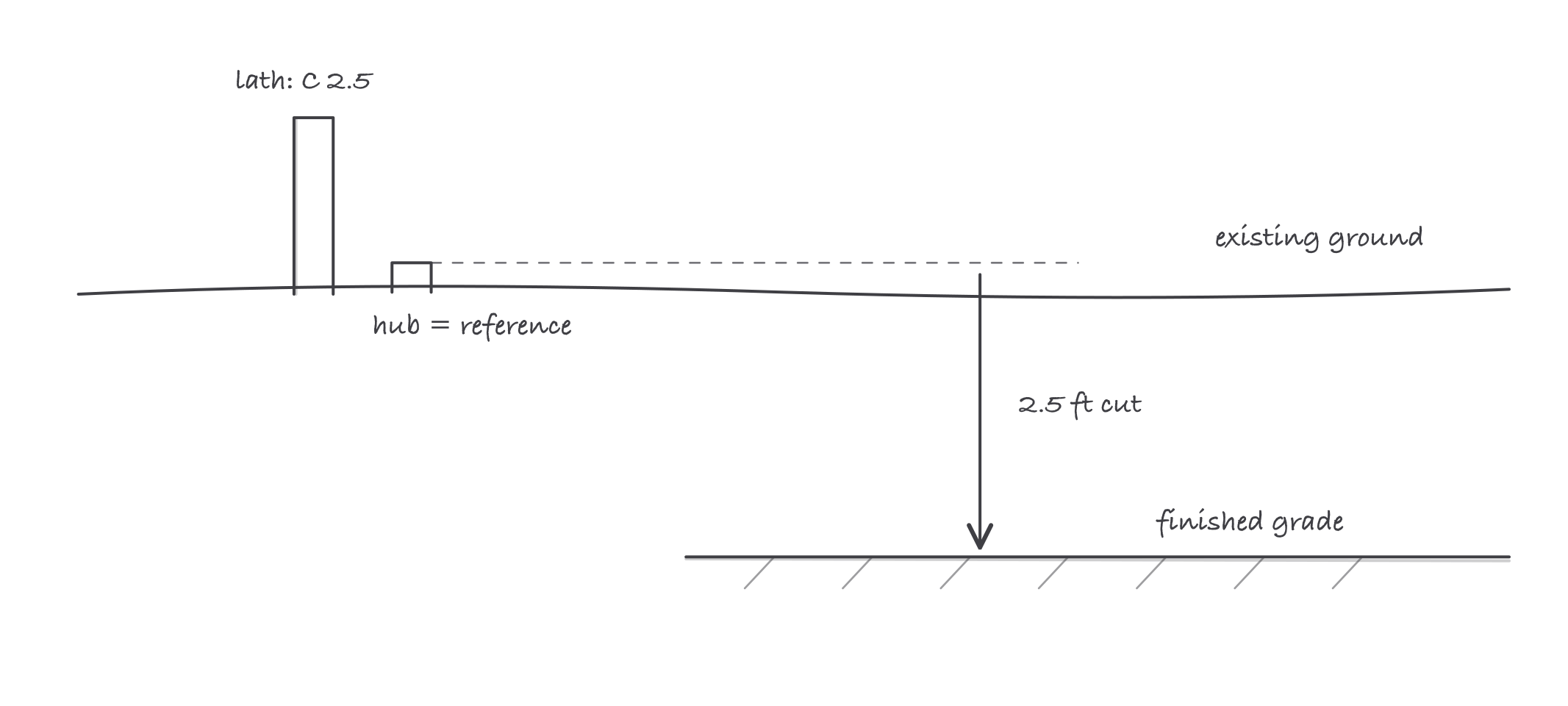
C 2.5: finished grade sits 2.5 ft below the hub reference, measured at the point the stake describes
The grade: the same job runs a storm line at a 1.5 percent falling grade for 200 ft. Percent grade is rise over run times 100, so the fall is 0.015 × 200 = 3.00 ft. If the invert cut at the first stake is 4.0 ft, the cut 200 ft downstream is 4.0 + 3.0 = 7.0 ft below that stake’s reference, exactly what the next stake should confirm. When the stakes and your arithmetic disagree, stop and get the line checked before you dig it.
Where it bites
- Tenths read like inches until they cost you. A crew that treats 0.4 ft as 4 inches is off by 0.8 in per stake, every stake, in the same direction.
- Cut and fill are directions from the reference, not descriptions of the ground. Ground that looks high can still carry a fill stake, because the reference is what counts.
- The offset is part of the instruction. C 2.5 at O/S 10 says nothing about the ground at the stake itself.
- Protect the stakes. A knocked-out hub is not a nuisance: it is a lost survey point that costs a re-stake and a delay. Grade toward stakes, not over them.
- When a stake looks wrong, it might be. Stakes get set from bad control, disturbed by frost or traffic, or misread in the field book. Good operators question a stake that disagrees with its neighbors instead of faithfully grading an error.