Learn · Heavy Equipment
The CDL: Why Operators End Up Needing One
Part of CCO Crane Operator Prep · step 21 of 21
In learning paths: CCO Crane Operator Prep
Assumes you know: Equipment Types and Applications
No commercial driver’s license is needed to run an excavator. One is very often needed to get the excavator to the job, and that distinction (the haul versus the dig) is the whole logic of the CDL for equipment operators. The Bureau of Labor Statistics notes that operators often need a CDL to haul their equipment between jobsites, and shops quietly sort applicants by who can legally move iron.
*Learn the Trades is a free study resource. We are not a licensing body, an authorized training provider, or an exam administrator. Reading this page does not award any card, license, or certification. Always verify requirements with the issuing authority linked in the sources.*Why it matters on the job
An operator with a CDL is two employees in one: the machine hand, and the legal driver of the water truck, the dump truck, or the truck and trailer that move the machine between digs. On small crews, the operator who cannot haul waits for the one who can. It shows up directly in dispatch order, overtime and pay.
The two classes that matter
The federal lines are weight ratings, not actual scale weight:
- Class A: a combination vehicle with a gross combination weight rating (GCWR) of 26,001 lb or more, where the towed unit has a gross vehicle weight rating (GVWR) over 10,000 lb. This is the equipment hauler’s license: truck plus heavy trailer.
- Class B: a single vehicle with a GVWR of 26,001 lb or more (towing nothing heavier than 10,000 lb). Dump trucks and water trucks live here.
Both thresholds read from the manufacturer’s ratings. An empty trailer rated at 24,000 lb counts its rating, not its load that day.
Worked example: three rigs, three answers
Rig 1: dump truck and tag trailer. Truck GVWR 33,000 lb towing a tag trailer with a GVWR of 24,000 lb carrying a compact excavator. Combination rating: 33,000 + 24,000 = 57,000 lb. That is at least 26,001 lb, and the towed unit is over 10,000 lb, so this is Class A work.
Rig 2: the same dump truck alone. Single vehicle, GVWR 33,000 lb, no trailer: over 26,001 lb on its own, so Class B covers it.
Rig 3: pickup and mini-excavator trailer. Pickup GVWR 11,400 lb towing a trailer with a GVWR of 14,000 lb. Combined ratings: 11,400 + 14,000 = 25,400 lb, under the 26,001 lb line, so no CDL class is triggered federally even though the trailer exceeds 10,000 lb. State rules and non-CDL licensing tiers can still apply; check yours.
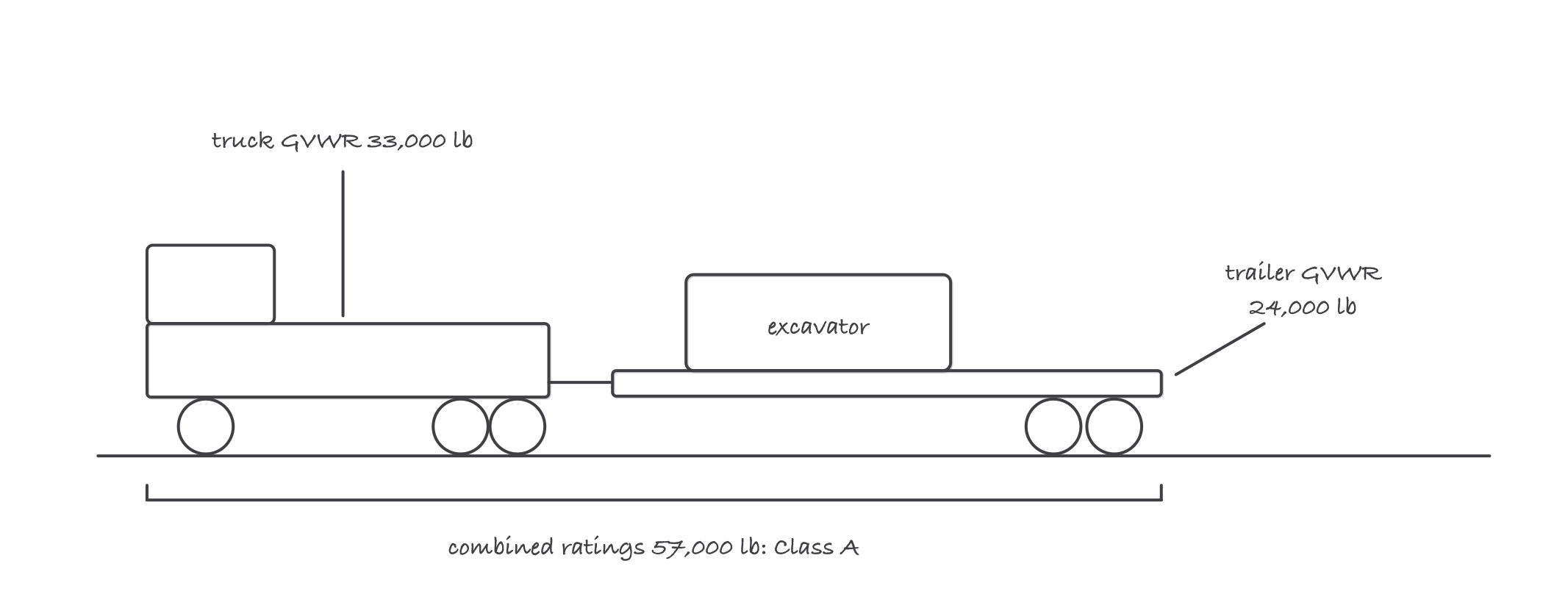
Rig 1 from the worked example: ratings, not scale weight, put this combination in Class A
Getting the license
Testing is run by your state: a knowledge test, then a skills test in the class of vehicle you will drive. Since 2022-02-07, first-time Class A or Class B applicants (and drivers upgrading from B to A) must first complete entry-level driver training from a provider listed on the FMCSA Training Provider Registry before taking the skills test. Renewal periods are state-set. Many employers will put a promising operator through CDL training; it is one of the cheapest raises you can ask for.
Where it bites
- “Operators need a CDL” stated flat. False without the framing: the requirement attaches to driving the hauling vehicle on public roads, not to operating equipment. Plenty of operators work whole careers CDL-free; they wait for the lowboy.
- Judging by how heavy it looks. Classification follows GVWR and GCWR plates. A lightly loaded rig with heavy ratings is still CDL work.
- Forgetting the second condition of Class A. Both parts matter: the 26,001 lb combination line and the over-10,000 lb towed unit. Rig 3 shows a heavy trailer that still triggers nothing federally.
- Assuming the machine rides free. The machine’s weight lives inside the trailer’s rating math when the rig was specced; an overloaded trailer is a violation regardless of license class.
Exam relevance
CDL knowledge tests cover vehicle classes and weight ratings exactly as above, plus air brakes and combination-vehicle handling for Class A. Expect your state manual to drill the 26,001 lb and 10,000 lb lines; they are the most examined numbers in this lesson.
Verified requirements
| Where | Expires | Renewal | Continuing education |
|---|---|---|---|
| United States (federal) | Yes | state-set | Confirm with issuer |
Information comes from issuing-authority sources. Confirm current rules, fees and eligibility with the authority before acting.