Learn · Heavy Equipment
Trenching and Excavation Safety for Operators
Part of CCO Crane Operator Prep · step 8 of 21 · next: Crane Types and Configurations
In learning paths: CCO Crane Operator Prep
Assumes you know: Excavator Operation
The excavator operator digs the trench, so the excavator operator shapes most of what makes it survivable: the slope, the spoil placement, the room for protective systems, and the machine’s own weight near the edge. This lesson is trench safety from the seat, and it starts with knowing which calls are yours and which belong to the competent person.
Why it matters on the job
A cubic yard of soil weighs on the order of 3,000 lb, and trench walls fail in seconds, without warning. The operator can make a trench dangerous in a single move: one bucket of spoil dumped at the edge, one track parked too close, one “we’ll slope it later.” OSHA’s excavation rules exist because those habits kill utility workers every year, and the operator who knows the rules digs the protection into the trench from the first pass.
The rules of the hole
Protection at 5 feet. OSHA requires a protective system in any trench 5 ft deep or more unless the excavation is entirely in stable rock, and below 5 ft whenever the competent person sees a cave-in hazard. Every protective system is one of three ideas: slope the walls back to an angle the soil holds, shore them with supports that press against both faces, or shield the workers inside a trench box that survives a collapse.
Spoils and loads stay 2 feet back. OSHA’s trenching rules keep excavated spoil and other materials at least 2 ft from the trench edge. Closer than that, the pile’s weight loads the wall below it, and spoil rolls back in on the crew. You placed that pile; its distance is entirely your doing.
A way out within 25 feet. Trenches 4 ft deep or more need a ladder, ramp, or steps within 25 ft of lateral travel for every worker in the trench, so nobody has a long escape run.
The machine is a surcharge too. An excavator parked at the edge loads the wall exactly like a spoil pile, only heavier. Work from the end of the trench where the work allows, keep tracks back from the edge, and treat vibration from your own machine as one more thing the wall has to carry.
Whose call is which
The competent person, trained to identify hazards and authorized to stop work, owns the judgment calls: classifying the soil, choosing the protective system, and inspecting the excavation daily and after rain or any change. Those calls are not the operator’s to make alone.
The operator owns execution: cutting the slope that was specified, placing spoil legal distances back, benching the machine safely, setting boxes gently and square. One rule needs no supervisor: never dig with people in an unprotected trench, and never swing the bucket over them. If you see water seeping, wall cracks, or sloughing, you are the first witness: stop and get the competent person, because the trench that “held all morning” has proven nothing about the next five minutes.
Worked example: the room a slope needs
The competent person classifies the soil Type C, the weakest common class, sloped at 1.5 horizontal to 1 vertical. The pipe crew needs an 8 ft deep trench with a 4 ft bottom.
- Cutback per side: 1.5 × 8 = 12 ft.
- Top opening: 12 + 4 + 12 = 28 ft wide.
- Add the 2 ft spoil setback and the pile itself, and the work zone spans well past 30 ft.
That is why you plan the bench, the spoil, and the truck path before the first bucket: an 8 ft trench in weak soil is a 28 ft excavation, and if that room does not exist, the crew needs boxes or shoring, not a steeper slope.
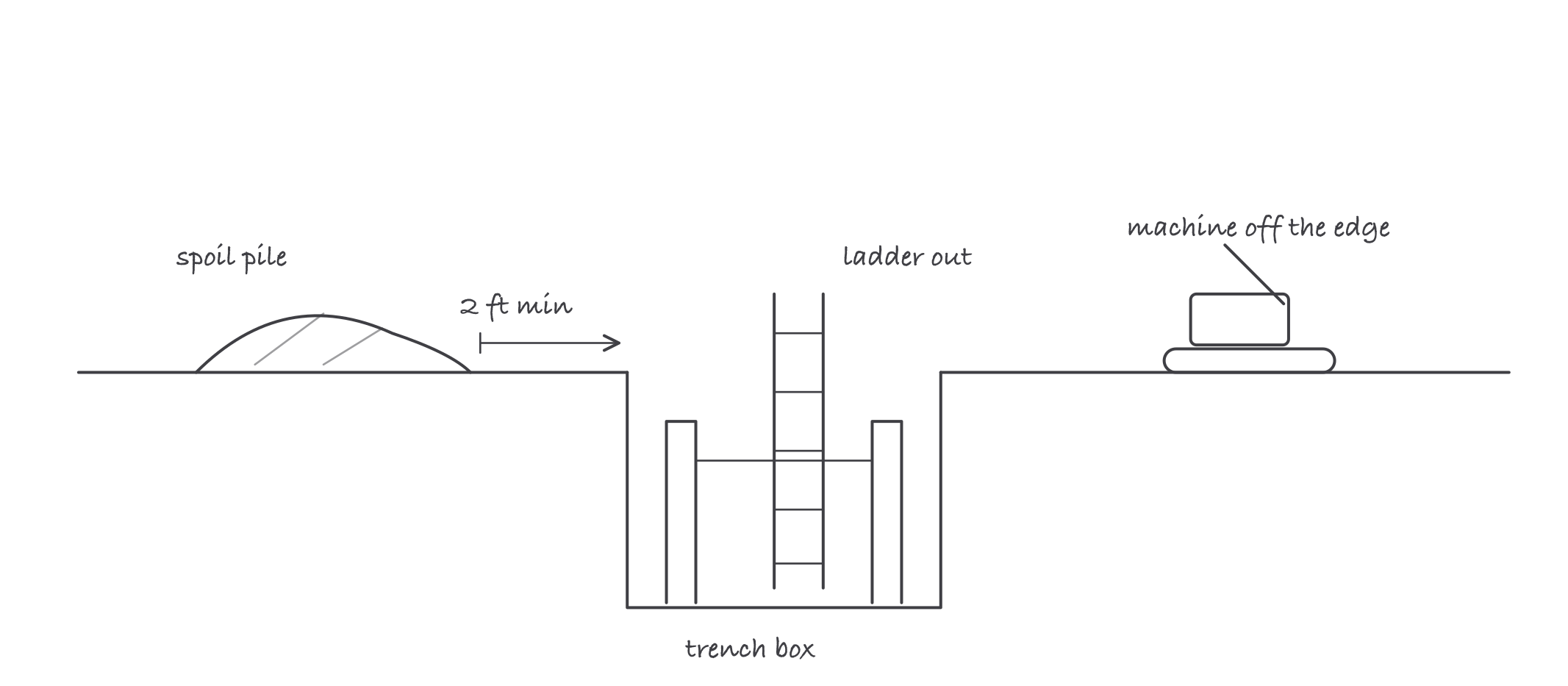
What the operator controls: spoil 2 ft back or more, the machine off the edge, and room for the box and the ladder
Where it bites
- “It held all morning” is not evidence. Soil stress redistributes over hours; drying, rain, and vibration change the wall while nobody watches. Only the protective system is evidence.
- The box is not the trench. A trench box protects the people inside it. Digging ahead of the box, or a worker stepping out of it, is unprotected exposure even though a box is on site.
- Spoil placement is not housekeeping. It is structural loading of the wall you dug. Two feet is the minimum, not the target; further is better, and downhill of nobody.
- Previously disturbed soil lies. Digging along an existing utility means soil that has already failed once. Expect the competent person to classify it weaker than it looks, and dig accordingly.
- Utilities first, always. The locate tickets and hand exposure at the marks come before the first production bucket. A strike is the one trench emergency the operator personally triggers.