Learn · Heavy Equipment
Crane Types and Configurations
Part of CCO Crane Operator Prep · step 9 of 21 · next: Reading Load Charts
In learning paths: CCO Crane Operator Prep
Mobile cranes divide along two lines: how the boom is built (lattice or telescopic) and what carries it (crawler tracks or a truck chassis, swing cab or fixed cab). Those distinctions are not trivia. Operator certification attaches to crane type, so which machine you sit in determines which credential the work calls for.
Why it matters on the job
Under OSHA’s construction crane rules, operators are certified by type of crane, or by type and capacity, so “crane operator” is not one qualification but a family of them. The CCO certifications from NCCCO (the National Commission for the Certification of Crane Operators) mirror the same machine families with four mobile crane designations, and employers hire against those letters. Knowing the families is the first step of the certification path, and it is also how you read a job posting correctly.
Lattice or telescopic
Lattice boom cranes carry a boom built from welded steel sections, triangulated like a bridge truss, pinned together to the length the lift plan needs. The boom is light for its strength but it cannot change length during work, and the crane arrives on site in pieces with an assembly plan.
- On tracks, this is the lattice boom crawler crane (CCO designation LBC): the heavy-lift workhorse that walks the site with the load.
- On a wheeled carrier, it is the lattice boom truck crane (LBT): the same boom idea, road-transportable.
Telescopic boom cranes carry a hollow boom whose sections extend hydraulically, one inside the next. Setup is fast: drive in, set up, boom out.
- With a swing cab that rotates with the boom and load, this is CCO designation TLL: the typical rough-terrain and all-terrain crane arrangement.
- With a fixed cab that stays put while the boom swings, it is TSS: the arrangement of boom trucks and carry-deck industrial cranes.
Note what separates TLL from TSS: the cab, not the tonnage. Folklore about capacity cutoffs between the designations has no basis in the definitions; the cab type is the line.
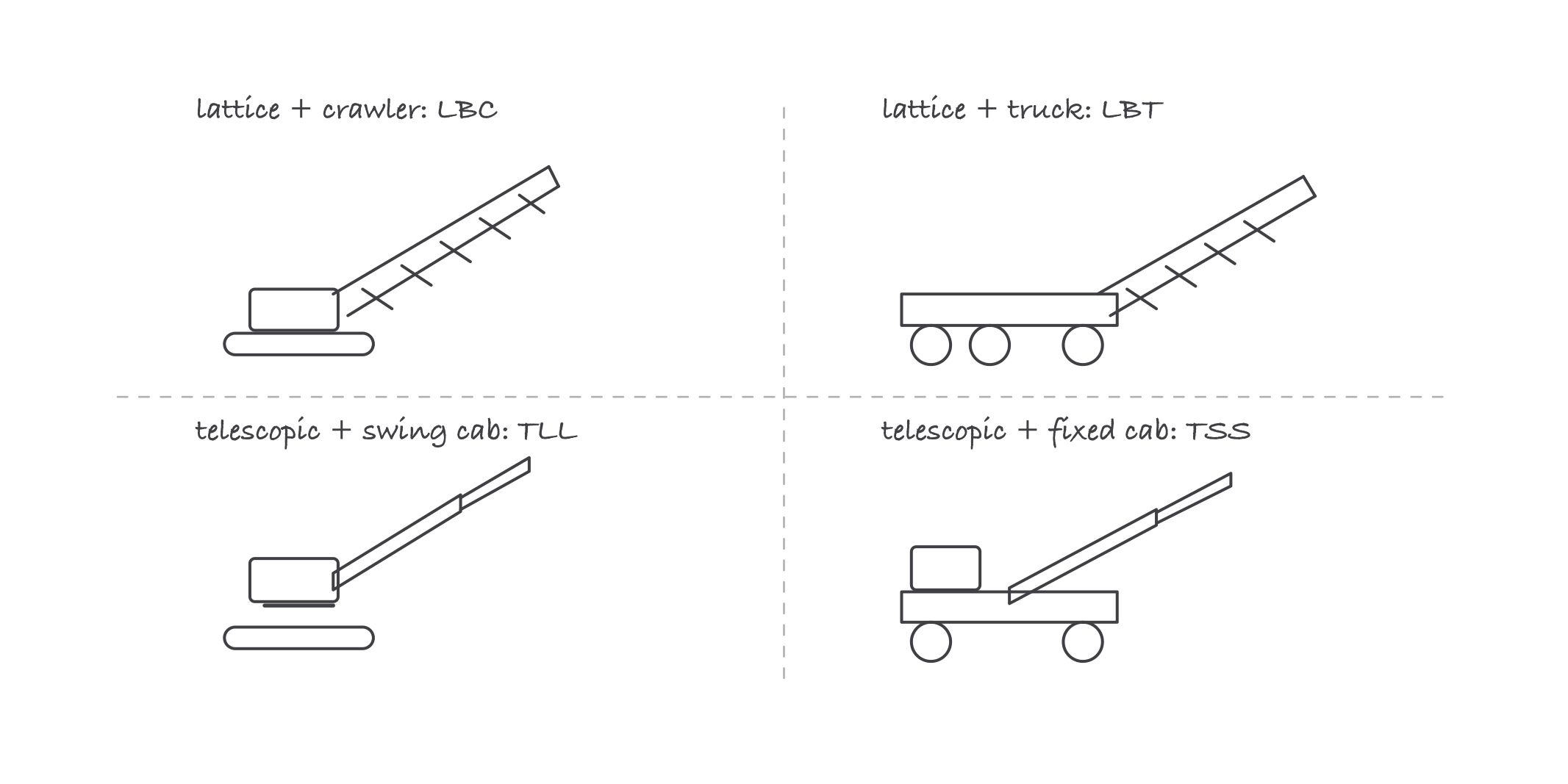
The four CCO mobile crane designations: boom construction on one axis, carrier and cab on the other
How certification maps onto the families
The CCO mobile crane program is built as one core plus specialties: a Core written exam covering what all mobile cranes share, at least one Specialty written exam (LBC, LBT, TLL, or TSS), and a practical exam, all completed within 12 months. Certification runs on a 5-year cycle. Practical exams are offered for three configurations, and the lattice boom practical covers both LBC and LBT.
Worked example: building the right combination
An operator runs boom trucks today and wants lattice crawler work next year:
- Core written exam: one exam, shared by every designation.
- TSS specialty written + telescopic fixed cab practical: certified on the boom trucks she runs now.
- LBC specialty written + lattice boom practical: adds the crawler designation.
- Because the lattice practical covers both lattice designations, adding LBT later takes only the LBT specialty written, no new practical.
All parts of each certification must land inside the 12-month window, and each designation then rides the same 5-year certification.
Where it bites
- The card is not permission to operate. Since OSHA’s 2018 rule, certification alone is not enough: the employer must also train, evaluate, and document the evaluation of each operator on the equipment they will run. The OSHA crane operator rule lesson covers that duty; expect it on every compliant jobsite.
- Certified on one type is not certified on all. A TSS-only certificate holder is not certified on a lattice crawler. The type designation is the certification.
- NCCCO is the body, CCO is the credential. Job ads mix the names freely; on paper, you hold CCO certification administered by NCCCO.
- Older references say “type and capacity” as if it were the only option. The 2018 rule allows certification by type, or by type and capacity. Read anything published before then with that change in mind.
- State and city layers exist. Some jurisdictions (New York City, California, Washington among them) add licensing or their own certifier rules on top of the federal floor. The state crane licensing lesson maps the pattern; always check the local authority.
Exam relevance
The Core written exam tests the shared fundamentals (load charts, setup, operations, rigging awareness) while each Specialty exam tests the machine family: lattice assembly matters for LBC and LBT candidates, boom extension and fixed-cab sightlines for TSS. BLS notes crane operators generally pass a skills test plus a written safety exam wherever they work, and the CCO structure is exactly that pattern formalized. Pick your specialty exams by the machines in your market, not by which exam looks easiest.
Verified requirements
| Where | Expires | Renewal | Continuing education |
|---|---|---|---|
| United States (federal) | Yes | 5 years | Confirm with issuer |
| California | Yes | 5 years | Confirm with issuer |
| Washington | Yes | 5 years | Confirm with issuer |
Information comes from issuing-authority sources. Confirm current rules, fees and eligibility with the authority before acting.