Learn · Heavy Equipment
GPS Machine Control
Part of CCO Crane Operator Prep · step 7 of 21 · next: Trenching and Excavation Safety for Operators
In learning paths: CCO Crane Operator Prep
Assumes you know: Reading Grade Stakes and Plans
GPS machine control puts the design surface in the cab: the machine knows where its blade or bucket is against finished grade, live, everywhere on site. Instead of working stake to stake, you watch cut and fill numbers at the cutting edge and the surface grows out of the model.
Why it matters on the job
3D-equipped dozers, graders, and excavators cut grade with fewer stakes, fewer grade checkers walking the site, and far less rework. That is why contractors put their best operators in those seats, and why operators who can run the systems are in demand. But the system automates the measuring, not the judgment. Everything from the grade-reading lesson still applies; the display is one more instrument that can be wrong.
How the parts fit
Position comes from satellites, accuracy comes from corrections. GNSS receivers on the machine (mast antennas on the blade or roof) fix position from satellite signals. Satellite position alone is not tight enough for grade work, so a correction source refines it: typically a base station set up on a known survey point broadcasting corrections to the machine, or a network correction service doing the same job over the air. Vertical accuracy is always the weak axis of GNSS, which is why grade tolerances get checked, not assumed.
The design surface lives in the cab. The plan becomes a 3D model loaded into the machine’s display. The system continuously compares blade position to that surface and shows the difference as cut or fill at the blade, anywhere on site, no stake required.
Indicate versus automatic. In indicate-only mode the display shows cut and fill and you move the blade. In automatic mode the system drives the blade hydraulics to hold grade while you steer and manage the load. Automatics finish faster, but they will hold the wrong grade with exactly the same confidence as the right one.
Localization ties it all to the site. The model and the machine only agree with the stakes because someone calibrated the system to the site’s survey control. That localization, plus the measured geometry of the machine itself, is the foundation under every number on the screen.
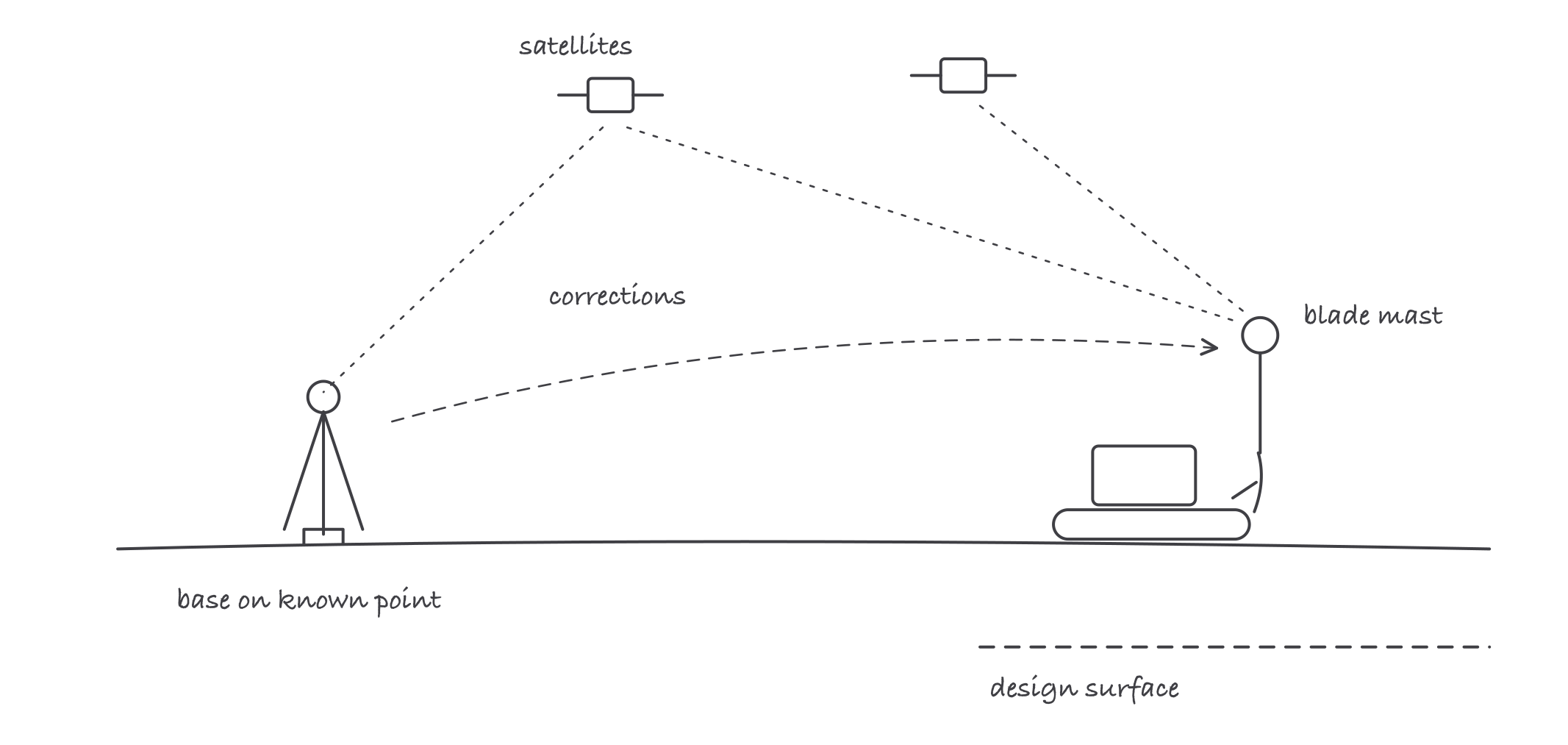
Satellites give position, the base on a known point makes it accurate, and the cab compares the blade to the design surface
Worked example: the daily check-in
Every shift starts by proving the system against something surveyed. Park the cutting edge on a known hub whose elevation is 101.50 ft.
- The display reports the blade elevation as 101.47 ft.
- Difference: 101.50 − 101.47 = 0.03 ft low. Your site sets the tolerance for that check; a few hundredths is the normal neighborhood for RTK-corrected grade work.
- Now suppose the display had read 101.15: a 0.35 ft bust. That is not noise. It is a bumped mast, a wrong machine measure-up, a stale design file, or a base station problem, and the only correct response is to stop cutting and find out which.
The check takes two minutes. Grading all morning on a 0.35 ft error takes two days to fix.
Where it bites
- The model is only as good as its revision. Loading last week’s design file cuts last week’s grade. Confirm the file and revision against the current plan before the first pass.
- The base station is a single point of failure. Set on the wrong hub, or bumped by a truck, it poisons every machine listening to it. Base setup is survey work: treat it that way.
- Trees, buildings, and deep cuts block satellites. When coverage drops out, the system tells you, and the answer is conventional methods, not optimism.
- Automatics obey but do not think. Blade automatics will happily carve a wrong surface at full production speed. The operator is the sanity check: if the numbers disagree with the stakes still on site, believe the disagreement and investigate.
- The screen is not the ground. Final acceptance still happens with survey instruments on real dirt. Check into hubs as you go and keep the grade checker in the loop at the finish.