Learn · Heavy Equipment
Equipment Types and Applications
Part of CCO Crane Operator Prep · step 1 of 21 · next: Excavator Operation
In learning paths: CCO Crane Operator Prep
Heavy equipment sorts into a handful of machine families, and each family exists to do one job well: dig, push, load, finish, or compact. Learn the families and their verbs first. Every machine you will ever run, from a mini excavator to a 100-ton crane, is a variation on one of them.
Why it matters on the job
Crews are built around matching machines to tasks. A foreman who says “we need iron on this” is really asking which verb the job needs next, and the operator who understands that gets moved between machines instead of parked on one. Versatility is what moves you up in this trade. The Bureau of Labor Statistics reports a median wage of $58,320 for construction equipment operators (May 2024), about 46,200 openings a year through 2034, and steady 4 percent growth. The operators who fill the best of those openings run more than one family.
The five verbs
Dig: excavators. A tracked undercarriage, a house that swings a full circle, and a boom, stick, and bucket that pull soil toward the machine. Excavators dig below their own level better than anything else on site: trenches, basements, footings, mass excavation. Sizes run from mini excavators that fit through a gate to mining-class machines, but the controls and the digging cycle stay the same.
Push: dozers. A tracked tractor with a blade on the front. Dozers strip topsoil, push fill, rough in grades, and open haul roads. Their tracks give them the traction and flotation to work ground no wheeled machine can cross.
Load and carry: loaders. A wheel loader lifts material into trucks, hoppers, and stockpiles with a front bucket, and it can carry that bucket across the site at speed. The backhoe loader bolts a small excavator to the back of one, which is why it lives on utility crews.
Finish: graders. A long-framed machine with a moldboard slung under its belly. Graders cut grade to final tolerance on roads, pads, and parking lots. Finish work carries the tightest tolerances in dirt work, and the seat is paid accordingly.
Compact: rollers and compactors. Smooth drum, padfoot, pneumatic, and walk-behind machines that squeeze the air out of fill so it can carry load. Every lift of fill that goes in has to be compacted before the next one goes on top.
Cranes are the sixth family, and they are different in kind: they lift instead of moving dirt, and federal rules treat crane operators separately. The cranes subject covers them on their own.
Worked example: one job, five machines
Follow a 300 ft sewer extension from grass to pavement and every family shows up in order:
- A dozer strips topsoil and cuts the working bench.
- An excavator digs the trench, and sets the pipe with a rigging crew.
- A loader or the dozer pushes bedding and backfill back in, in lifts.
- A trench compactor seals each lift before the next.
- A grader cuts the restored surface to final grade for paving.
Same soil, five verbs. No single machine could do the whole run efficiently, which is exactly why the families exist.
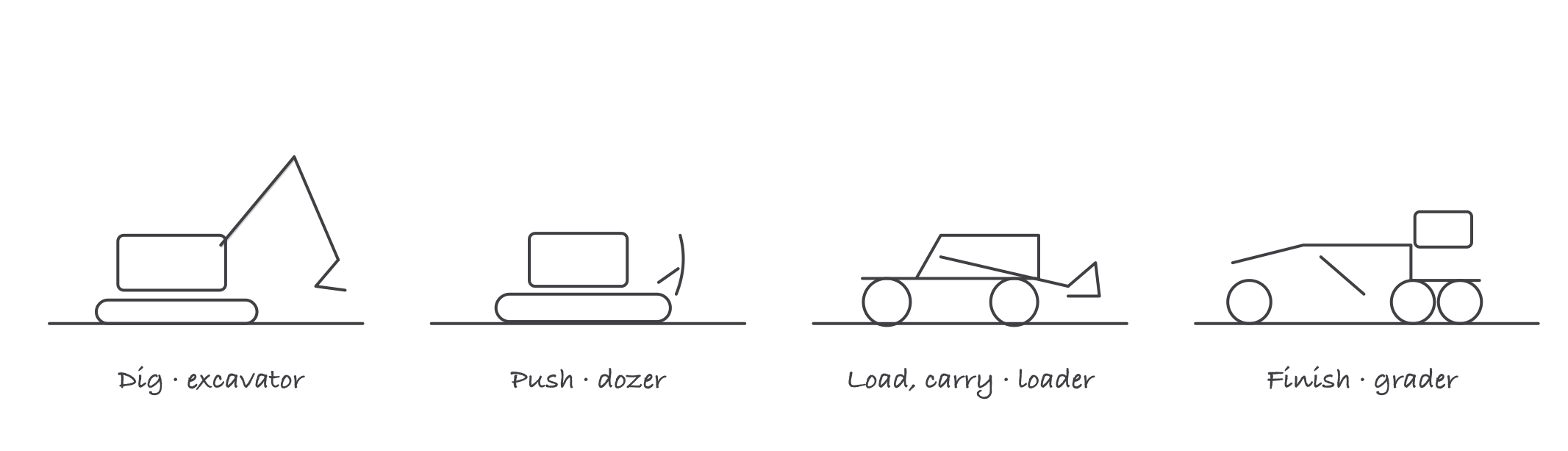
Match the machine to the verb: dig, push, load and carry, finish
Where it bites
- “Operator” means different things in different rules. In union and career language, an operating engineer runs the whole earthmoving craft. In OSHA’s crane rules, “operator” means specifically the person at the crane controls. Career pages use the first sense, regulatory pages the second.
- A CDL is about the haul, not the dig. No commercial driver’s license is required to operate an excavator. BLS notes operators often need a CDL because someone has to drive the truck and trailer that move the machine between jobsites. The license attaches to the road, not the seat.
- One machine is not one skill. Control patterns, visibility, and stability behave differently across families. Seat time in a loader does not make you an excavator operator, and telling a foreman otherwise gets found out in one bucket.
- Compaction is a family, not an afterthought. Skipping the compactor in the sequence above is how settled trenches and sunken patches happen a year later.