Learn · Heavy Equipment
OSHA's Crane Operator Rule: Certified, Evaluated, Documented
Part of CCO Crane Operator Prep · step 14 of 21 · next: NCCCO Certification: The Federal Gate
In learning paths: CCO Crane Operator Prep
Assumes you know: Crane Types and Configurations
29 CFR 1926.1427 is the federal rule that makes crane operator certification law on US construction sites, and it asks for two different things: the operator must be certified, and the employer must separately train, evaluate and document that operator on the actual equipment. Most of the industry knows the first half. The second half is where compliance actually fails.
*Learn the Trades is a free study resource. We are not a licensing body, an authorized training provider, or an exam administrator. Reading this page does not award any card, license, or certification. Always verify requirements with the issuing authority linked in the sources.*Why it matters on the job
This rule decides who may sit in the seat, which exams you take, how long your certification lasts, and what paperwork must exist before your first unsupervised pick for a new employer. Operators who understand the rule can also spot the jobs that are running illegally, which is worth knowing before your name goes on the lift.
The four certification paths
The rule accepts certification or licensing from four sources:
- An accredited testing organization. CCO certification from NCCCO is the dominant example. This is the portable path: the certification belongs to you and travels between employers.
- An audited employer program. An in-house certification program audited to the rule’s standards. It is valid only within that employer: leave, and the certification stays behind.
- The US military. Qualification issued to military employees. Like the employer path, it does not transfer to civilian employers.
- A state or local government licensing program. Where a government license meets the rule’s criteria, holding it satisfies (and in that jurisdiction, supersedes as a minimum) the federal requirement.
Whichever path, certification is issued by equipment type, or type and capacity, and is valid for a maximum of 5 years. The 2018 rule relaxed the older requirement that certification always match both type and capacity; material written before 2018 still states the stricter version.
The employer’s second gate
Certification proves general competence on a type. The evaluation proves you can run the machine in front of you. The employer must evaluate each operator on the equipment they will use, and the documented record must identify the operator, the evaluator, the date, and the make, model and configuration of the equipment covered. Re-evaluation is triggered by equipment that presents different operating characteristics, not by the calendar.
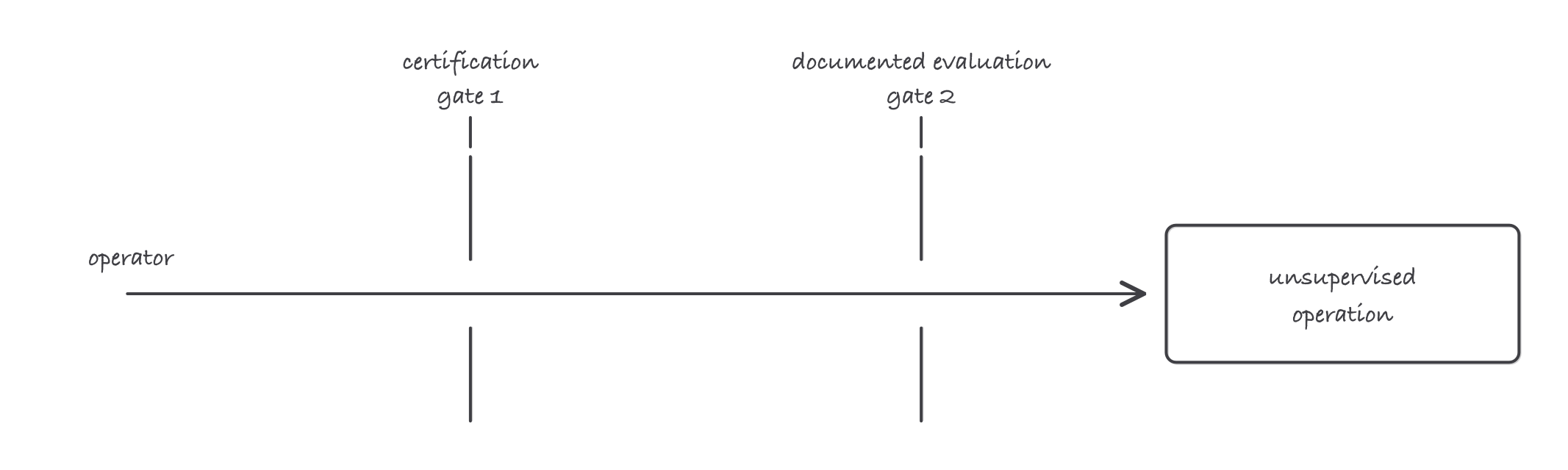
Certification and the documented employer evaluation are separate gates; you pass both before operating unsupervised
A concrete example: a CCO-certified operator (TLL designation) hired to run a 90-ton rough terrain crane still cannot make unsupervised picks until the new employer evaluates them on that crane, or one with the same operating characteristics, and writes the evaluation down. The certification card did not expire, weaken or change; it was never the whole requirement.
What the rule does not cover
The rule exempts equipment with a maximum manufacturer-rated hoisting capacity of 2,000 lb or less, along with derricks and sidebooms, from the certification requirement (other duties still apply). This 2,000 lb line is where small telehandler and carry deck arguments get settled. It also applies to construction; general industry crane work runs under different standards, and states can impose more on top.
Where it bites
- “I’m certified, I’m legal.” Certification without the documented evaluation is not authorization; see the fact box above.
- Trainee operation has conditions. Uncertified operators may operate only as operators-in-training under the rule’s supervision conditions, not casually “under a certified guy on site.”
- In-house certification is a golden handcuff. An audited employer program is fully legal and completely non-portable. If you expect to change employers, the accredited testing path protects you.
- The exemption line is about rated hoisting capacity. 2,000 lb or less by manufacturer rating, not by the load you happen to be lifting that day.
Exam relevance
The certification exams this rule mandates are described in the NCCCO certification lesson. Expect the rule itself to appear in written exam content and site safety discussions: the 5-year validity, the type or type-and-capacity principle, and the operator-in-training conditions are the tested points.
Verified requirements
| Where | Expires | Renewal | Continuing education |
|---|---|---|---|
| United States (federal) | Yes | 5 years | Confirm with issuer |
| California | Yes | 5 years | Confirm with issuer |
| Washington | Yes | 5 years | Confirm with issuer |
Information comes from issuing-authority sources. Confirm current rules, fees and eligibility with the authority before acting.