Learn · Heavy Equipment
Dozer and Grader Operation
Part of CCO Crane Operator Prep · step 3 of 21 · next: Loader and Backhoe Operation
In learning paths: CCO Crane Operator Prep
Assumes you know: Equipment Types and Applications
Dozers rough it in, graders finish it. The two machines split earthmoving between them: the dozer moves volume with a blade it pushes, the grader cuts accuracy with a blade it drags. Learn what each blade is actually doing to the dirt and both machines start making sense.
Why it matters on the job
Dozer and grader seats are where dirt-crew reputations are made. A dozer operator who can carry a full blade without spinning tracks moves more material per gallon of fuel. A grader operator who can hit finish grade is in demand, because everything the paving crew does sits on that surface.
Dozing: manage the blade load
A dozer cuts and pushes. The skill is holding the biggest load the machine can move without stalling the tracks:
- Cut at the start, carry to the end. Tip the blade in to load it over the first few feet, then lift to carry grade and push the load to the dump. Cutting the whole way buries the machine.
- Slot dozing. After the first pass, push in the same groove. The spoil walls on either side keep material from spilling off the blade ends and can raise the load noticeably.
- Short pushes win. Dozers are most efficient over short distances; long hauls belong to loaders, trucks, or scrapers. If you are pushing the same dirt hundreds of feet, the plan is wrong, not the machine.
- Track slip is information. Spinning tracks mean too much blade. Feather the lift instead of adding throttle.
Blades differ by job: a straight blade cuts and pushes hard material, a universal (U) blade’s big curved wings carry light material in volume, and the six-way blade on smaller dozers angles and tilts for shaping. The blade type sets what the machine is for.
Grading: the blade under the belly
A grader’s moldboard hangs between the front and rear axles, which is why it can cut a smooth plane: the frame bridges bumps instead of riding over each one. Three habits make a finish operator:
- Angle the blade. The moldboard is set at an angle to the direction of travel so cut material rolls along the blade and windrows off the trailing end, instead of piling up and pushing ahead.
- Light cuts, many passes. Finishing is repeated thin cuts, each pass picking up the windrow from the last.
- Let the machine do the accuracy. Steady speed, consistent blade settings, and reading the surface behind you beat chasing the blade with constant corrections.
Worked example: what angling the blade costs and buys
Angle the moldboard and you trade cutting width for material flow. The effective width is the moldboard length times the sine of the blade angle (the angle between moldboard and the direction of travel).
A 12 ft moldboard set at 60 degrees:
- Effective width = 12 × sin 60° = 12 × 0.866 = 10.39 ft, call it 10.4 ft.
- Grading a 30 ft roadbed with a 2 ft overlap between passes, each pass advances 10.4 − 2 = 8.4 ft of new width.
- Passes needed: 30 / 8.4 = 3.57, so 4 passes per lap of the roadbed.
Flatten the angle toward 90 degrees and you cut wider but the material stops rolling and starts pushing. Sharpen it and material flows beautifully but every lap needs more passes. The angle is always that trade.
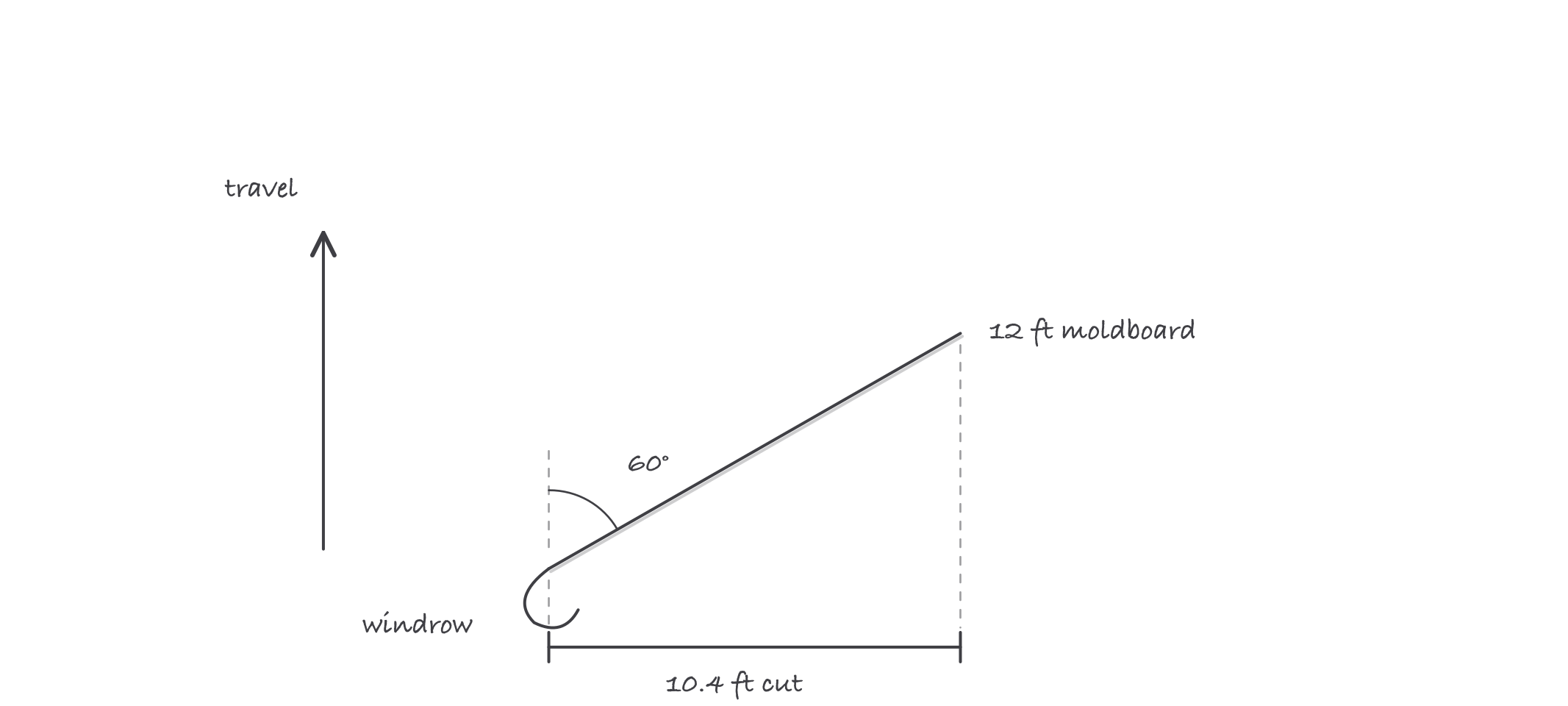
The angled blade rolls material to its trailing end: 12 ft of moldboard cuts 10.4 ft of width at 60 degrees
Where it bites
- Material piling in front of a grader blade means the angle is too flat. The load should travel along the moldboard and leave a windrow at the trailing end, not build a wall ahead of you.
- A dozer blade full of dirt hides the grade. Check behind you: the surface the tracks leave is the work, and rework costs double.
- Both machines get in trouble sideways. Working across a slope with a loaded blade shifts weight downhill; work up and down the slope where the plan allows.
- The stakes rule the blade. Cut means the ground comes down, fill means it comes up, measured at the stake, not at the machine. The grade-reading lesson covers the markings; misreading them turns a finish pass into a repair.