Learn · Heavy Equipment
State Crane Licensing on Top of NCCCO
Part of CCO Crane Operator Prep · step 16 of 21 · next: The NYC Hoisting Machine Operator License
In learning paths: CCO Crane Operator Prep
Assumes you know: NCCCO Certification: The Federal Gate
Federal OSHA’s crane operator rule is a floor, not a ceiling: states running their own OSHA-approved plans, and even individual cities, can require more than 29 CFR 1926.1427 does. California, Washington and New York City are the three worked examples every traveling crane operator should know, because each adds a different kind of layer, and together they teach you the questions to ask anywhere.
*Learn the Trades is a free study resource. We are not a licensing body, an authorized training provider, or an exam administrator. Reading this page does not award any card, license, or certification. Always verify requirements with the issuing authority linked in the sources.*Why it matters on the job
Crane operators travel: shutdowns, wind work, disaster response, boom seasons in other states. The operator who assumes the CCO card settles everything eventually meets an inspector for whom it does not. Knowing how the three big layered regimes work, and what kind of layer each one is, turns “am I legal here?” from a gamble into a checklist.
California: the state writes its own certification rule
California’s Title 8 regulations (§5006.1 for general industry, §5006.2 for construction) require crane and derrick operators to hold a certificate of competency from an Accredited Certifying Entity, issued for the crane type. Certificates are valid a maximum of 5 years, with full requalification at recertification, and the accrediting body itself is reviewed on a 3-year cycle.
The practical effect: NCCCO is an accredited certifying entity, so a CCO certificate is how most operators comply. The structural point is bigger: California wrote certification into its own general industry rules too, so the requirement reaches crane work that federal 1926.1427, a construction standard, does not touch.
Washington: the operator is certified, and so is the crane
Washington’s construction crane rule (WAC 296-155-53300) requires operators to hold a valid certificate for the crane type from an accredited testing organization; Labor & Industries recognizes NCCCO, OECP and CIC. The distinctive layer is aimed at the machine: cranes on Washington construction sites must be inspected and proof-load tested annually by an L&I-accredited crane certifier.
So in Washington two different things get called “certified” in conversation: the operator’s certificate, and the crane’s annual certification by an accredited certifier. They are separate systems with separate people behind them, and a compliant operator in a non-certified crane is still a stopped job.
New York City: a license on top of certification
NYC requires a Department of Buildings Hoisting Machine Operator license, with NCCCO certification as a prerequisite underneath it, plus a 40-hour DOB course and a supervised experience ladder. It has its own lesson; here it stands as the municipal case: a city government building a full licensing regime on top of the national credential.
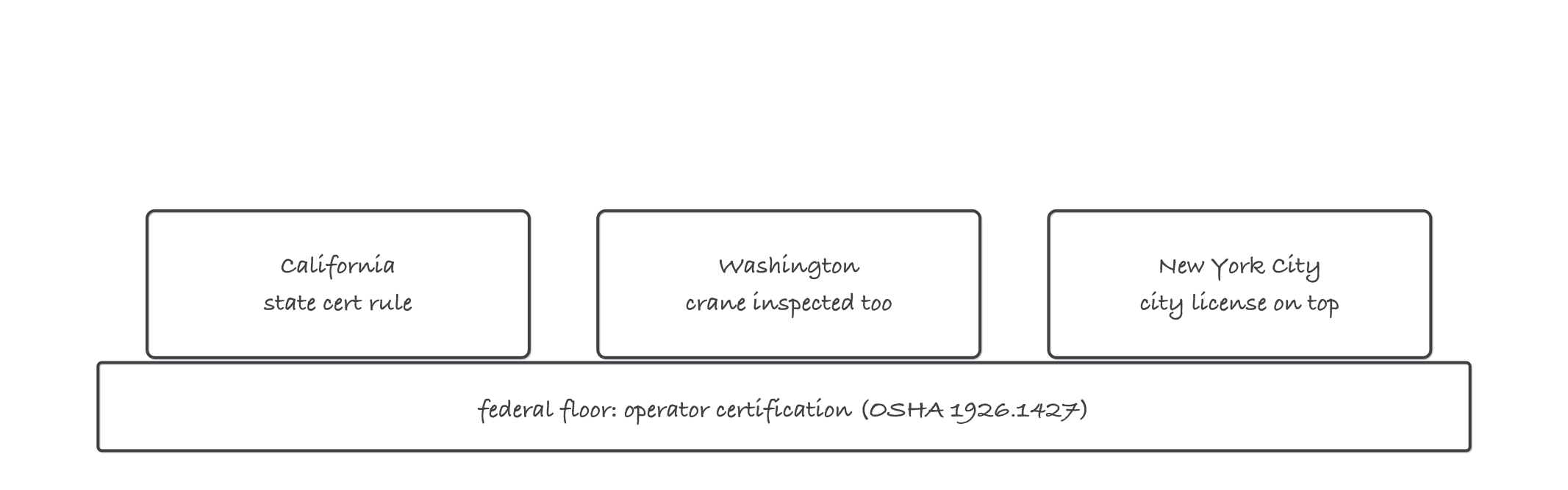
One federal floor, three different layers: a state certification rule, a machine inspection regime, and a city license
The pattern to carry
When you land in a new jurisdiction, ask three questions:
- Who regulates crane operators here? Federal OSHA states default to 1926.1427; state-plan states may have their own rule with its own reach.
- Is anything required beyond accredited certification? A state certificate, a city license, registration, or specific courses.
- Does anything attach to the crane itself? Annual certification, inspection or permits, Washington-style.
The answers come from the jurisdiction’s own authority, not from job boards or forums. Every regime above publishes its rules directly.
Where it bites
- Assuming construction rules are the whole story. California’s general industry sections catch crane work outside construction; plant and yard cranes have rules too.
- Confusing the two Washington certifications. Your operator certificate does not make the crane legal, and the crane’s proof-load test does not make you legal.
- Old information. Layered regimes change on their own schedules. The issuing authority’s current page outranks anything printed, including this one.
Exam relevance
The certification exams themselves are national (the CCO exams), and California and Washington both accept accredited certification, so studying for the layer rarely means a new technical exam. It means paperwork precision: certificate type matching the crane type, validity inside the 5-year windows, and, in NYC, a documented experience ladder. Treat jurisdiction research as part of exam prep for any traveling career.
Verified requirements
| Where | Expires | Renewal | Continuing education |
|---|---|---|---|
| United States (federal) | Yes | 5 years | Confirm with issuer |
| California | Yes | 5 years | Confirm with issuer |
| Washington | Yes | 5 years | Confirm with issuer |
Information comes from issuing-authority sources. Confirm current rules, fees and eligibility with the authority before acting.