Learn · Heavy Equipment
Compaction Equipment
Part of CCO Crane Operator Prep · step 5 of 21 · next: Reading Grade Stakes and Plans
In learning paths: CCO Crane Operator Prep
Assumes you know: Equipment Types and Applications
Compaction squeezes the air out of placed soil so it can carry load without settling. Every lift of fill on every job has to be compacted before the next lift goes on, and the machine that does it right depends entirely on what the soil is made of.
Why it matters on the job
Nothing on a site is better than the fill under it. Slabs crack, pipes shear, and pavements sink over fill that was placed too thick, too wet, or under the wrong machine, and the failure shows up a year later with your crew’s name on it. Compaction is also the quiet specialty that makes apprentices valuable early: the roller seat is often the first machine a new operator gets.
Match the machine to the soil
Soils split into two families, and each family densifies differently:
Granular soils (sands and gravels) respond to vibration. The particles do not stick to each other; shaking rearranges them into a tighter packing. The machine is the smooth drum vibratory roller: a heavy drum plus a vibration system that sets amplitude and frequency.
Cohesive soils (clays and silty clays) respond to kneading and pressure. The particles bond and trap air in pockets that vibration alone will not close. The machine is the padfoot roller (the sheepsfoot is its older cousin): projecting pads punch into the lift and knead it from the inside, walking out of the lift as it densifies.
Two more tools round out the family: pneumatic (rubber-tire) rollers, whose kneading tire action seals and finishes surfaces, and plate compactors and rammers for trenches and spots too tight for a roller. In a trench, the walk-behind rammer is not the lesser tool: it is the correct one.
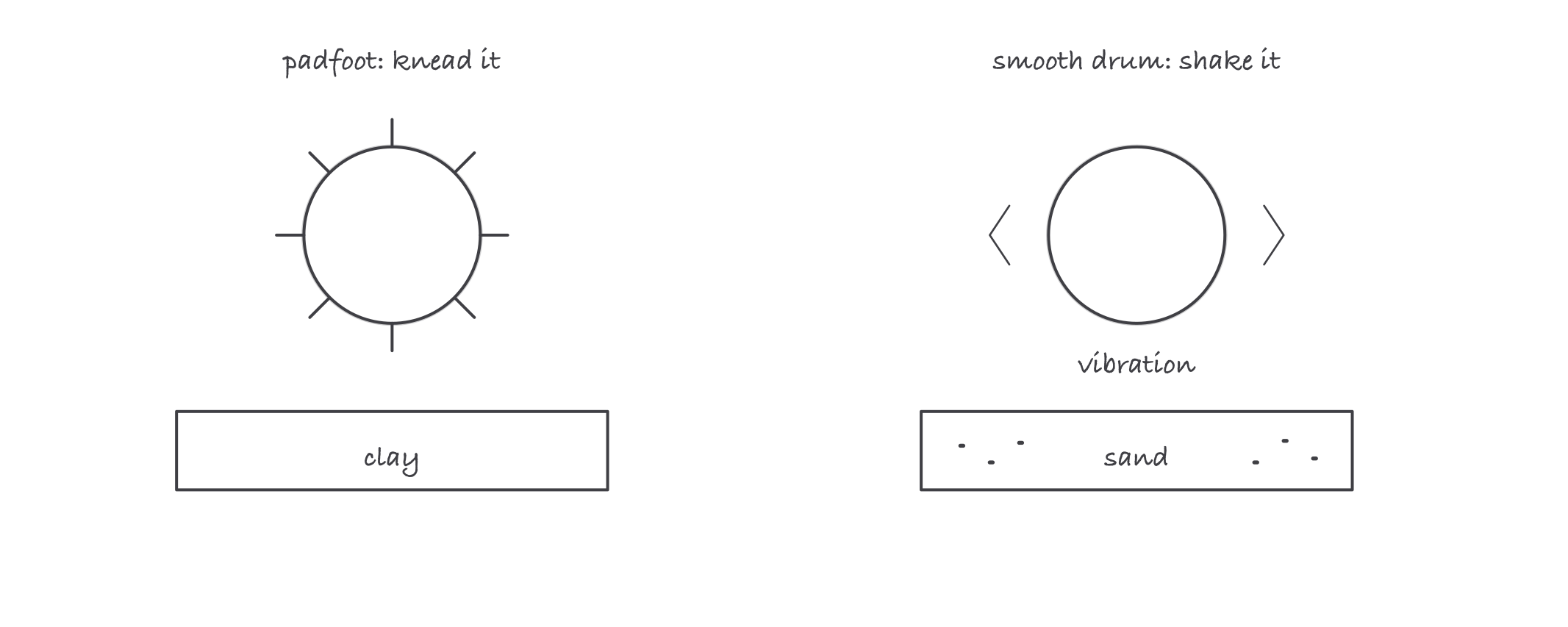
Clay gets kneaded by pads; sand gets shaken by a smooth vibrating drum. Swapping them wastes passes
Thin lifts, tested lifts
Compactive effort only reaches so deep, so fill goes in as lifts: layers thin enough for the machine to densify all the way through, each one compacted and often tested before the next is placed. The spec tells you the lift thickness and the target density.
The target is usually written as relative compaction: the density achieved in the field as a percentage of the soil’s maximum dry density from a laboratory Proctor test. “95 percent compaction” means the field measurement must reach 95 percent of that lab maximum. Moisture matters as much as effort: every soil has an optimum moisture content where it densifies easiest. Too dry and it will not consolidate; too wet and it pumps under the drum like rubber.
Worked example: a trench backfill that passes
A utility trench needs 2 ft of backfill, specified at 95 percent relative compaction in 8 in compacted lifts.
- Number of lifts: 24 in / 8 in = 3 lifts, each placed, compacted, and tested in turn.
- The lab Proctor for this soil says maximum dry density is 120 lb/ft³.
- The field density test on lift one reads 115.2 lb/ft³.
- Relative compaction: 115.2 / 120 = 0.96 = 96 percent. That beats the 95 percent spec, so lift two can go in.
Had the crew dumped all 24 inches and compacted from the top, the surface would test fine while the bottom two-thirds stayed loose. That is the failure that becomes a sunken trench patch next spring.
Where it bites
- The top of a thick lift lies. Compaction effort decays with depth, so a thick lift can pass a shallow test and still be loose underneath. The lift thickness in the spec is the fix; respect it.
- Vibrating clay accomplishes almost nothing. If the padfoot machine is on another job, the answer is to get it, not to make extra passes with a smooth drum.
- More passes stop helping. Each machine and lift combination reaches a density plateau; crews often prove pass counts with a test strip at the start of the job, then repeat the recipe.
- Watch vibration near structures. Vibratory rollers transmit energy into the ground; near buildings, fresh concrete, or shallow utilities, switch to static passes or smaller equipment per the plan.
- Moisture is a control, not a nuisance. Water trucks and discing exist because adjusting moisture toward optimum is cheaper than fighting soil that will never pass as placed.