Qualifications · Heavy Equipment
The NYC Hoisting Machine Operator License
Part of CCO Crane Operator Prep · step 17 of 21 · next: The CCO Lift Director Certification
In learning paths: CCO Crane Operator Prep
Assumes you know: NCCCO Certification: The Federal Gate
New York City does not accept national crane certification as the end of the story: to operate cranes and hoisting machines in the five boroughs, you need a Hoisting Machine Operator (HMO) license from the NYC Department of Buildings, layered on top of NCCCO certification. It is the clearest US example of the pattern this subject keeps returning to: the federal rule is the floor, and jurisdictions can build on it.
*Learn the Trades is a free study resource. We are not a licensing body, an authorized training provider, or an exam administrator. Reading this page does not award any card, license, or certification. Always verify requirements with the issuing authority linked in the sources.*Why it matters on the job
NYC crane work pays well precisely because this gate is steep: national certification, a DOB-approved course, and years of documented supervised experience inside a defined ladder. Operators who plan the ladder early hold a license that few competitors have. Operators who discover it late lose years re-sequencing their experience.
The shape of the license
Every HMO class shares the same skeleton:
- NCCCO certification as the prerequisite national credential.
- A DOB-approved 40-hour Hoisting Machine Operator course.
- Supervised experience, specific to the class you are applying for.
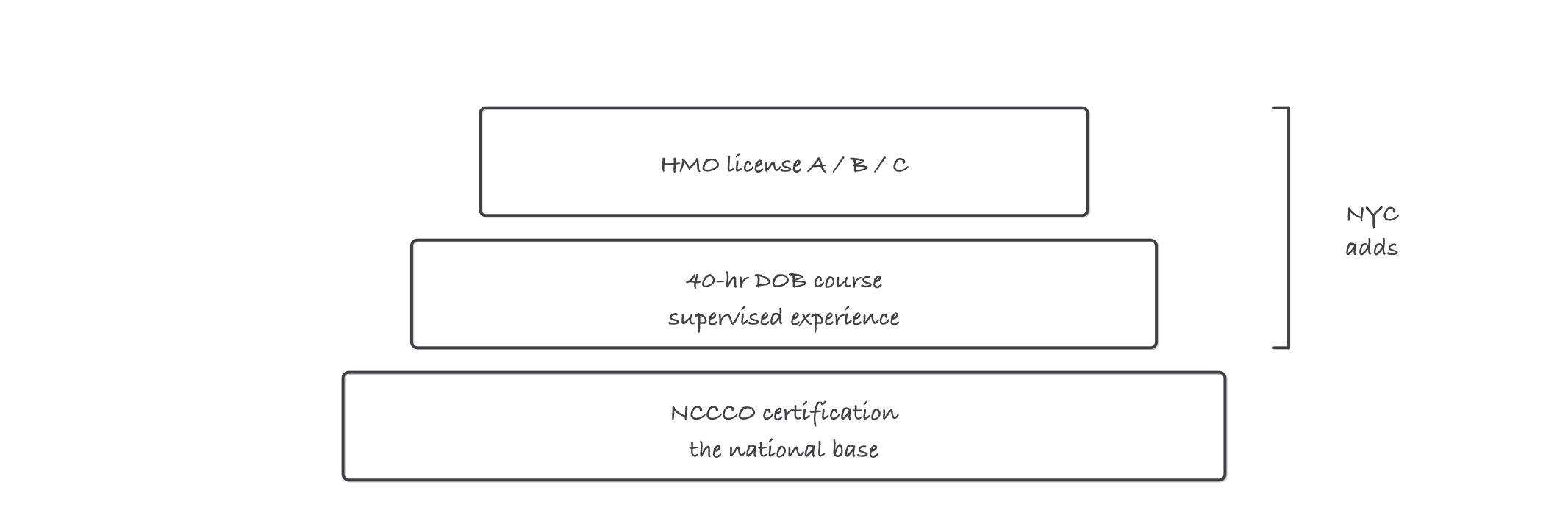
The NYC stack: national certification underneath, city requirements built on top
The three classes
- Class A covers cranes with booms under 200 ft. This is the entry crane license and the base of the ladder.
- Class B covers all cranes, with no boom limit. It requires holding Class A, plus 1 further year of experience on booms over 200 ft under the supervision of a licensed Class B operator, gained within 5 years of the application.
- Class C (C1, C2, C3) covers smaller hoisting machines, with subclasses defined by the city’s own machine definitions. The experience requirement is 2 years of supervised experience, including 1 year on wheel-mounted telescopic cranes with booms of 200 ft or less and rated capacity over 3 tons.
Read the ladder in Class B carefully: the year of over-200-ft experience must itself happen under a licensed Class B operator. The people who hold the top license are the only path to it, which is deliberate: the city wants big-boom experience formed inside its own supervision chain.
A concrete sequencing example: an operator who earns CCO certification and Class A in 2026, then works under Class B supervision on long-boom work through 2027, can assemble a Class B application with that year of experience inside the 5-year window. An operator who spends those years on short-boom work starts the Class B clock from zero.
Where it bites
- Classes are NYC definitions, not NCCCO designations. The 200 ft boom line and the C subclasses come from the city’s machine definitions. Do not assume your CCO specialty tells you which HMO class you need; check the DOB’s class pages against the actual machine.
- Experience must be supervised the way the class demands. Hours under the wrong supervision level do not count toward the ladder.
- The license renews on the DOB’s schedule. The renewal period is set by the DOB; check the current renewal requirements on the DOB licensing pages rather than assuming a cycle from other licenses.
- Applications are digital. Since 2024-10-16, licensing runs through DOB NOW: Licensing; paper-era guidance you find elsewhere may be stale.
Exam relevance
The national exams behind the prerequisite are the CCO exams covered in the NCCCO certification lesson. On top of that sits the DOB-approved 40-hour course and the DOB’s own application scrutiny of your documented experience. Treat your logbook as exam material: in NYC, the paperwork is the exam.
Verified requirements
| Where | Expires | Renewal | Continuing education |
|---|---|---|---|
| New York City | Yes | Confirm with issuer | Confirm with issuer |
Information comes from issuing-authority sources. Confirm current rules, fees and eligibility with the authority before acting.