Learn · Heavy Equipment
Crane Setup and Ground Conditions
Part of CCO Crane Operator Prep · step 11 of 21 · next: Crane Hand Signals and Communication
In learning paths: CCO Crane Operator Prep
Assumes you know: Reading Load Charts
The load chart from the last lesson assumes three things: the crane is level, the outriggers are set exactly as the chart page says, and the ground under them will not move. Setup is the work of making those assumptions true, and until they are true, every number on the chart is fiction.
Why it matters on the job
Cranes rarely fail mid-lift out of nowhere; they fail because of a decision made an hour earlier at setup. An outrigger punching into a backfilled trench, a machine a few degrees off level, a “fully extended” chart read over half-extended beams: each one quietly rewrites the chart without telling the operator. Setup is also front and center on the CCO practical exam, because examiners know it is where real lifts are won or lost.
Ground: the part of the crane you did not bring
An outrigger concentrates enormous load onto a small float (the foot). The ground has an allowable bearing pressure, and the crane does not care whether you know it. Setup means answering two questions:
What can this ground carry? Soil type, moisture, and compaction all matter, and the site should tell you. Responsibility for adequate ground conditions is shared with the site under OSHA’s crane rules, but the crew standing on it does the verifying.
What is under the surface? The dangerous failures are hidden: backfilled trenches and foundation excavations (recently disturbed soil that has already failed once), buried vaults and pipes, basements and voids near structures. Flat and dry on top proves nothing. Ask for the site plan, look for patch lines in pavement, and treat the area beside any new wall or utility run as suspect.
Mats and pads spread the load. Timber or synthetic mats turn a point load into a distributed one. The arithmetic is direct, and it is the worked example below.
Outriggers and level
Set them like the chart page. If the capacities you plan to use say outriggers fully extended, every beam is fully extended and pinned, floats down, tires clear of the ground, load off the suspension entirely. An intermediate position is a different chart page; using it with full-extension numbers is an overload you built in at setup.
Level within the manufacturer’s tolerance. The chart assumes a level machine. Out of level, the boom side-loads and swing forces change, and capacity falls off in ways the chart does not show. Check the machine’s level indicator and verify it, because indicators drift and mats settle: re-check after the first picks, not only before them.
Worked example: sizing the mat
The lift plan says the heaviest-loaded outrigger will see a 60,000 lb reaction. The site allows a ground bearing pressure of 2,000 lb per square foot.
- Required bearing area: 60,000 / 2,000 = 30 ft².
- The outrigger float alone is 2 ft × 2 ft = 4 ft². Pressure: 60,000 / 4 = 15,000 lb/ft², seven and a half times what the ground can carry. The float punches in.
- A 6 ft × 6 ft mat gives 36 ft². Pressure: 60,000 / 36 = 1,666.7, call it 1,670 lb/ft². Under the 2,000 allowable, with margin.
The mat did not make the crane stronger; it made the chart’s assumption about the ground true.
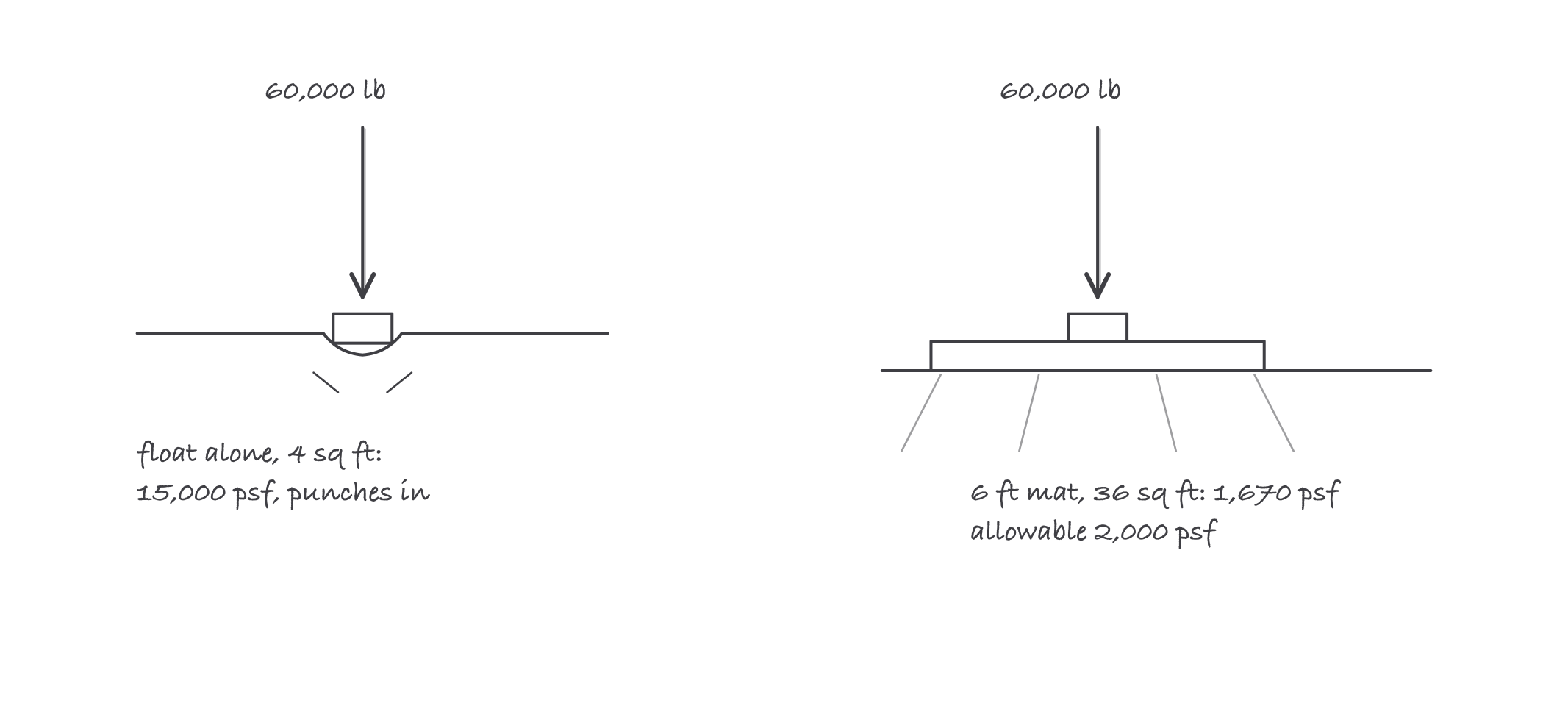
Same load, different area: the mat divides 60,000 lb over 36 sq ft and brings the pressure under what the ground allows
Where it bites
- “Fully set” beats “down.” Floats touching the ground is not set. Tires clear, weight on the outriggers, beams pinned at the chart position.
- Yesterday’s trench is today’s void. If the site was ever open there, treat it as weak until proven otherwise.
- Level is a live condition, not a checkbox. Mats seat, soil consolidates, and a machine that was level at 7 am may not be at noon. Re-verify after loading the ground.
- The mat must actually spread the load. A mat bridging a soft spot or set on uneven bearing carries the load on its edges, and the effective area collapses back toward the float size. Bed mats fully.
- Weather rewrites the ground. Overnight rain changes bearing capacity; what held Friday can fail Monday. Ground calls are always about the ground as it is now.
Exam relevance
The CCO practical exam grades setup behaviors directly (leveling, outrigger deployment, pre-operational checks) before a single test lift, and written exams carry setup and ground-condition questions in the site and operations domains. Examiners are looking for the sequence this lesson teaches: verify ground, match the chart configuration, level, then lift. Skipping steps on the exam costs points; on the job it costs the crane.
Verified requirements
| Where | Expires | Renewal | Continuing education |
|---|---|---|---|
| United States (federal) | Yes | 5 years | Confirm with issuer |
| California | Yes | 5 years | Confirm with issuer |
| Washington | Yes | 5 years | Confirm with issuer |
Information comes from issuing-authority sources. Confirm current rules, fees and eligibility with the authority before acting.