Business · Heavy Equipment
Operator Career Paths
Part of CCO Crane Operator Prep · step 20 of 21 · next: The CDL: Why Operators End Up Needing One
In learning paths: CCO Crane Operator Prep
Operating is a trade with an unusually wide fan of destinations: the same seat that starts you spreading fill can lead to finish grading with GPS machine control, a crane cab, running the lift plan, or running the crew. The Bureau of Labor Statistics puts the median wage for construction equipment operators at $58,320 a year (May 2024), projects about 4 percent growth from 2024 to 2034, and expects roughly 46,200 openings a year, mostly from operators retiring or moving up. Where you land inside that spread depends on which branch you take.
Why it matters on the job
Operators who drift take whatever iron the dispatcher has left; operators who choose a branch stack the specific hours, credentials and reputation that branch pays for. Every branch below starts from the same place: journey-level competence on common machines. The differences are what you add on top.
The branches
The precision specialist. Finish grading, GPS machine control, tight-tolerance work around utilities. No formal gate: the credential is your reputation for hitting grade without a checker, and the operators who hold it are the last ones laid off. The precision subject in this trade (grade reading, GPS machine control) is its curriculum.
The crane path. The one branch with a legal gate: crane operators on construction sites must be certified, which means written and practical exams, and BLS notes crane operators pass a skills test plus a written safety exam. Pay steps up accordingly, and the whole certification sequence (load charts, the CCO exams, the OSHA rule) sits in the cranes subject. In a few places the crane gate reaches wider than you expect: some states and cities require pile driver operators to hold a crane license.
The lift director. Cranes from the ground: the person in charge of planning and running the lift rather than pulling the levers. It is the natural step for senior crane people and riggers, and it has its own certification, covered in the lift director lesson.
The foreman. Supervision: scheduling machines and people, production rates, talking to engineers and inspectors. The operators who move here are the ones who understood the print, not only the machine. Usually paired with years of credibility on the iron.
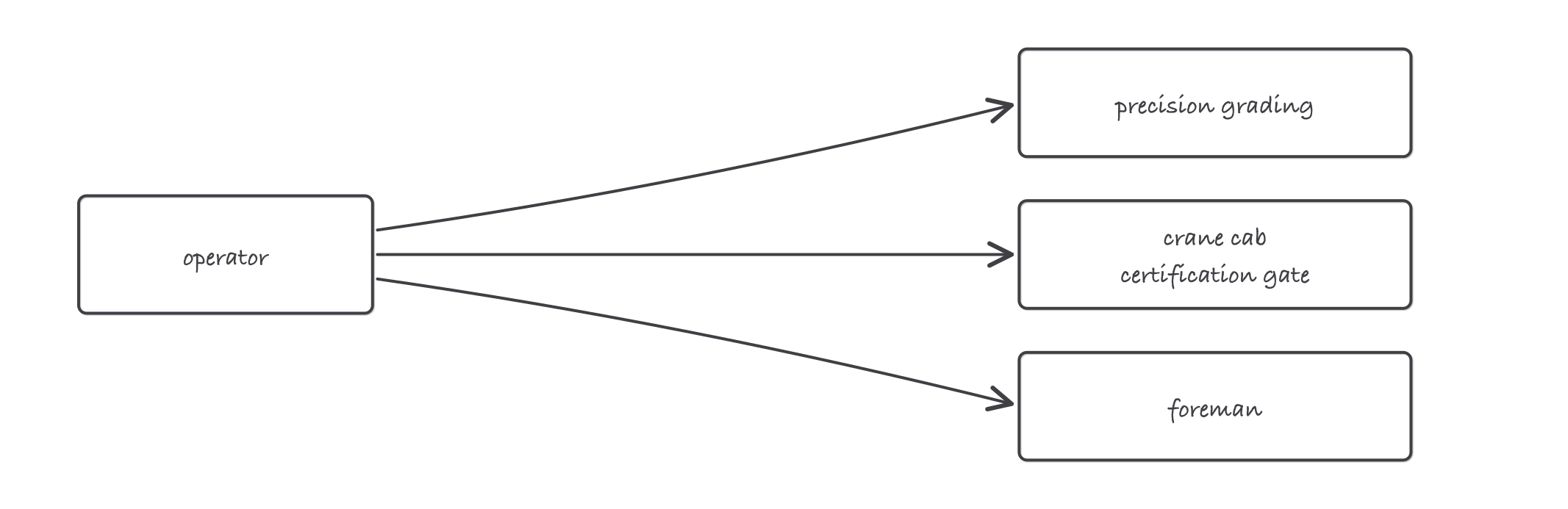
Same seat, three directions: precision work, the crane gate, or the crew
A note on the CDL
Whichever branch you take, expect the question “can you haul it?” BLS notes operators often need a commercial driver’s license to move their own equipment between sites, and the operators who hold one are more dispatchable for the same machine skills. The CDL lesson in this subject covers when the license is actually required.
Where it bites
- The median is not the offer. $58,320 is the national median across all construction equipment operators: region, union status and branch move real pay a long way in both directions. Use the number as a baseline, not a forecast.
- Waiting to be picked. Crane seats and foreman jobs go to people who asked for them and prepared; hours on a certification path or supervision experience rarely land by accident.
- Treating the crane gate as optional paperwork. The certification requirement is federal law, with employer duties on top. Read the OSHA crane operator rule lesson before planning that branch.
Exam relevance
No exam gates this lesson itself, but it is the map of which exams exist: the CCO exams on the crane branch, the lift director exams above it, and the CDL knowledge and skills tests for hauling. Pick the branch first; the exam list follows from it.