Qualifications · Fire Protection
NICET Special Hazards Certification (Levels I-IV)
Part of Sprinkler Fitter to NICET · step 20 of 21 · next: Texas Fire Sprinkler Licensing (SCR and RME)
In learning paths: Sprinkler Fitter to NICET
Assumes you know: Special Hazards Suppression Systems
NICET’s Special Hazards Systems certification is the four-level credential for technicians who work on clean agent, CO2, foam and other non-water suppression systems. Where the water-based tracks certify sprinkler and inspection work, this program covers the suppression agents themselves, the hydraulic flow of agents through their piping and nozzles, installation, servicing, and the applicable codes.
*Learn the Trades is a free study resource. We are not a licensing body, an authorized training provider, or an exam administrator. Reading this page does not award any card, license, or certification. Always verify requirements with the issuing authority linked in the sources.*Why it matters on the job
Special hazards is the smaller, more specialized lane of fire protection, and the certification is often what separates the technician trusted with a CO2 or clean agent system from the one who watches. Because the systems are engineered discharges rather than head-by-head water coverage, employers lean on the certification ladder to prove who can install and service them at each level of independence.
The four levels
Special Hazards Systems runs four levels, like NICET’s Layout track and unlike the three-level Inspection and Testing track. The pattern across levels is the standard NICET shape: early levels certify supervised, task-level competence; later levels certify independent work and supervision of others. Every level requires an exam plus a documented work history with performance measures verified by your employer, and Levels III and IV additionally require personal recommendations.
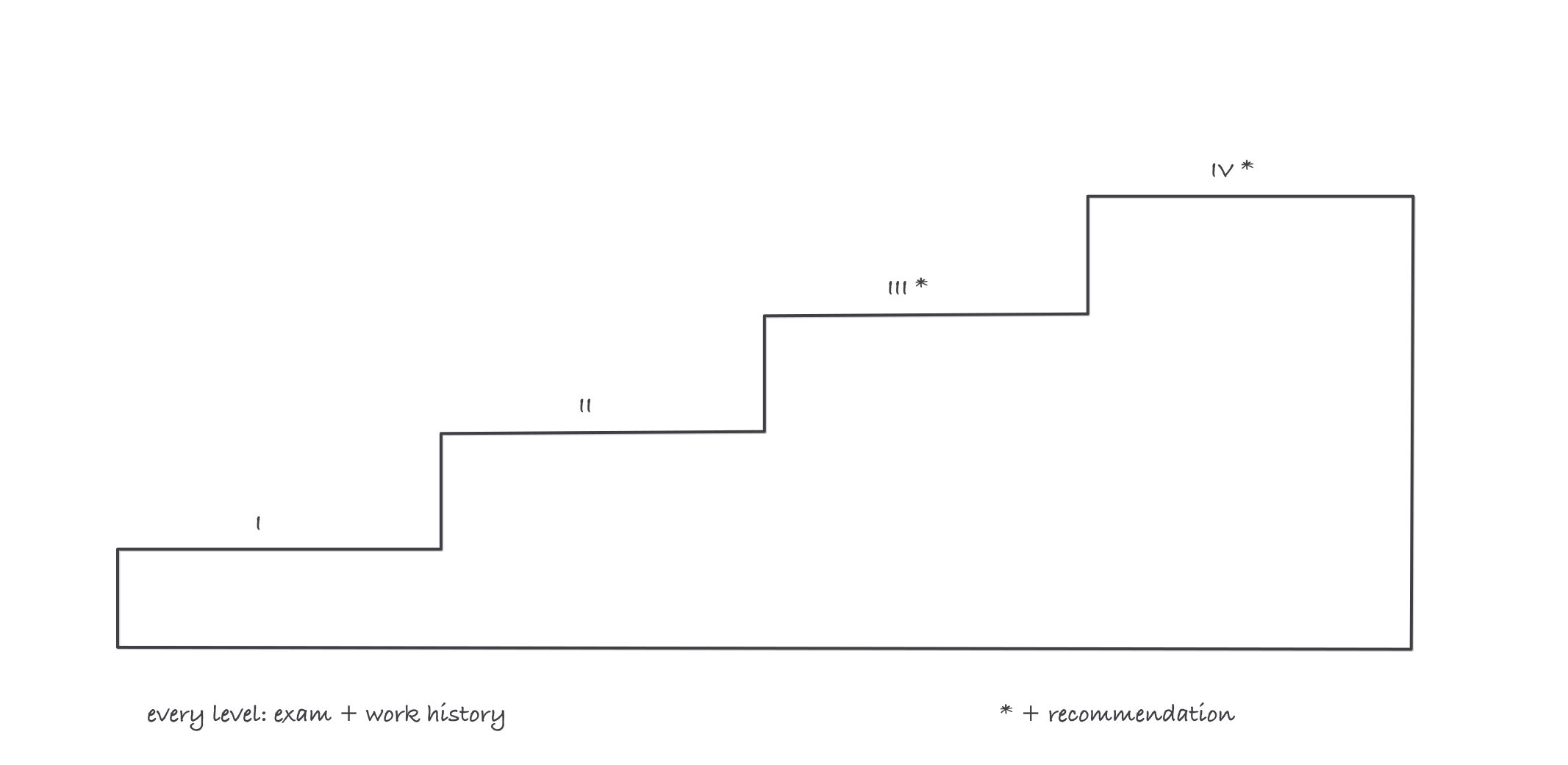
Four levels, each gated by exam plus verified work; recommendations join at III and IV
What the program tests
The exam content follows the discipline you met in the special hazards systems lesson:
- Suppression agents: the clean agent, CO2 and foam families, what each does, and where each belongs.
- Hydraulic flow of agents: how an engineered quantity of agent moves through pipe and nozzles in a single discharge event.
- Installation and servicing: putting systems in per their design and keeping them dischargeable for years.
- Applicable codes: the standards environment the systems live in.
Worked example: sequencing the credential
A technician on a suppression crew maps the climb. Level I is available early, while all work is supervised. Level II follows once his employer can verify the documented installation and servicing history the level requires. At Level III the recommendation requirement joins the exam and the work history, matching the shift to independent work. He also checks the calendar: with new exam versions expected Fall 2026, he schedules his next level either comfortably before the change or after it with updated study materials, not across it. The mechanics at every level are the same three ingredients: exam, verified experience, and, from Level III, recommendations.
Where it bites
- Four levels here, three on ITM. NICET tracks do not share a level count. Say the track name with the level: “Special Hazards Level II” means something; “NICET Level II” alone does not.
- Recertification is a cycle, not a formality. Certification expires on a three-year cycle with continuing professional development required.
- The 2026 exam transition. Prep material aligned to the old exams will age quickly once the Fall 2026 versions land. Verify which version you are studying for.
- Certification without licensing homework. Depending on your state, special hazards work can sit under a fire marshal program, a contractor classification, or municipal rules. The certification does not settle the licensing question: check the licensing lesson’s patterns against your jurisdiction.
Verified requirements
| Where | Expires | Renewal | Continuing education |
|---|---|---|---|
| United States (federal) | Yes | 3 years | CPD required each 3-year certification period |
Information comes from issuing-authority sources. Confirm current rules, fees and eligibility with the authority before acting.