Learn · Elevator
Periodic Inspections and Category Tests
Part of Elevator Constructor, Start to Finish · step 14 of 20 · next: Working Safely in the Hoistway
In learning paths: Elevator Constructor, Start to Finish
Assumes you know: ASME A17.1 Basics
An elevator stays legal to run through a recurring regime of periodic inspections and tests: mechanics perform the tests, inspectors witness and evaluate them, and the jurisdiction’s records show every unit’s standing. The shape of the regime comes from A17.1’s periodic test requirements as adopted by each jurisdiction, and in the field its rhythm goes by the category names: shorter-interval tests yearly, the heavyweight test on a multi-year cycle.
Why it matters on the job
This is where the maintenance program (previous lessons) meets the law. A unit that misses its tests can be ordered out of service regardless of how well it runs, and the tests themselves are the only moments the trade proves, with load and speed, that the safety systems from the machines lessons actually perform. For mechanics, test days are demanding rigging-and-procedure work; for QEI inspectors (next subject), witnessing them is the core of the job.
Inspections and tests are different events
- A periodic inspection is observational: an inspector examines the unit (machine space, car top, pit, doors, fixtures) against the code’s inspection items, on the jurisdiction’s schedule.
- A periodic test is operational: the crew makes the equipment demonstrate its protections, with the inspector witnessing. Tests are grouped by interval, and the field shorthand names them by category: Category 1 for the yearly no-load tests (safeties, governor operation, and related devices proven functional), and Category 5 for the roughly five-yearly full-performance test (rated load in the car, rated speed, governor tripped, safeties set, buffers struck, as applicable to the equipment). The exact intervals, applicability, and procedures come from the adopted code edition and the authority having jurisdiction, so the unit’s jurisdictional requirements, not the shorthand, govern.
Worked example: a Category 5 day on a traction unit
The heavyweight test, in its usual shape:
- Test weights arrive and are loaded to the car’s rated capacity (2,500 lb of weights for a 2,500 lb car, stacked and secured).
- With the inspector witnessing, the loaded car runs at rated speed, and the crew demonstrates the overspeed protections: the governor is tripped and the safeties set, stopping the loaded car on the rails (the exact chain the safeties lesson taught, now proven with load).
- Buffer tests follow where required: the car (and counterweight, as applicable) is run onto its buffer to demonstrate the stop.
- Brakes, leveling, and related items are proven per the procedure; results, tags, and records are completed, because an untagged, unrecorded test does not exist to the jurisdiction.
- The safeties are released, the rails and marks inspected, and the unit returned to service.
A clean Category 5 is choreography: weights, riggers, an inspector’s time, and a building’s patience, all scheduled around one afternoon of controlled violence done safely.
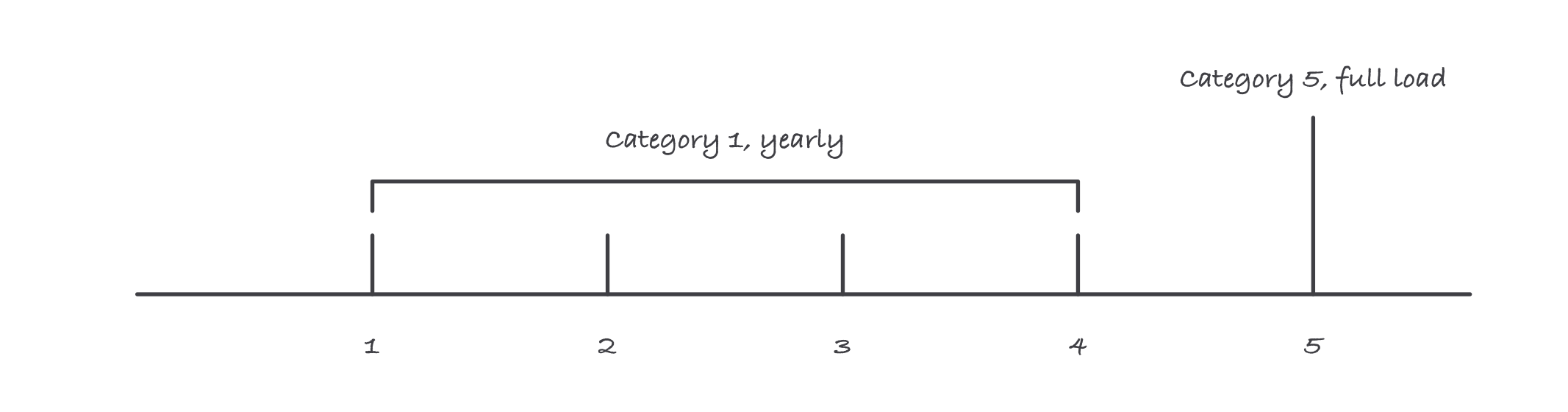
The rhythm of a unit’s legal life: routine tests every year, the full-load proof on the long cycle
Where it bites
- Category names are shorthand, not citations. Write reports and plan work from the adopted code’s test table and the AHJ’s rules; the category label is how crews talk, not what the law says.
- Test day finds what maintenance missed. A safety that will not set or a governor that will not trip on test day is a failed test with an inspector watching. The maintenance program exists so these systems are exercised and examined long before the witness arrives.
- Weights are their own hazard. Thousands of pounds of test weights moved through a lobby and loaded into a car is rigging work with the public nearby. Plan it with the same seriousness as the test itself.
- Records are the product. The inspector’s report and the test tags are what the jurisdiction, the insurer, and the next mechanic rely on. A passed test with sloppy paperwork is half a test.