Learn · Elevator
Escalators and Moving Walks
Part of Elevator Constructor, Start to Finish · step 8 of 20 · next: Machine-Room-Less Elevators and Modernization
In learning paths: Elevator Constructor, Start to Finish
Assumes you know: Elevator Types: Traction and Hydraulic
An escalator is not an inclined elevator. It is a continuous machine: an endless loop of steps pulled by chains around the incline, with a handrail loop driven to match and a combplate where the moving steps meet the fixed floor. Everything about maintaining one (the checks, the safety devices, the injuries it can cause) follows from that continuous motion.
Why it matters on the job
Escalators and moving walks sit in A17.1 alongside elevators, ride the same service contracts, and belong to the same mechanics, but they fail differently and hurt people differently. Elevator injuries mostly involve falls and doors; escalator injuries are entrapments at the machine’s moving edges (combplates, skirts, handrail entries), with children overrepresented. The public walks straight into this machine with no doors in between.
The machine under the steps
- Steps and step chains: each step is a wheeled truck riding tracks, pulled by a step chain on each side. The track geometry flattens steps into a moving floor at each end and folds them into stairs on the incline. Below the visible steps, the loop returns underneath.
- The drive: a machine (typically in the upper landing’s machinery space) drives the step chains through a main drive shaft; the same drive powers the handrails so their speed tracks the steps.
- Combplates: toothed plates at each landing that mesh with grooves in the step surface, so objects are combed off the step as it submerges. Broken comb teeth defeat that combing.
- Skirts and clearance: the panels beside the steps. The step-to-skirt gap is a code-controlled clearance, because a shoe drawn against the skirt can wedge into an oversized gap.
- Moving walks: the same idea with flat pallets or belt instead of stepped treads, for horizontal or gently inclined travel.
The safety devices
Escalators carry devices that stop the machine when its geometry is violated: skirt obstruction devices, handrail entry devices (where the handrail dives into the balustrade), missing-step and step-level devices, broken step-chain and drive-chain devices, combplate impact devices, and emergency stop buttons at the landings. Maintenance proves these devices; inspection witnesses them.
Worked example: checking speeds with a stopwatch
A common contract speed for escalator steps is 90 fpm, and the handrail must track step speed closely (a slow handrail slowly pulls a rider’s hand behind them; a fast one tugs them forward). Chalk-mark a step and a point on the handrail, then time each mark over a measured run:
- The step mark travels 30 ft in 20 s: speed = 30 / 20 = 1.5 ft/s × 60 = 90 fpm.
- The handrail mark travels 29 ft in the same 20 s: speed = 29 / 20 = 1.45 ft/s × 60 = 87 fpm.
- The handrail is running 3 fpm slow (87 against 90, a 3.3 percent lag). A lag like that points at handrail drive wear or tension, and it gets corrected against the code’s tolerance, not eyeballed.
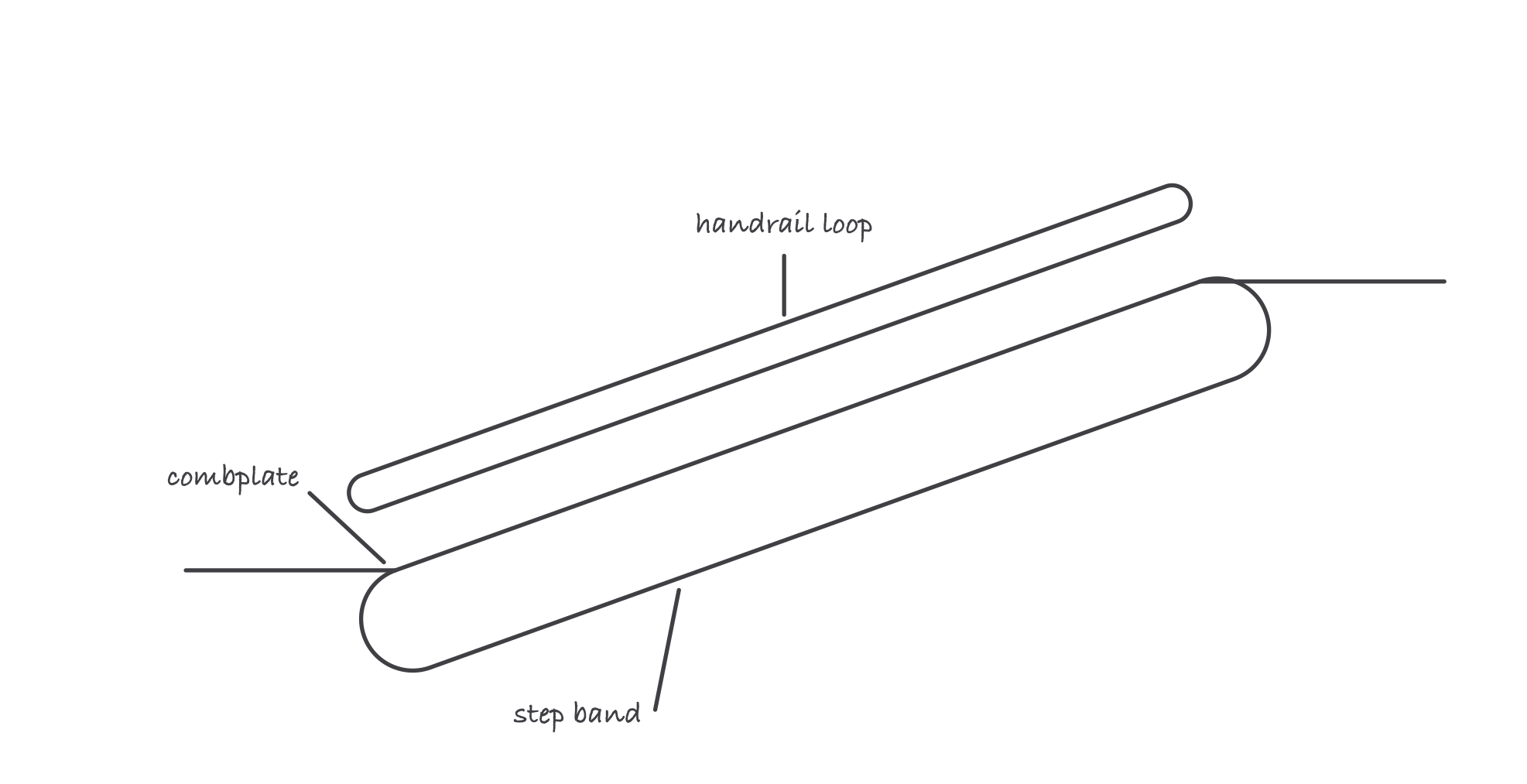
A continuous loop of steps with a matched handrail loop: the combplates are where moving meets fixed
Where it bites
- “It’s an inclined elevator” fails immediately. No car, no hoistway, no leveling: a different machine with its own A17.1 requirements and its own inspection items (combplates, handrail speed, skirt clearance among them).
- A stopped escalator is not automatically safe stairs. Step heights at the ends are wrong for walking, and an unexpected restart is the hazard barricades exist for. Control the machine before anyone walks it.
- Skirt and comb condition is public-safety work. Worn skirt panels, missing comb teeth, and oversized clearances are entrapment mechanisms. Treat them as urgent findings, not cosmetic ones.