Learn · Elevator
Door Operators and Equipment
Part of Elevator Constructor, Start to Finish · step 5 of 20 · next: Safeties and Governors
In learning paths: Elevator Constructor, Start to Finish
Assumes you know: Hoistway Anatomy
The door operator is the motor-driven mechanism on the car that opens and closes the doors, and doors are where elevator service work actually lives: most callbacks trace to the door system. Understand one principle and the whole system falls into place: the car door is powered, and the hoistway door only moves because the car door drags it along.
Why it matters on the job
Door equipment takes more abuse than anything else on the unit (every trip means door cycles, and every hurried passenger means an impact on the reopening device). A mechanic who can read the door system methodically clears the most common callbacks in the trade.
One operator, two doors
The door operator rides on the car top and drives the car door through an arm or belt linkage. At a landing, a clutch (or vane) on the car door engages rollers on the hoistway door, so both doors move as one. Between floors the clutch disengages, which is why hoistway doors stay shut when no car is behind them.
That coupling explains a classic symptom: a unit that runs fine but scrapes, bangs, or stalls its doors at one particular floor has a landing-side problem at that floor (rollers, track, or interlock), not an operator problem. The operator is the same at every landing; the hoistway door is not.
The two proving devices, and why they differ
- The hoistway door interlock does two jobs: it mechanically locks the landing door shut, and it electrically proves the door is closed and locked before the car may run.
- The car gate switch does one job: it electrically proves the car door is closed. It does not lock anything.
Both sit in the safety circuit that must be complete before the controller allows movement (the controllers lesson wires this up fully). The distinction between locking-and-proving and proving-only is exam material and callback material alike.
Reopening devices
Modern doors reverse on an infrared light curtain across the opening; older equipment used a mechanical safety edge, and operators also limit closing force and speed. These devices protect the public, which means a defeated or failing reopening device is never a “works fine, leave it” item: it gets fixed.
Worked example: the door callback, in order
A car sits at a floor with doors open and will not run. Work the chain, not the guess:
- Watch a close cycle. Doors close fully and the car still will not run: suspect the proving side (interlock contact or gate switch). Doors will not finish closing: suspect the mechanical side.
- Doors stall or reopen near fully closed: check the reopening device for a blocked or failed light curtain, then the door track and gibs for binding at this landing.
- Symptom follows one landing only: inspect that landing’s rollers, clutch engagement, and interlock. Symptom appears at every landing: work on the car side (operator adjustment, gate switch).
The order matters. Each step splits the door system in half, which is exactly the troubleshooting method the maintenance lessons formalize.
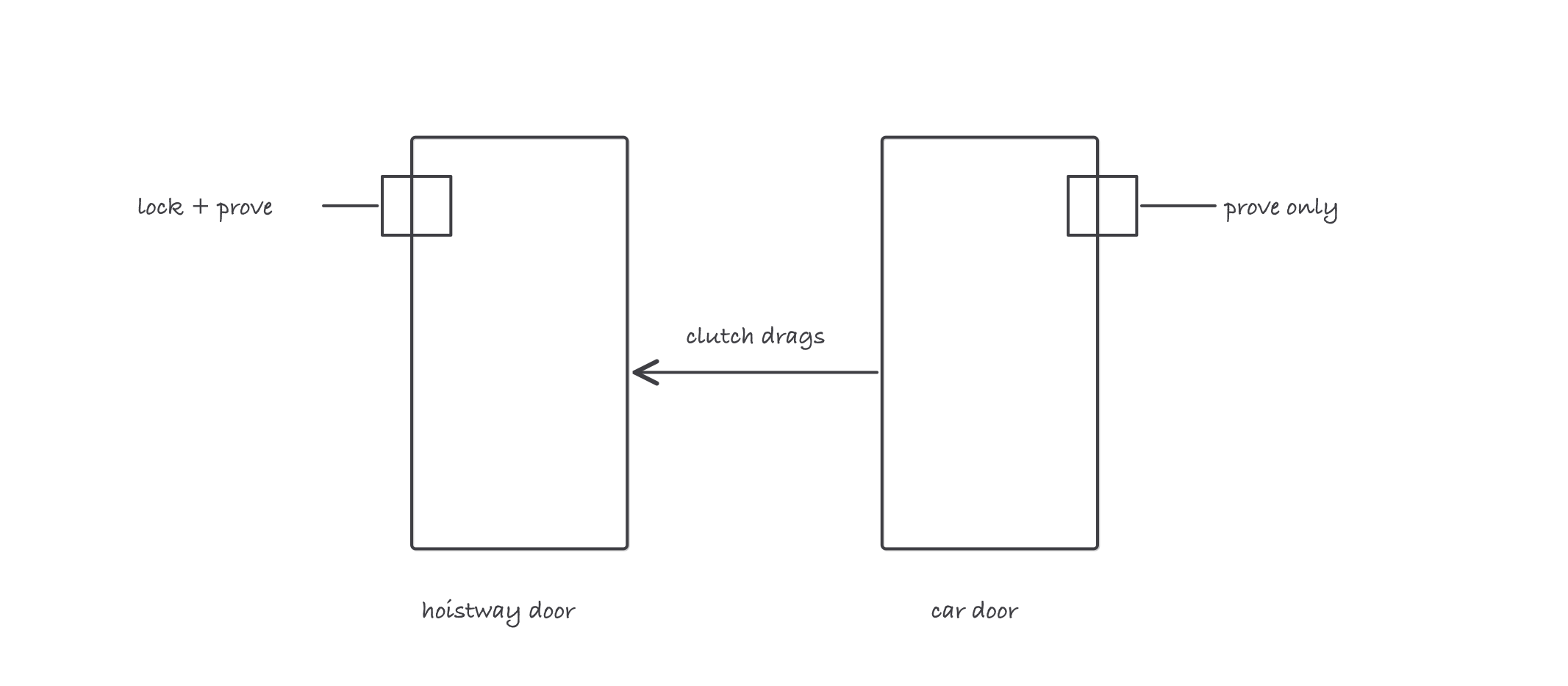
The powered car door drags the hoistway door; the interlock locks and proves, the gate switch only proves
Where it bites
- Interlock and gate switch are not interchangeable words. One locks and proves the landing door; the other only proves the car door. Diagnosis and exams both turn on the difference.
- The hoistway door is a fire and fall barrier. An interlock that lets a landing door open without the car present is among the most dangerous conditions in the trade. It comes out of service, immediately.
- Door timing hides mechanical causes. Before touching operator settings, clean and inspect tracks, sills, and rollers. Grit in a sill produces symptoms that look electronic.