Learn · Elevator
Safeties and Governors
Part of Elevator Constructor, Start to Finish · step 6 of 20 · next: Elevator Controllers
In learning paths: Elevator Constructor, Start to Finish
Assumes you know: Traction Machines and Roping
A traction elevator cannot fall the way people imagine, because a mechanical chain with no electronics in it is watching the speed: the overspeed governor and the car safety. If the car runs too fast, the governor trips, and through nothing but ropes, linkages, and wedges, the car clamps itself to its guide rails.
Why it matters on the job
This system is why the public rides elevators without thinking about it, and it is equipment you maintain, inspect, and periodically test for witnesses (the inspections lesson covers the test regime). It is also the correction to a myth repeated by passengers and by some new mechanics: the machine brake does not catch a falling car. The brake holds a stopped car. Overspeed belongs to the governor and safety.
The players
- The governor is a sheave-and-flyweight device, typically in the overhead, driven by its own dedicated rope loop that runs down to the car and back over a tensioning sheave in the pit. The car moves, so the governor spins; governor speed always mirrors car speed.
- The safety is a set of jaws or rollers mounted in the car frame at the guide rails, held clear of the rails in normal running, connected to a lifting linkage.
- The governor rope ties them together: it is both the governor’s drive and the safety’s trigger line.
The chain of events
Suppose a car loses control going down and accelerates past its contract speed:
- The car overspeeds, and the governor, driven by its rope loop, overspeeds with it.
- First response is electrical: at a set speed above contract speed, the governor opens its overspeed switch, cutting power to the machine and dropping the brake. On most events, this alone ends the story.
- If speed keeps rising, the governor’s flyweights swing far enough to trip its rope-gripping jaws. The governor seizes its own rope.
- The car keeps moving, but the gripped governor rope now cannot move with it. The rope pulls the safety linkage on the car frame.
- The linkage drives the safety’s wedges or rollers into contact with the guide rails. On a progressive safety the grip builds over a designed sliding distance, bringing the car to a controlled stop; instantaneous safeties (low-speed equipment) grab at once.
- Setting the safety opens another switch, so the car cannot restart until a mechanic responds, investigates, and releases it.
Every step after the overspeed switch is mechanical. No power, no software, and no operator is required, which is the entire design philosophy.
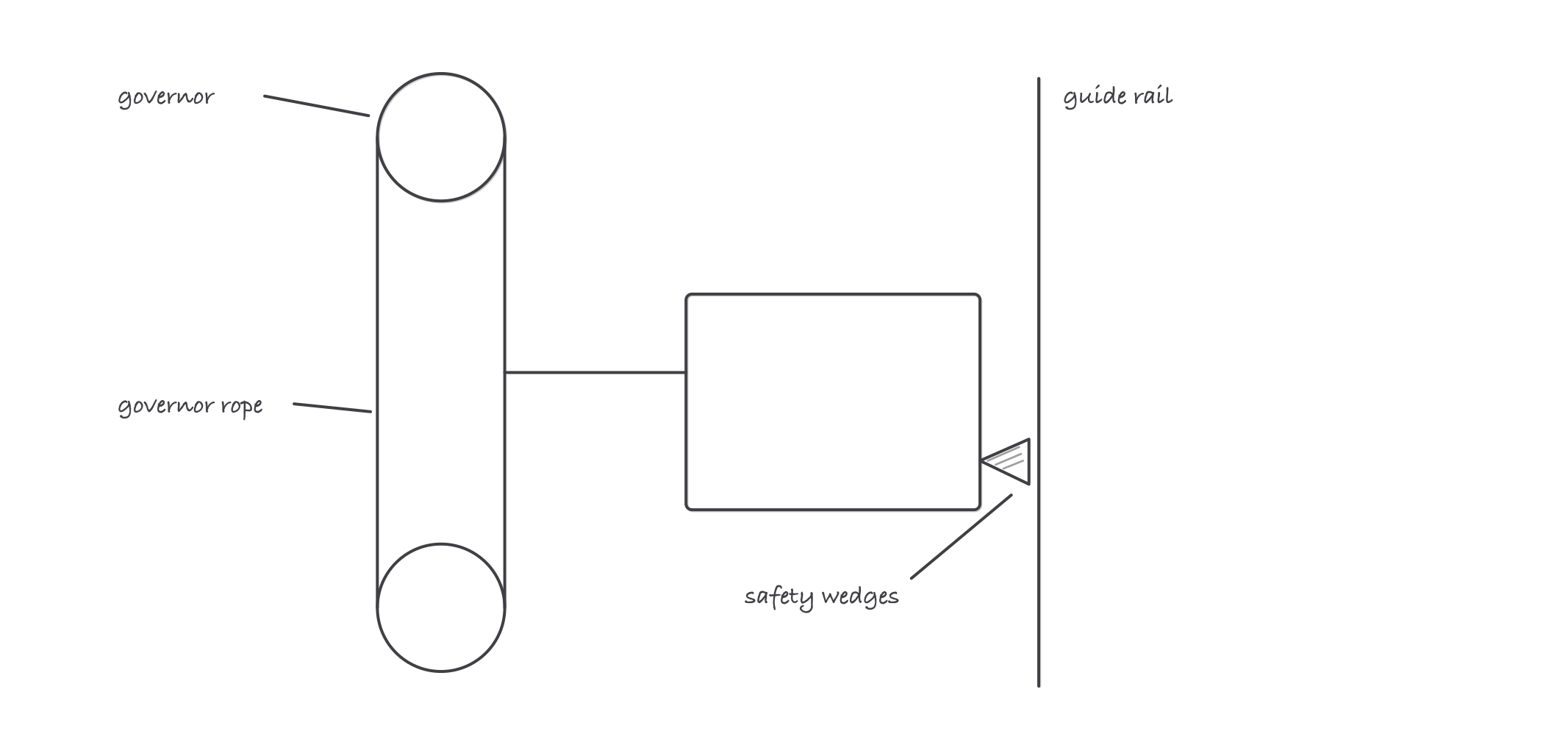
One rope loop, one linkage, one grip on the rails: the mechanical chain that catches an overspeeding car
Where it bites
- “The brake stops a falling car” is the wrong model. The brake is a holding device. Say it wrong on an exam or in a mechanic interview and it costs you.
- The counterweight fights the fall too. With ropes intact, a loaded car cannot free-fall; the counterweight and machine resist it. The safety exists for the cases beyond that, and for the counterweight’s own overspeed protection where the code requires it.
- A tripped safety is evidence. The car stopped hard for a reason. Find the cause of the overspeed before releasing the safety and returning the unit to service; resetting without diagnosis rearms the failure.
- The governor rope is part of the safety system. Its condition, tension, and seal matter as much as the suspension ropes. A painted, seized, or mis-tensioned governor system is a disabled safety wearing a working one’s clothes.