Business · Elevator
Getting Into the NEIEP Apprenticeship
Part of Elevator Constructor, Start to Finish · step 16 of 20 · next: The CET Certification
In learning paths: Elevator Constructor, Start to Finish
The main door into the elevator trade is the IUEC apprenticeship, schooled by NEIEP (the National Elevator Industry Educational Program). Entry runs through a local union recruitment, an aptitude test, and a ranked interview, and the apprenticeship that follows is 4 to 5 years of paid work plus classroom study, finishing at the Mechanic Exam.
Why it matters on the job
Elevator constructors are among the highest-paid workers in the construction trades: the Bureau of Labor Statistics reports a median wage of $106,580 for elevator and escalator installers and repairers (May 2024), with employment projected to grow 5 percent from 2024 to 2034 and roughly 2,000 openings a year. Pay like that with no degree requirement makes entry competitive, and understanding how recruitment actually works is a real advantage.
How you actually get in
You apply to an IUEC Local’s recruitment, not to NEIEP. NEIEP is the joint labor-management educational trust that runs the schooling; the IUEC (International Union of Elevator Constructors) is the union whose Locals hire apprentices. Writing to NEIEP asking for a job misunderstands the structure.
Recruitment is local and intermittent. Each Local opens recruitment only when its ranked list is exhausted or has expired (lists run for two years). There is no national, always-open application. Watch the Locals in every region you would work in, and be ready when a window opens, because it will close.
The gate is the EIAT (Elevator Industry Aptitude Test): reading, mechanical aptitude, and math, pass at 70 percent. Passing does not admit you; it earns you the interview. Candidates are then scored and ranked, and Locals offer apprenticeships from the top of the list as work demands. “Pass the test and you’re in” is false, and repeating it to hopeful applicants is unkind. The EIAT gets its own preparation lesson.
The apprenticeship itself
- Duration: 4 to 5 years, employed and paid from the first day, with wage steps as you progress.
- Classroom: 144 hours per year across 8 semesters of NEIEP coursework (electrical theory, safety, equipment, code among the subjects).
- On the job: about 2,000 hours per year working under mechanics, which puts the completed apprenticeship in the region of 8,000 hours.
- The finish line is an exam, not a birthday. Completing the hours and semesters qualifies you to sit the Mechanic Exam; passing it is what makes you a mechanic. In states that license elevator mechanics, the state license is a further, separate step (covered later in this subject).
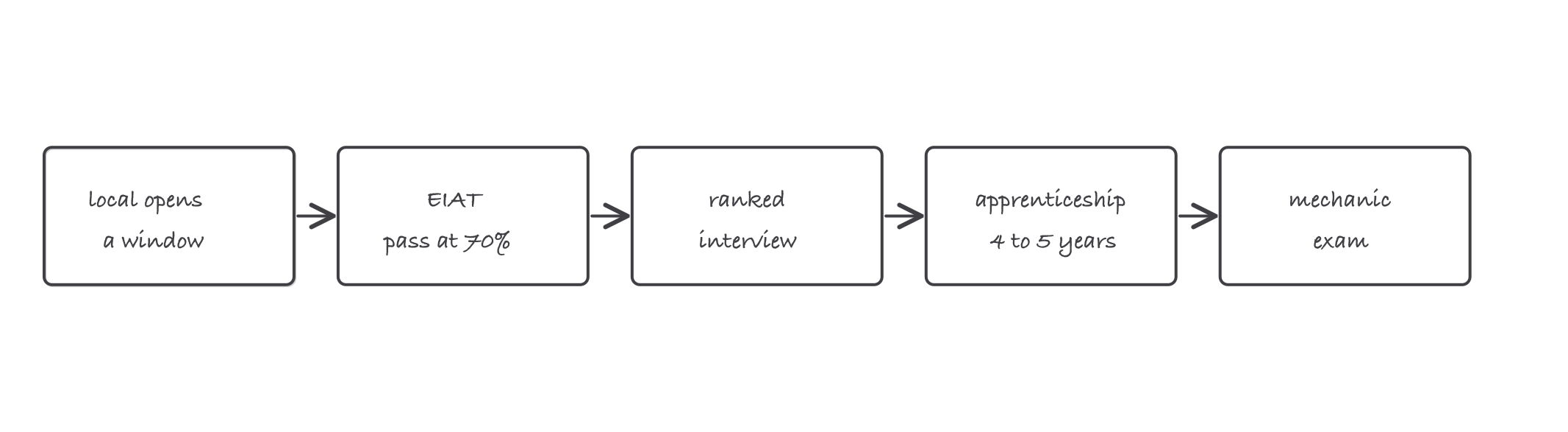
Local window, aptitude test, ranked list, then 4 to 5 years of earning while learning
Where it bites
- NEIEP is not the union, and neither is it hiring you. Apply through IUEC Local recruitments. Know the difference before an interviewer asks whether you do.
- The ranked list is the hard part. Plenty of applicants pass the EIAT. Interview scoring, and how deep the Local dips into its list, decide who works. Treat the interview as the competition it is.
- Two years, then the list dies. If a Local’s list expires before your rank comes up, you reapply from zero at the next recruitment. It stings, and it is normal; apply broadly if you can travel.
- Apprentice does not equal future mechanic automatically. The Mechanic Exam at the end is real, and the classwork through 8 semesters is cumulative. Treat the schooling as seriously as the tools.