Learn · Elevator
Elevator Types: Traction and Hydraulic
Part of Elevator Constructor, Start to Finish · step 1 of 20 · next: Hoistway Anatomy
In learning paths: Elevator Constructor, Start to Finish
An elevator is either pushed from below or hauled from above. Hydraulic elevators push: a pump drives oil into a cylinder and the rising piston lifts the car. Traction elevators haul: steel ropes run over a driven sheave with a counterweight on the far end. Nearly every unit you will ever work on belongs to one of these two families, and building height usually decides which one you are standing in.
Why it matters on the job
The family decides the machine you maintain, the faults you chase, and the tests an inspector witnesses. A hydraulic callback points at the valve, the pump, and the oil; a traction callback points at ropes, brake, and drive. Service routes mix both, so you diagnose faster the moment you can read a unit’s family from the machine space and the paperwork.
Hydraulic: pushed from below
A motor-driven pump forces oil into a jack (the cylinder and piston assembly); the piston extends and lifts the car. Down travel needs no motor at all: a valve meters oil back to the tank and the car descends under its own weight. That one-way power flow is the hydraulic signature. Up-direction faults implicate the pump, motor, and valve together; down-direction faults implicate the valve alone.
Hydraulics dominate low-rise buildings (roughly two to six landings). Over short travel a jack is economical, but speeds stay modest, and travel is limited by how much piston the design can extend or bury. The design runs out of road as buildings grow.
Traction: hauled from above
Ropes pass over a grooved drive sheave, and friction between rope and groove (traction, the effect the family is named for) moves the car. The far end of the ropes carries a counterweight sized to balance the car plus part of its rated load. The machine does not lift the whole car: it works against the difference between the two sides.
Here is the arithmetic. A car weighs 5,000 lb empty and is rated for 2,500 lb of load. A common counterweight sizing is car weight plus 40 percent of rated capacity:
- Counterweight = 5,000 + (0.40 × 2,500) = 5,000 + 1,000 = 6,000 lb
- Empty car: 5,000 lb against 6,000 lb, a 1,000 lb imbalance, counterweight side heavy
- Fully loaded car: 7,500 lb against 6,000 lb, a 1,500 lb imbalance, car side heavy
The machine only ever works against the imbalance plus friction, never the full 7,500 lb. That balance is why traction serves tall buildings efficiently, and it is the first picture to hold when you reason about loads in the hoistway.
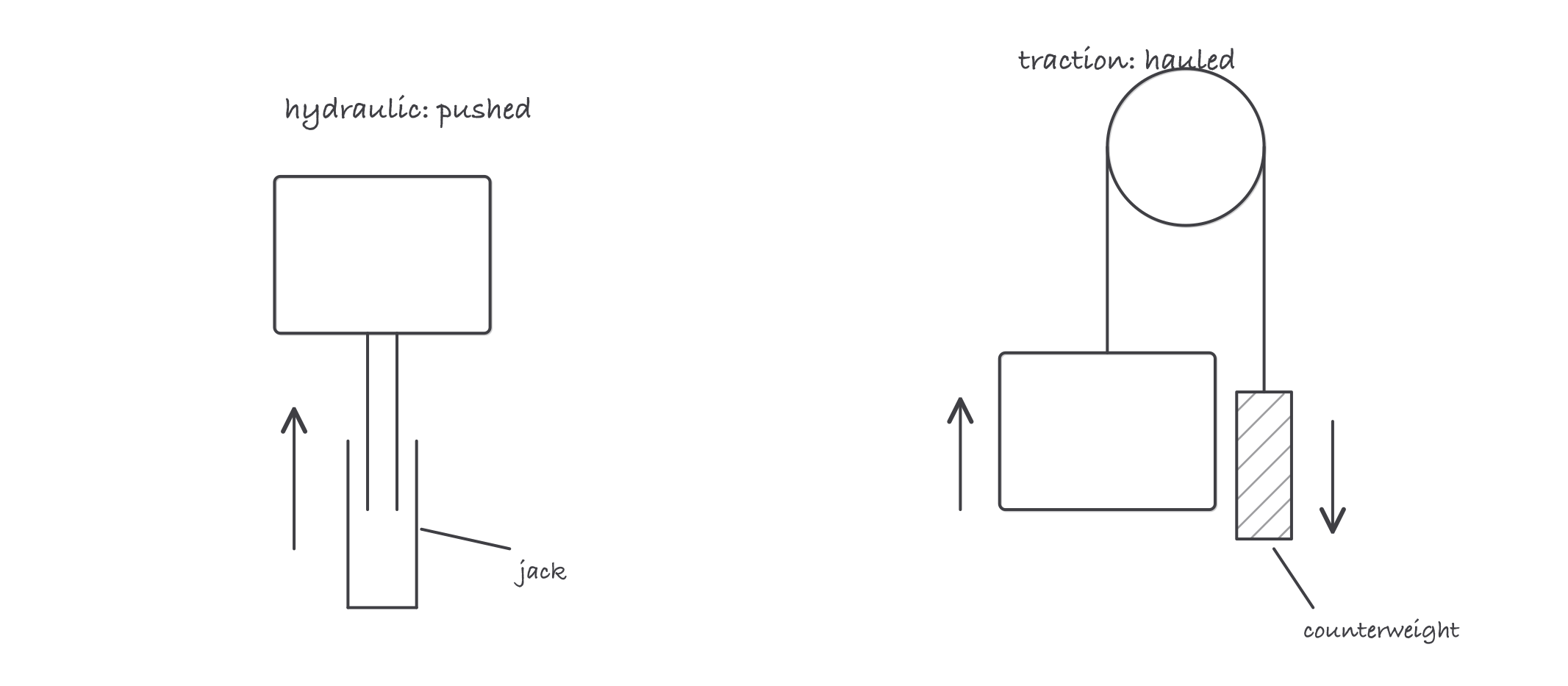
Pushed from below or hauled from above: the two families in one glance
Where it bites
- Traction versus hydraulic is a height decision, not a quality tier. Customers assume hydraulic means cheap or outdated. It means low-rise economics, nothing more.
- Roped hydraulics blur the line. Some hydraulic designs rope the car off the piston to extend travel. Ropes do not make it a traction unit: the family follows the power source, and the power source is still the jack.
- Modern traction hides its machine. Machine-room-less designs (their own lesson later in this group) put the traction machine inside the hoistway, so “no machine room” no longer means hydraulic.