Learn · Elevator
Machine-Room-Less Elevators and Modernization
Part of Elevator Constructor, Start to Finish · step 9 of 20 · next: Accessibility Lifts and Dumbwaiters
In learning paths: Elevator Constructor, Start to Finish
Assumes you know: Traction Machines and Roping
A machine-room-less (MRL) elevator still has a machine. The MRL idea is architectural, not mechanical: a compact gearless traction machine mounts inside the hoistway (usually at the top, on the rails or the structure), the controller moves to a cabinet at a landing, and the building gets its machine-room floor space back. For the mechanic, the physics is unchanged and the access is transformed.
Why it matters on the job
MRLs are now routine in new low- and mid-rise traction work and in modernizations, so adjusters spend their careers around them. Every procedure a machine room used to host (drive work, brake work, rescue) had to move somewhere, and knowing where it moved is the difference between confident work and improvisation.
What actually changed
- The machine: a compact gearless unit with a permanent-magnet motor, driving the same ropes-and-counterweight system as any traction elevator (the traction-machines lesson applies in full). It sits in the hoistway overhead, reached from the car top or a platform, per the design.
- The controller: in a cabinet at or near the top landing, often built into the entrance frame. Diagnostics, drive parameters, and the safety string all terminate there, at the landing, in public space.
- The work positions: maintenance that was standing-in-a-room work becomes car-top work under the trade’s access ritual (Working Safely in the Hoistway), planned around the car’s position.
Rescue is the procedure that changed most
In a machine room, entrapment rescue meant working the brake and moving the car from the room. On an MRL there is no room to stand in, so manufacturers provide a landing-based rescue arrangement: brake-release and car-movement controls (electrical or mechanical, per design) operated from the controller cabinet, with car position indicated at the cabinet. The steps are manufacturer-specific and sequence matters, which is why MRL rescue is trained per product and posted per unit, not improvised from elevator instinct.
Walk one generic shape of it: passengers confirmed calm and clear of the doors, unit taken out of service, car position read at the cabinet, brake lifted in controlled bursts so the imbalance (that counterweight arithmetic from the elevator-types lesson) drifts the car to a landing zone, brake reset, doors opened. Every burst is controlled because an unbalanced car moves on its own the moment the brake lifts.
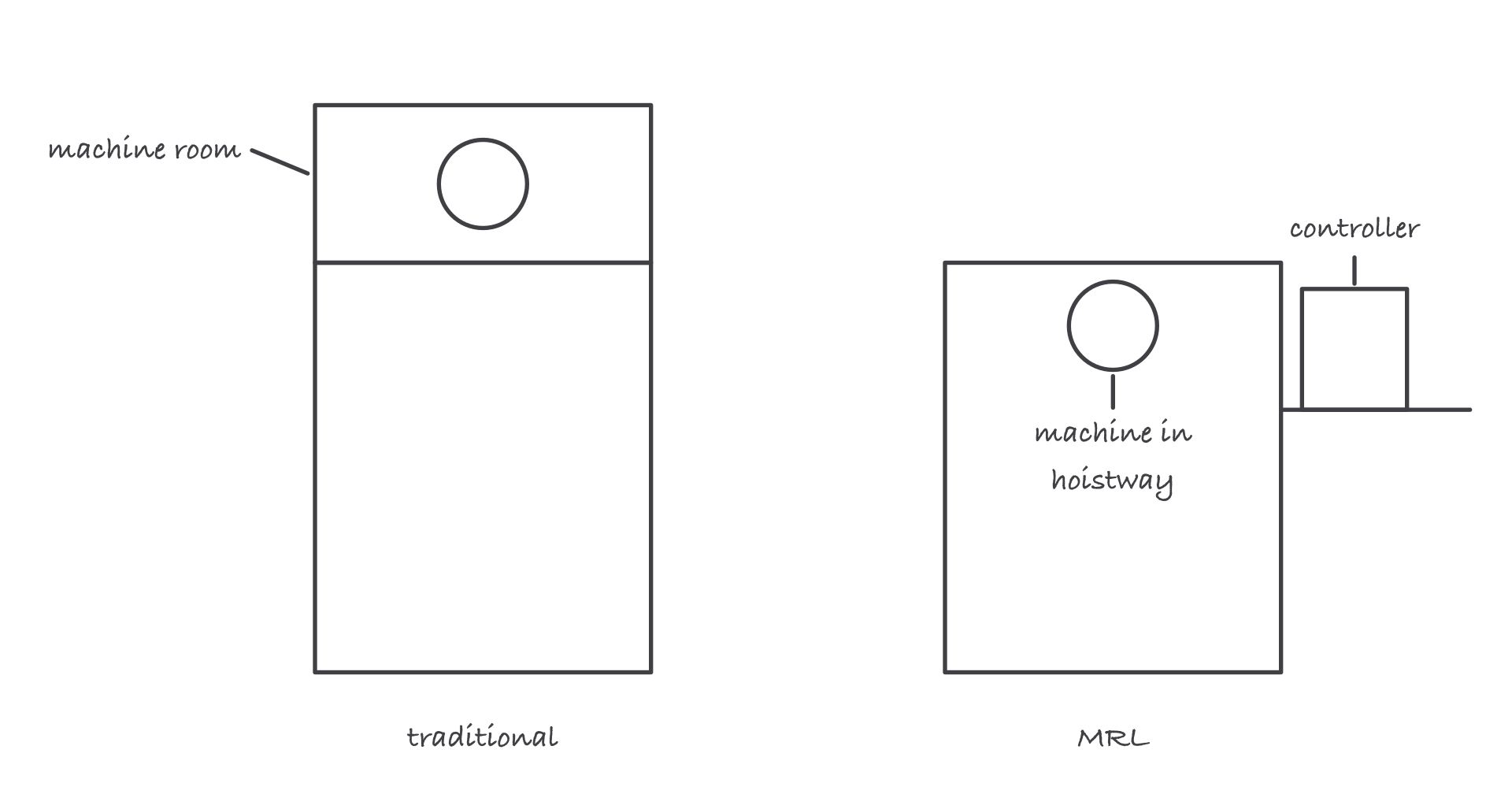
Same ropes, same counterweight: the machine moved into the hoistway and the controller moved to a landing cabinet
MRLs and modernization
Modernization (replacing a unit’s machine, drive, and controller while keeping the hoistway and rails) is where many MRLs enter old buildings: a geared machine and its machine room give way to a compact gearless unit in the overhead, and the freed room becomes building space. Modernization work is adjuster-heavy: new drive, new controller, new parameters, old building.
Where it bites
- “No machine room” never means no machine. The machine is in the hoistway, with everything that implies for access planning and rescue. Say it precisely; the public already says it wrong.
- Product training is not optional. MRL layouts, rescue arrangements, and diagnostics vary sharply by manufacturer. The unit’s own documentation governs, and guessing across brands is how rescues go wrong.
- The controller lives in public space. A landing cabinet is accessible to keys other than yours and to curiosity. Leave it locked, and treat its posted rescue instructions as safety equipment.