Learn · Elevator
ASME A17.1 Basics
Part of Elevator Constructor, Start to Finish · step 13 of 20 · next: Periodic Inspections and Category Tests
In learning paths: Elevator Constructor, Start to Finish
ASME A17.1/CSA B44, the Safety Code for Elevators and Escalators, is the document the entire North American trade works under. ASME has published it since 1921, it is harmonized with Canada’s CSA B44 as one binational code, and it covers the equipment family end to end: elevators, escalators, dumbwaiters, and moving walks.
Why it matters on the job
The code is where the rules in every other lesson come from: interlocks proving doors, governors and safeties, buffer and clearance requirements, maintenance documentation. Mechanics do not memorize it; they learn its shape well enough to find the governing requirement, and exams (mechanic exams, and inspector credentials later in the career path) test exactly that navigation skill.
What the code is, and is not
A17.1 is a model code. ASME writes and updates it, but it has no force of its own. Rules become law when a jurisdiction adopts the code, and adoption is where the practical complications live:
- Editions differ. The code is revised on a regular cycle, and jurisdictions adopt specific editions, often not the newest. Two states can both “use A17.1” and enforce different editions with different requirements.
- Amendments are normal. Jurisdictions strike, modify, and add requirements when adopting. The state’s adopting regulation, not the bare ASME text, is the law.
- The AHJ interprets. The authority having jurisdiction (the state elevator division, or a city program) enforces the code and rules on gray areas.
So the first question about any code issue is not “what does A17.1 say?” but “which edition, with what amendments, does this jurisdiction enforce?”
How the code is organized
The code is arranged in numbered parts by subject (electric elevators, hydraulic elevators, escalators and moving walks, existing installations, maintenance and testing among them), with requirements numbered hierarchically inside each part, so a citation like “part, section, requirement” pinpoints one rule. Two habits make lookups fast: learn which part owns your equipment type, and always confirm the edition before quoting a number, because requirement numbering and content shift between editions.
ASME also publishes companion documents mechanics encounter, including a guide used for inspections and a code for existing installations; the credential lessons return to how inspectors use them.
Worked example: answering a code question properly
An inspector flags pit clearance on a 1990s hydraulic unit, and the building asks whether the current code requires a change.
- Identify the enforcing jurisdiction and the edition plus amendments it has adopted.
- Determine which rules the jurisdiction applies to existing installations. Codes distinguish new construction from equipment already in service, and many requirements are not retroactive unless the unit is altered.
- Read the adopted text for that case, then confirm the interpretation with the AHJ if any doubt remains.
The answer might be “no change required” in one state and “upgrade on alteration” in the next, from the same model code. That is not the code being vague; that is adoption working as designed.
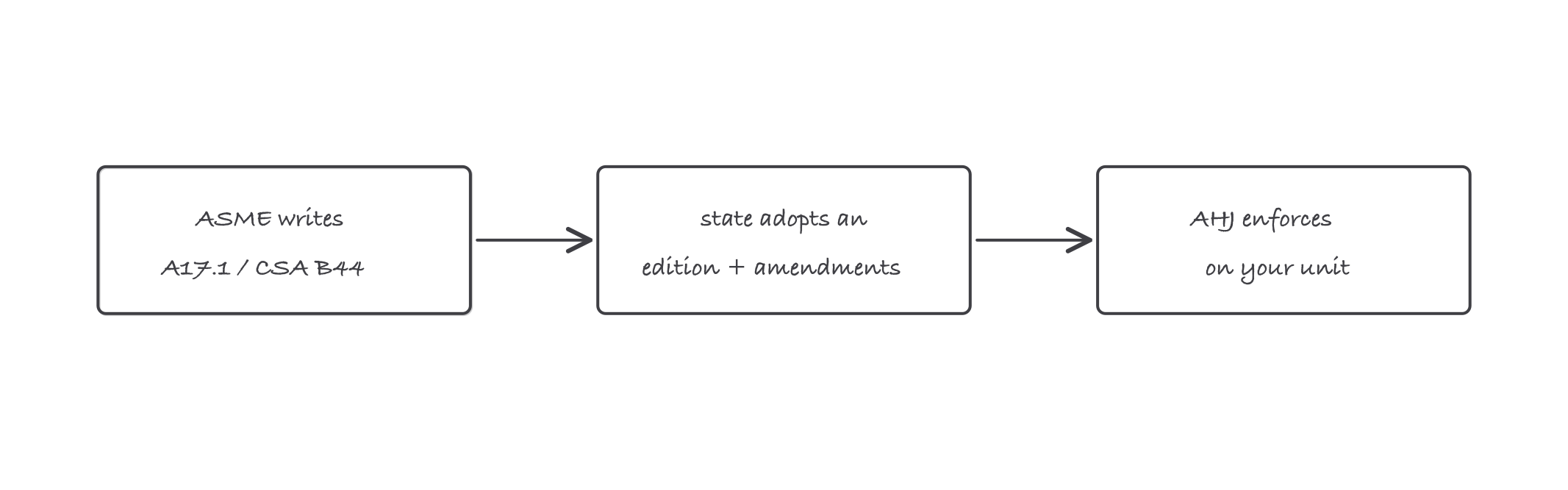
A model code becomes law by adoption: edition plus amendments plus the AHJ that enforces them
Where it bites
- Quoting the newest edition can be wrong. The enforceable text is the adopted one. Verify the jurisdiction’s edition before citing a number in a report or an argument.
- Existing equipment is its own category. Applying new-construction requirements to a 30-year-old unit, or assuming old units are exempt from everything, are both errors. The adoption rules say which requirements reach back.
- “The code says” ends arguments only with a citation. Part, section, requirement, edition. Anything less is an opinion wearing a code’s name.