Learn · Elevator
Elevator Controllers
Part of Elevator Constructor, Start to Finish · step 7 of 20 · next: Escalators and Moving Walks
In learning paths: Elevator Constructor, Start to Finish
Assumes you know: Traction Machines and Roping
The controller is the cabinet that decides two things about every run: where the car should go, and whether it is safe for the car to move at all. Dispatch logic has evolved from walls of relays to microprocessor boards, but the second job has kept the same shape for a century: a series string of safety contacts that must all be closed before the machine gets power.
Why it matters on the job
Adjusters live in the controller. Callbacks end at its fault log, modernizations replace it, and every safety device in the earlier lessons (interlocks, gate switch, governor switch, limits, stop switches) terminates here. Reading a controller well means reading the whole elevator.
Two generations, one logic
Relay controllers implement the logic in electromechanical relays: car calls, landing calls, direction, leveling, each a physical circuit you can trace with a print and a meter. Plenty are still running, and older units keep mechanics who can read ladder prints employable.
Microprocessor controllers move dispatch and motion logic into software, add fault logs and diagnostics, and drive the machine through solid-state drives. Group dispatch (several cars answering a building’s calls as a team) went from mechanical selectors to algorithms.
What did not move into software is the principle that safety proving stays honest: the code-required protective devices are real contacts in a real circuit, not suggestions to a program.
The safety string
Picture the string as one long series loop threaded through everything that must be true before the car moves: pit stop switch closed, car-top stop switch closed, governor overspeed switch closed, final limits not struck, every hoistway door interlock closed and locked, car gate switch closed. Any one contact open anywhere breaks the loop, and the controller cannot energize the machine.
Series wiring is the design’s genius: there is no combination of failures, shorts to ignore, or software states that lets the controller run past an open safety contact, because the current path itself is missing.
Worked example: finding the open contact
A car is shut down; the controller shows the safety string open. The string is fed at 120 V, and a meter tells you everything through one property of series circuits: nearly the full source voltage appears across the open contact, while closed contacts read close to 0 V.
- Measure across the string’s accessible sections: across the closed pit and car-top stop switches you read roughly 0 V each.
- Across the landing 3 interlock contact you read close to 120 V. That contact is open: the fault is found.
- Inspect landing 3: a worn interlock roller is leaving the contact shy of made. Repair, then watch the string prove closed and the car return to service.
One meter, one principle, no parts swapped on a guess.
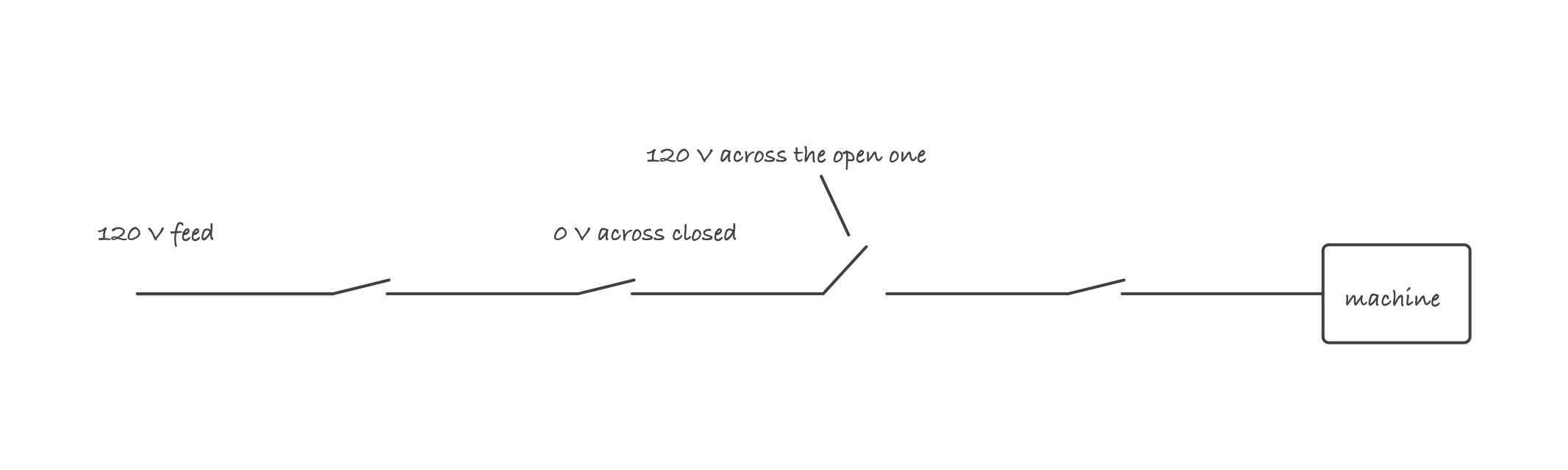
Every safety contact in one series loop: the open one is the one with voltage across it
Where it bites
- Never jump out a safety contact to “test”. A jumper across an interlock turns the string’s guarantee off, and forgotten jumpers have killed people in this trade. Where diagnostics require bypassing, it is done under strict, temporary, logged control per your employer’s procedure, then removed and proved removed.
- The fault log is a witness, not a verdict. A logged door fault says where the string broke, not why. The why lives in the hoistway.
- On relay equipment, the print is the diagnostic tool. Learn to read ladder logic even if your route is all microprocessor; the safety string logic is the same string.