Learn · Elevator
Hoistway Anatomy
Part of Elevator Constructor, Start to Finish · step 2 of 20 · next: Traction Machines and Roping
In learning paths: Elevator Constructor, Start to Finish
Assumes you know: Elevator Types: Traction and Hydraulic
The hoistway is the shaft the elevator lives in, and ASME A17.1 has a name for every part of it: pit, rails, car, counterweight, buffers, overhead. Learn the names from the bottom up once and every drawing, code reference, and radio call afterward makes sense.
Why it matters on the job
Parts get ordered, faults get described, and code sections get looked up by these names. “The thing at the bottom of the shaft” orders you nothing; “the counterweight buffer” orders the right part. The vocabulary is also the skeleton for every later lesson in this group, because each major component here gets a deeper treatment of its own.
From pit to overhead
The pit is the space below the lowest landing. It holds the buffers, a stop switch, lighting, and the pit ladder. Buffers are the energy-absorbing stops of last resort for car and counterweight: spring buffers on slower units, oil buffers on faster ones. There is one set under the car and another under the counterweight.
Guide rails run the full height of the hoistway: machined steel tee sections, spliced and bracketed to the building. The car rides its rail pair on guide shoes or roller guides, and the counterweight rides a pair of its own. Rails keep everything aligned, and they are what the car safety grips in an overspeed (covered in Safeties and Governors).
The car is more than the cab riders see. A structural steel frame (the sling) carries the platform, and the cab sits on the platform. Load paths, safeties, and roller guides all belong to the sling, which is why mechanics talk about the car frame rather than the cab.
The counterweight is a stack of steel weights in its own frame, roped to the opposite end of the suspension ropes on traction units. It travels opposite the car: car at the top landing means counterweight at the bottom of its runway.
Landings and doors: at every floor, a hoistway door closes off the shaft. Each door carries an interlock that keeps it locked shut unless the car is at that landing (the device behind most service calls, and the subject of Door Operators and Equipment).
The overhead is the space above the top landing: the machine and its supports (in a machine room above the hoistway, or inside the hoistway on machine-room-less designs), the governor, and the terminal switches that slow and stop the car at the ends of travel.
Ride it once in your head
Stand in the pit and look up. Ahead of you, two rail lines climb out of sight with the car somewhere above; behind or beside them, the counterweight rails with their own buffer below. Ropes leave the top of the car frame, rise to the drive sheave in the overhead, and come back down to the counterweight. Every lesson that follows hangs equipment on this one picture.
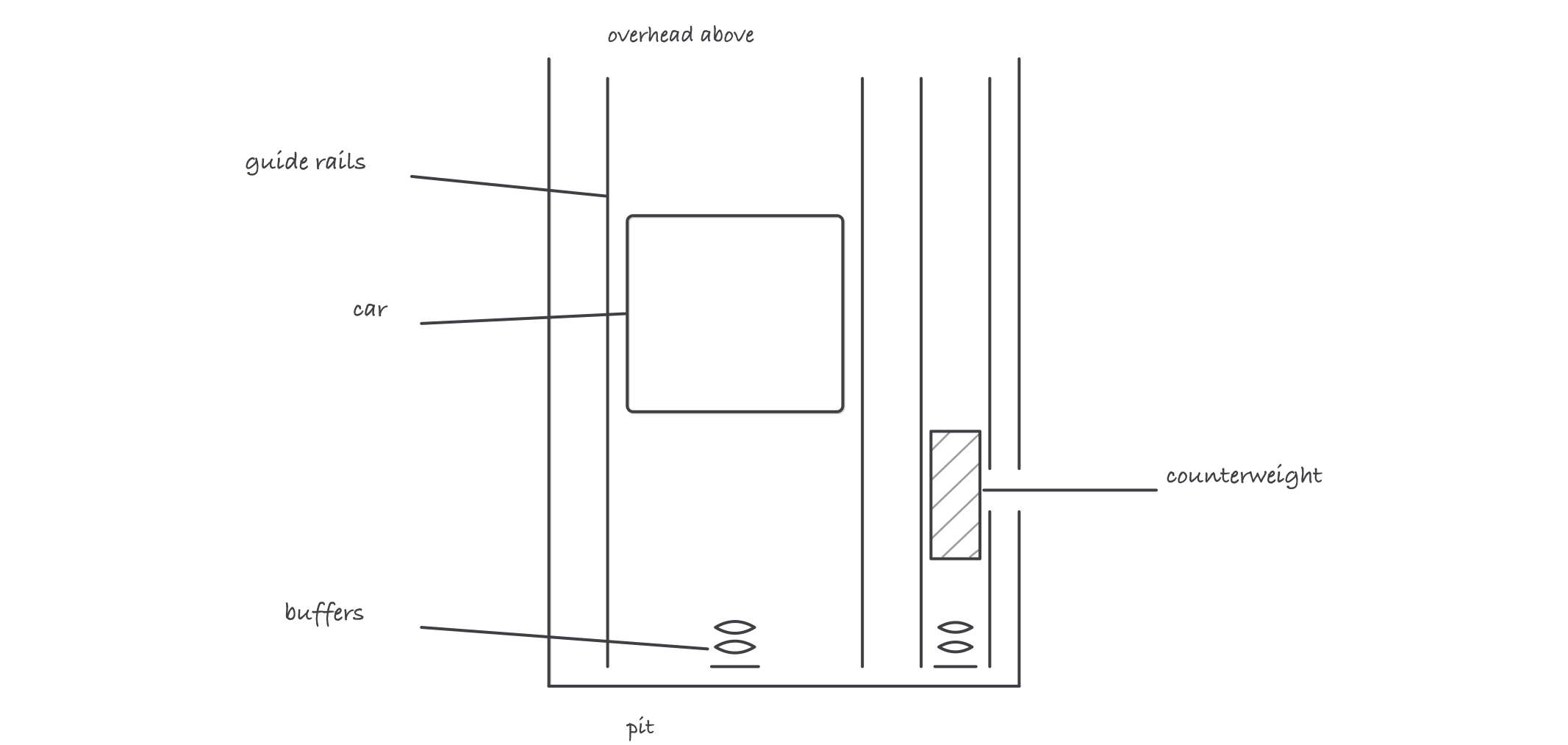
The hoistway in one view: car and counterweight on their own rails, each with a buffer below
Where it bites
- The counterweight has its own rails and its own buffer. Pit inspections and rail work cover both runways, not only the car side. Forgetting the counterweight side is a classic apprentice gap.
- “Shaft” is jobsite talk; “hoistway” is the code word. Use either with your crew, but search the code and order documents under hoistway.
- Clearances are code-set, not leftover space. Pit depth and overhead height exist to provide refuge space when the car runs to its limits. Treat them as safety equipment (Working Safely in the Hoistway builds the habits), never as storage.