Learn · Elevator
Traction Machines and Roping
Part of Elevator Constructor, Start to Finish · step 3 of 20 · next: Hydraulic Elevator Systems
In learning paths: Elevator Constructor, Start to Finish
Assumes you know: Hoistway Anatomy
The traction machine is the motor, brake, and drive sheave that move a traction elevator, and the roping arrangement decides how its effort reaches the car. Machines come geared and gearless; roping comes mostly 1:1 and 2:1. Those two choices explain most of what you see in a machine space.
Why it matters on the job
Machine type sets the maintenance you do (gear oil and thrust adjustments on geared machines, brake and bearing work on gearless) and roping sets the arithmetic of speeds and loads. Rope condition is a mechanic’s responsibility on every maintenance visit, and misreading it is one of the trade’s expensive mistakes in both directions: retiring good rope wastes money, and running bad rope is a safety failure.
Geared and gearless
A geared machine puts a reduction gear (classically a worm and gear) between motor and sheave. The motor spins fast; the sheave turns slowly with high torque. Geared machines serve low- and mid-rise traction work at moderate car speeds.
A gearless machine mounts the drive sheave directly on the motor shaft. No gearbox means fewer losses and smoother high-speed running, which is why gearless machines own the high-rise. Modern machine-room-less designs use compact gearless machines with permanent-magnet motors, a story continued in the MRL lesson.
The brake on either type is a spring-applied, electrically released holding brake. It sets when power is removed and holds the car at the floor. Keep the model straight: the machine brake is a parking and holding device, not the overspeed protection (that chain of events belongs to Safeties and Governors).
Roping: 1:1 and 2:1
In 1:1 roping, ropes run from the car frame, over the drive sheave, down to the counterweight. Car speed equals rope speed, and the ropes carry the full suspended weight.
In 2:1 roping, ropes anchor at the top of the hoistway, pass under sheaves on the car and counterweight, and cross the drive sheave in between. The car hangs on two rope parts, so the machine trades speed for force, the same bargain as any 2:1 rigging.
Work the numbers for a 2:1 unit with a fully loaded car side weighing 6,000 lb and a contract speed of 200 fpm:
- Rope tension: 6,000 lb shared across two supporting parts, so the ropes see 6,000 / 2 = 3,000 lb (ignoring rope weight and friction)
- Rope speed: the ropes must run twice the car speed, so 2 × 200 = 400 fpm at the sheave
Half the rope load at twice the rope speed: that is the whole reason 2:1 roping lets a smaller, faster machine move the same car.
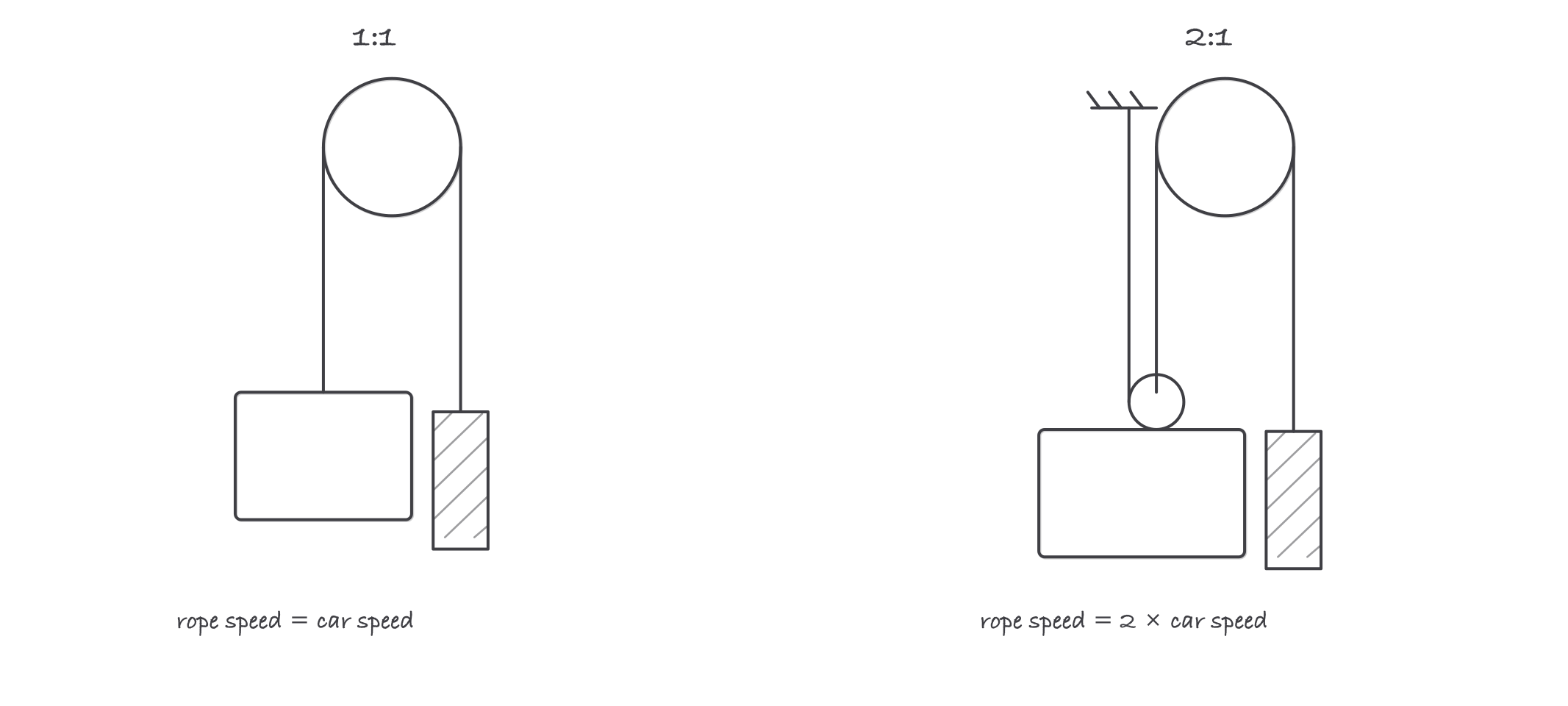
Two rope parts under the car: half the rope tension, twice the rope speed
What rope condition tells you
Suspension ropes announce their state if you look: broken wires (counted per length of lay against retirement criteria), reduced diameter (internal wear), rouge (fine red dust that signals wear inside the rope), and dryness that calls for the specified rope lubricant. Ropes are retired on condition against the code’s criteria, not on age. Count, measure, log, and compare with last visit: the trend matters as much as the number.
Where it bites
- Traction is friction. Worn sheave grooves lose grip long before ropes snap, and a car that slides at the landing or loses leveling accuracy may have a groove problem, not a control problem.
- The brake is not the safety. Repeating “the brake stops a falling car” marks you as untrained. The brake holds; the governor-and-safety system stops overspeed.
- Never lubricate ropes blind. The wrong lubricant, or lubricant on a traction surface that must grip, destroys the friction the whole system depends on. Follow the rope and machine documentation.