Learn · Elevator
Accessibility Lifts and Dumbwaiters
Part of Elevator Constructor, Start to Finish · step 10 of 20 · next: Preventive Maintenance Programs
In learning paths: Elevator Constructor, Start to Finish
Assumes you know: Elevator Types: Traction and Hydraulic
Below the passenger elevator sits a family of smaller conveyances: vertical and inclined platform lifts, stairway chairlifts, LULA elevators, private residence elevators, and dumbwaiters. They move shorter distances at lower speeds, they are governed by two different codes, and an entire NAEC credential (the CAT) exists for the technicians who work on them.
Why it matters on the job
Accessibility equipment is a real market: schools, churches, courthouses, and homes need code-compliant vertical access where a full elevator will not fit or cannot be justified. Companies specialize in it, and mechanics who know which code governs which device avoid the classic mistake of applying elevator rules to equipment that lives under a different book.
The equipment, and the code split
The dividing line is which ASME code covers the device:
- Under A17.1 (with the elevators): dumbwaiters (small material-only cars, strictly not for riders), LULA elevators (Limited-Use/Limited-Application: a small, slower, shorter-travel passenger elevator class for accessibility service), and private residence elevators.
- Under ASME A18.1 (its own safety standard for platform lifts and stairway chairlifts): vertical platform lifts (an open or enclosed platform climbing a few feet, the wheelchair-access workhorse), inclined platform lifts (a platform riding rails along a stair), and stairway chairlifts (a seat riding a stair rail).
Same manufacturer catalog, two different codes. Which book governs decides design limits, required safeties, and what an inspector checks.
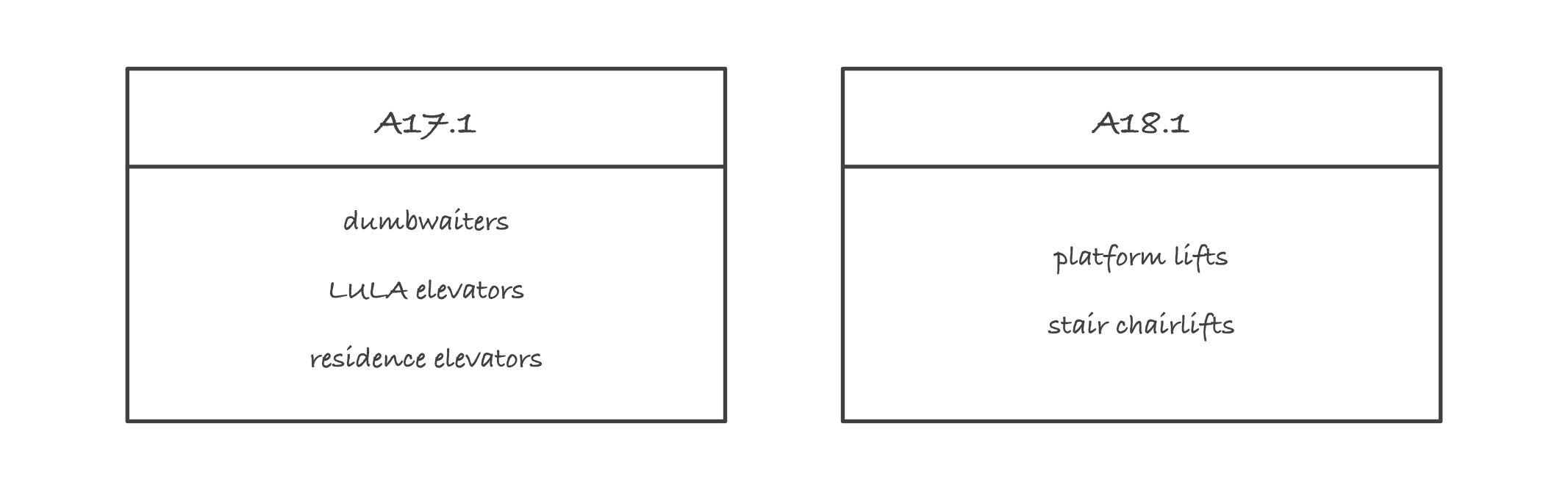
Two books, one catalog: A17.1 keeps the elevator-like devices, A18.1 governs the platform and stair lifts
Same logic, smaller machines
The safety grammar transfers from the bigger equipment: doors and gates are proved by interlocks before travel, drives are screw, hydraulic, or roped designs in miniature, and overspeed protection appears where the code requires it. What changes is scale and duty: lower speeds, shorter travel, lighter loads, and drive packages a single mechanic can handle. A technician fluent in the earlier lessons of this group already understands these machines; the discipline is looking up the right requirement in the right code.
Worked example: which rules govern this job
A church asks for wheelchair access to a chancel 4 ft above the main floor, and a school asks to move lunch trays between a kitchen and a second-floor cafeteria.
- The church platform lift is A18.1 equipment; its enclosure, travel, and safeties follow that standard, plus the jurisdiction’s adoption of it and any local accessibility requirements.
- The school’s tray mover is a dumbwaiter under A17.1: material only, with signage and interlocks to match, and it must never be treated as a small passenger elevator, no matter how tempting the shortcut.
Two low-rise jobs, two different codes, one lesson: identify the device class first, then open the right book.
The CAT credential
NAEC’s CAT (Certified Accessibility and Private Residence Lift Technician) is the certification mapped to exactly this equipment, run by the same NAEC Certification Board as the CET (the CET lesson covers the structure). For technicians building a career in accessibility work, CAT is the recognized credential, and some license states credit it: Washington accepts NAEC CAT completion toward its licensing requirements, as the licensing lesson details.
Where it bites
- Dumbwaiters carry freight, never people. Riding one is a code violation and a recurring cause of serious injuries. Interlocks and signage exist to stop it; leave them working.
- A platform lift is not a failed elevator. A18.1 devices are legitimate, code-designed solutions for their niche. Selling or servicing them as lesser elevators misleads owners about both capability and requirements.
- Residential work still has an inspector. Private residence equipment is code-governed and, in many jurisdictions, permitted and inspected. “It’s a house” waives nothing.