Learn · Elevator
Working Safely in the Hoistway
Part of Elevator Constructor, Start to Finish · step 15 of 20 · next: Getting Into the NEIEP Apprenticeship
In learning paths: Elevator Constructor, Start to Finish
Elevator work happens inside a machine’s moving parts: on top of the car, in the pit below it, beside a counterweight heavy enough to kill anything it meets. The trade’s answer is a set of access rituals (car top, pit, machine space) built on one principle: you control the car before your body enters the space it moves through.
Why it matters on the job
The hazards here are unforgiving: struck-by from a moving car or counterweight, falls into open hoistways, caught-in-machinery, and electrical contact. Every rule in this lesson exists because someone died without it. Apprentices are taught these habits in their first weeks; this lesson is why the habits look the way they do.
The car-top access ritual
The access ritual is not a formality; it is the sequence that turns a moving machine into a work platform.
- Take the car. Call it to a floor and confirm you, not the building’s passengers, control where it is.
- Open the hoistway door with the access key and hold the door. Verify the car is actually where you expect it (people have stepped into empty hoistways behind doors that opened onto nothing).
- Hit the car-top stop switch before anything else. Reaching in and opening that switch is the moment the car stops being able to move under dispatch control.
- Switch to inspection operation. Car-top inspection stations give slow-speed movement under your buttons only, overriding hall and car calls.
- Test before you trust. Prove the stop switch and inspection controls actually hold the car (attempt a call from the landing and watch it refuse) before your weight is on the car top.
- Ride positioned and holding on, inside the crosshead area, watching the approaching overhead, counterweight path, and rail brackets.
Leaving reverses the ritual: car parked, body out, stop switch restored, door proven locked behind you.
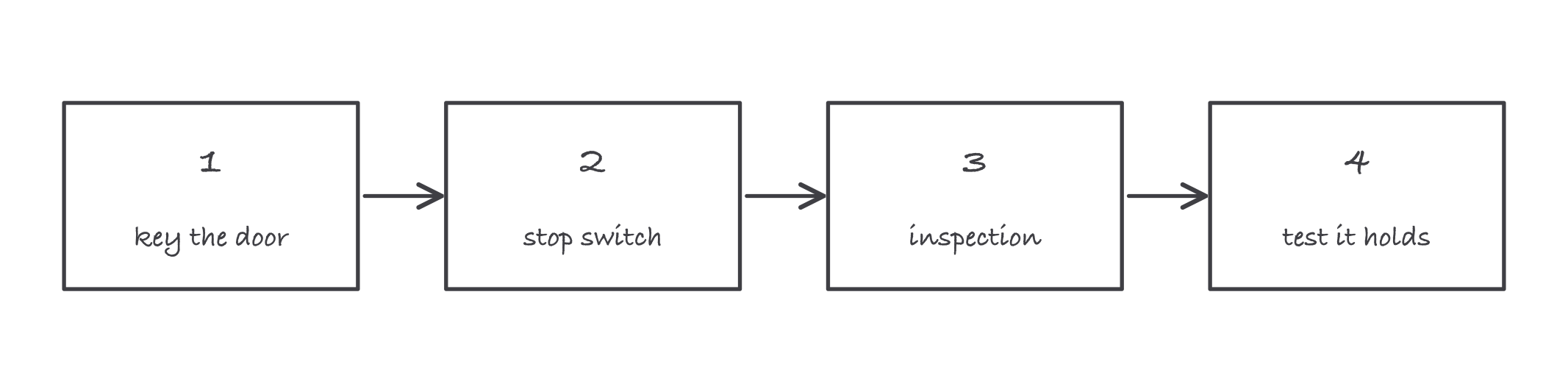
Key, stop, inspection, test: the order is the protection
Pit access
The pit adds depth, darkness, and the underside of a car to the hazard list. The entry shape is the same: door opened under control, pit stop switch operated as you enter (they are placed reachable from the landing for exactly this reason), pit light on, ladder used, and awareness that the counterweight runway is part of the pit whether or not the counterweight is visible. If a car must move during pit work, it moves because you commanded it, from a position outside its path.
Stored energy everywhere
A stopped elevator is still loaded with stored energy. The counterweight wants to fall; the ropes hold it. A hydraulic’s oil column holds the car up until a fitting opens. Buffer springs are compressed steel; door operators hold tensioned belts and springs; the controller holds lethal voltage behind an opened disconnect’s line side. Electrical lockout-tagout applies as it does in every trade, and the mechanical equivalents (car supported before jack work, counterweight secured for rope work) are planned into every task where gravity is the adversary.
Where it bites
- The order of the ritual is the protection. Stop switch before body, test before trust. Shortcutting one step once is how the trade’s worst stories start.
- Two hazards per space, minimum. The car above you in the pit and the counterweight beside you on the car top: always account for the moving mass that is not the one you are working on.
- Jumpers and defeated devices kill later. A bypassed interlock or stop switch left in place waits for the next person (the controllers lesson covers jumper discipline). Remove, restore, and prove restored before you leave.
- Falls need no elevator. An open hoistway door with no car behind it is a fall hazard as plain as any structural steel edge. Guard it, and never trust a door someone else opened.