Qualifications · Water and Wastewater
ABC Standardized Exams: How WPI Testing Works
Part of Water Operator, Certified · step 20 of 23 · next: The Professional Operator (PO) Designation
In learning paths: Water Operator, Certified
Assumes you know: Operator Certification: The Mandatory Ladder
Most state operator exams are not written by the state. They come from a shared bank: the ABC standardized exams, developed and maintained by Water Professionals International, the certification body formerly named the Association of Boards of Certification. One organization, one set of exam specifications, administered by state programs across the country.
*Learn the Trades is a free study resource. We are not a licensing body, an authorized training provider, or an exam administrator. Reading this page does not award any card, license, or certification. Always verify requirements with the issuing authority linked in the sources.*Why it matters on the job
If your state uses ABC exams, then the exam content, the class structure, and the study specification all come from WPI even though the application, fees, and certificate come from your state. Knowing which half owns what saves you from studying the wrong material and from asking your state board questions only WPI can answer.
The exam catalog
The core of the bank is four standardized series, one per discipline:
- Water treatment
- Water distribution
- Wastewater treatment
- Wastewater collection
Each series comes in four levels, Class I through Class IV. Around that core, ABC Testing also offers specialty exams: very small water systems, small wastewater systems, backflow prevention, laboratory analysis, biosolids land application, and plant maintenance. States pick from the catalog like a menu: some administer everything, others only a few series.
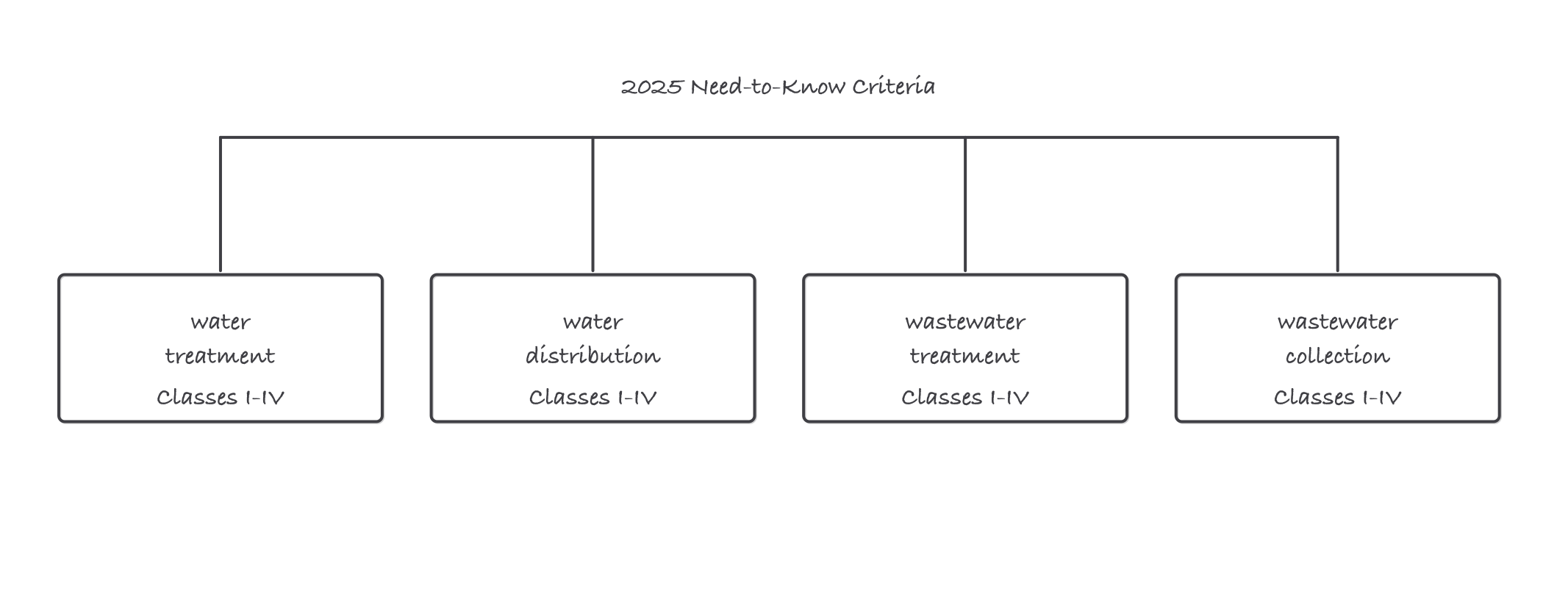
The core bank: four disciplines, four classes each, all built from one published specification
The specification behind the questions
Every exam is written against WPI’s Need-to-Know Criteria, the published breakdown of tasks and knowledge for each series and class. The 2025 edition is current and replaced the 2019 set. This is the document to study from, and the grade exams lesson walks through using it.
What WPI does not publish on its public pages: question counts, time limits, and scheduling logistics. Those live in your state’s candidate materials, because administration belongs to the state (or its testing contractor).
How a standardized exam reaches you
The division of labor runs like this: WPI writes and maintains the exams and criteria. Your state approves your application, decides which exam you sit and at which class, and sets fees and locations, often through a commercial testing provider. Your results go back to the state, which applies its own passing requirements and, with experience verified, issues the certificate.
Where it bites
- Two names, one body. Older study materials, state pages, and job postings still say “ABC exam.” That is the same organization as WPI, and gowpi.org is the current home. Anything still pointing at abccert.org is out of date.
- The exam is portable; the certificate is not. Because so many states test from the same bank, an exam passed at a given class carries weight when you move, but it is the state certificate that lets you work, and each state decides what it accepts.
- Not every state is an ABC state. Some states build their own exams for some or all grades. Confirm with your program which exam you are actually sitting before you commit to a study plan.
Exam relevance
This is the machinery behind most of the exams in this trade. If your state administers ABC exams, the Need-to-Know Criteria are your syllabus, and everything in the grade exams lesson applies to you directly.
Verified requirements
| Where | Expires | Renewal | Continuing education |
|---|---|---|---|
| California | Yes | Confirm with issuer | Continuing education required for renewal; approved-provider list and acceptable technical and safety topics published by DWOCP |
| California | Yes | Confirm with issuer | Confirm with issuer |
| Texas | Yes | 3 years | 30 hours of continuing education per 3-year term, including at least 2 hours of approved resiliency training (required for all water operators since April 1, 2024, under Senate Bill 3 after Winter Storm Uri). Class A and B operators may not count the Basic Water course for renewal credit. |
| New York | Yes | 5 years | Renewal training contact hours per 5-year cycle scale with grade: Grade 1/1A 20 hours, Grade 2/2A 40 hours, Grade 3/3A 60 hours, Grade 4/4A 80 hours |
| New York | Yes | Confirm with issuer | Confirm with issuer |
Information comes from issuing-authority sources. Confirm current rules, fees and eligibility with the authority before acting.