Qualifications · Water and Wastewater
How States Name Their Grades: T1-T5, Class D-A, Grade 1-4A
Part of Water Operator, Certified · step 22 of 23 · next: Very Small Water Systems Certification
In learning paths: Water Operator, Certified
Assumes you know: Operator Certification: The Mandatory Ladder
The same career ladder wears a different costume in every state. One state counts up with numbers, another counts down the alphabet, and a third splits its vocabulary between two agencies. None of it changes what the rungs mean: it only changes how they are written, and misreading a label costs real money in job searches and applications.
*Learn the Trades is a free study resource. We are not a licensing body, an authorized training provider, or an exam administrator. Reading this page does not award any card, license, or certification. Always verify requirements with the issuing authority linked in the sources.*Why it matters on the job
Recruiters and operators pattern-match on grade labels, and the patterns lie across state lines. A “Class A operator” is a top-rung professional in Texas and a nonexistent title in the WPI exam system. If you hire, apply, or study across state lines, you need the translation habits in this lesson.
Three naming systems, one ladder
California counts up, with a letter prefix for the ladder. Drinking water operators grade from T1 to T5 on the treatment side and D1 to D5 on the distribution side, 5 highest. The prefix is the license type; the number is the rung.
Texas counts down the alphabet. Water operator classes run D, C, B, A. Class A is the top. The alphabetical instinct (A first, so A must be basic) points exactly the wrong way. TCEQ’s Class A exam is the program’s hardest.
New York splits by agency and decorates with suffixes. Wastewater grades under DEC run 1 to 4, with “A” variants such as 2A. The A suffix means the certificate covers an activated sludge plant. It is not a higher rank. Drinking water grades under the Department of Health use a different vocabulary again: IA, IB, IIA, IIB, C, and D.
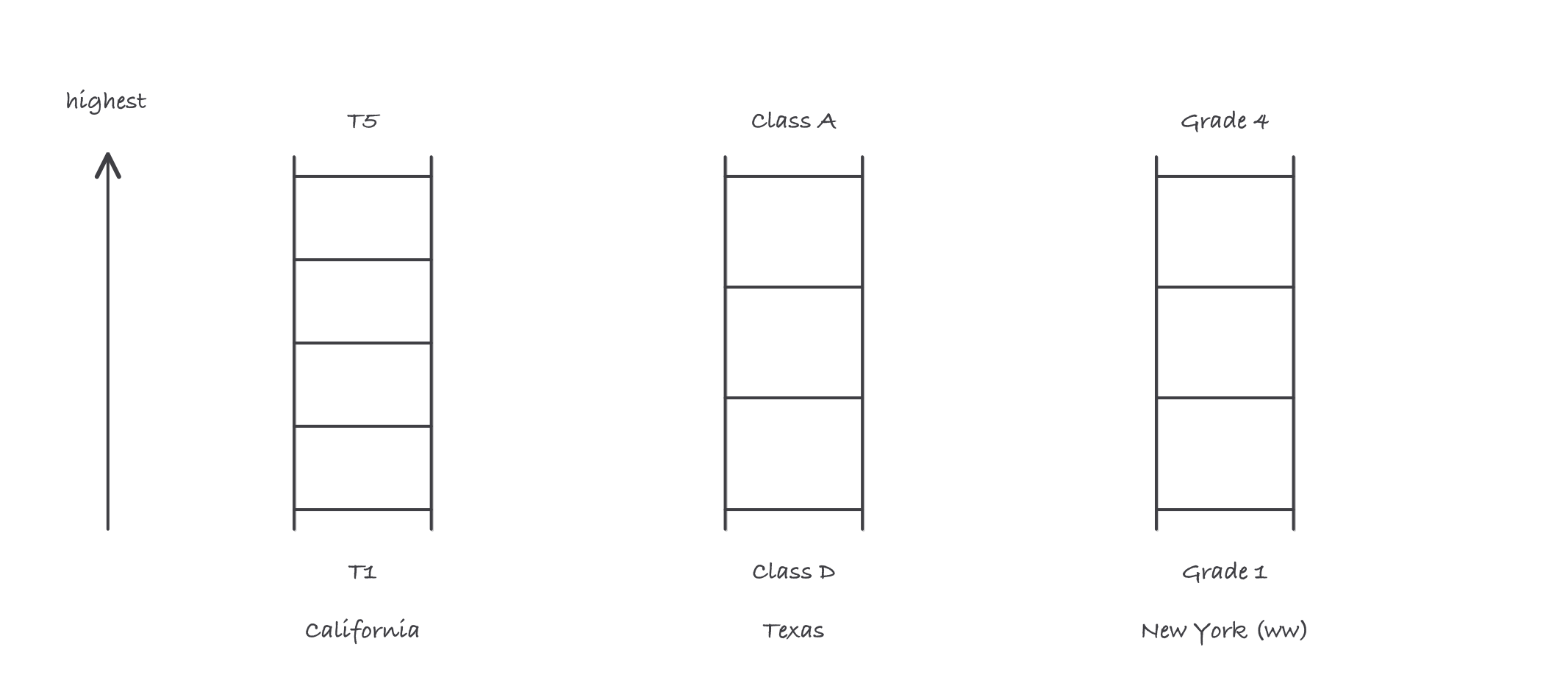
Three states, one ladder: the top rung is always the biggest responsibility, whatever the label says
Translation rules that hold
- Find the top of the ladder first. Before comparing anything, learn which label is highest in that state. Never assume direction from the label itself.
- Separate the license type from the rung. California’s T and D prefixes, and New York’s two agency vocabularies, encode which network you may run. The number or letter after them encodes how big.
- Translate through the state program, not between states. EPA’s January 2025 summary of state certification programs lists every state’s structure. When you must compare two states, compare each against its own definition of system classes, not label to label.
Where it bites
- “Class A” has three unrelated meanings. Texas’s top water operator license, a sludge-quality category in federal biosolids rules (Class A versus Class B biosolids), and nothing at all in WPI’s Class I to IV exam system. A sentence like “a Class C operator producing Class B biosolids” is perfectly coherent in Texas.
- Texas also licenses “Water Treatment Specialists.” That TCEQ license covers residential and commercial water treatment equipment and is a different credential from the public water system operator classes. Job boards mix them constantly.
- New York’s A suffix reads as rank. A Grade 2A wastewater certificate is a Grade 2 certificate for an activated sludge plant, not “Grade 2, advanced.”
- WPI class numerals leak into state conversations. Exam Classes I to IV describe the standardized exams, not any particular state’s certificate grades. Keep the two vocabularies apart in your head and your applications.
Exam relevance
Exam applications ask for your current grade and the grade you seek, in the state’s own vocabulary. Getting a label wrong on the form delays approval; getting it wrong in study planning means preparing for the wrong exam level. Nail the local names before anything else.
Verified requirements
| Where | Expires | Renewal | Continuing education |
|---|---|---|---|
| California | Yes | Confirm with issuer | Continuing education required for renewal; approved-provider list and acceptable technical and safety topics published by DWOCP |
| California | Yes | Confirm with issuer | Confirm with issuer |
| Texas | Yes | 3 years | 30 hours of continuing education per 3-year term, including at least 2 hours of approved resiliency training (required for all water operators since April 1, 2024, under Senate Bill 3 after Winter Storm Uri). Class A and B operators may not count the Basic Water course for renewal credit. |
| New York | Yes | 5 years | Renewal training contact hours per 5-year cycle scale with grade: Grade 1/1A 20 hours, Grade 2/2A 40 hours, Grade 3/3A 60 hours, Grade 4/4A 80 hours |
| New York | Yes | Confirm with issuer | Confirm with issuer |
Information comes from issuing-authority sources. Confirm current rules, fees and eligibility with the authority before acting.