Qualifications · Water and Wastewater
Operator Certification by State (WPI Reciprocity)
Part of Water Operator, Certified · step 17 of 23 · next: The Chief Operator Path
In learning paths: Water Operator, Certified
Assumes you know: Operator Certification: The Mandatory Ladder
There is no national operator certificate. Fifty states run fifty programs, each with its own grade names, fees, renewal cycles, and exam arrangements, built on the same federal floor. This lesson shows the range with three real programs and then answers the question every mobile operator asks: what happens to my certificate when I move.
*Learn the Trades is a free study resource. We are not a licensing body, an authorized training provider, or an exam administrator. Reading this page does not award any card, license, or certification. Always verify requirements with the issuing authority linked in the sources.*Why it matters on the job
Job postings, exam prep, and advice from operators in other states all speak their own state’s dialect. If you do not know that the labels and rules change at the state line, you will study the wrong ladder or, worse, assume your certificate travels when it does not.
One floor, fifty buildings
EPA’s operator certification guidelines set the minimum every state program must meet, and EPA’s summary of state programs (updated January 2025) is the best single map of how each state built on it. Three examples show the spread:
California runs drinking water certification through the State Water Resources Control Board’s DWOCP program: treatment grades T1 up to T5 and distribution grades D1 up to D5, with roughly 35,000 certified operators. Treatment and distribution are fully separate ladders.
Texas licenses through TCEQ with four classes (D, C, B, A) and Class A on top: the inverse of what the alphabet suggests. A Texas Class A operator is a senior professional.
New York splits by agency. Drinking water certification belongs to the Department of Health under 10 NYCRR Subpart 5-4, with grades IA, IB, IIA, IIB, C, and D. Wastewater certification belongs to the Department of Environmental Conservation, which uses ABC standardized exams delivered through PSI with a passing score of 70.
Worked example: one ladder in full (Texas)
To see what a complete state program specifies, walk the Texas water operator ladder as TCEQ publishes it:
- Four license classes, D to A, each with its own experience and education requirements.
- The Class A exam is a 6 hour computer-based test.
- A license term runs 3 years, renewal costs $111, and renewal takes 30 hours of continuing education, including 2 hours of water utility resiliency training (a requirement added after Winter Storm Uri, effective April 2024).
Every state’s program answers these same questions (classes, exams, term, fee, CE) with different numbers. Pull your own state’s page and fill in the blanks before you plan anything.
What reciprocity really gets you
Moving states does not move your certificate. Each state decides for itself whether, and at what grade, it will recognize experience and exams from elsewhere. That decision is called reciprocity, and it is an application you make to the new state, not a right you carry.
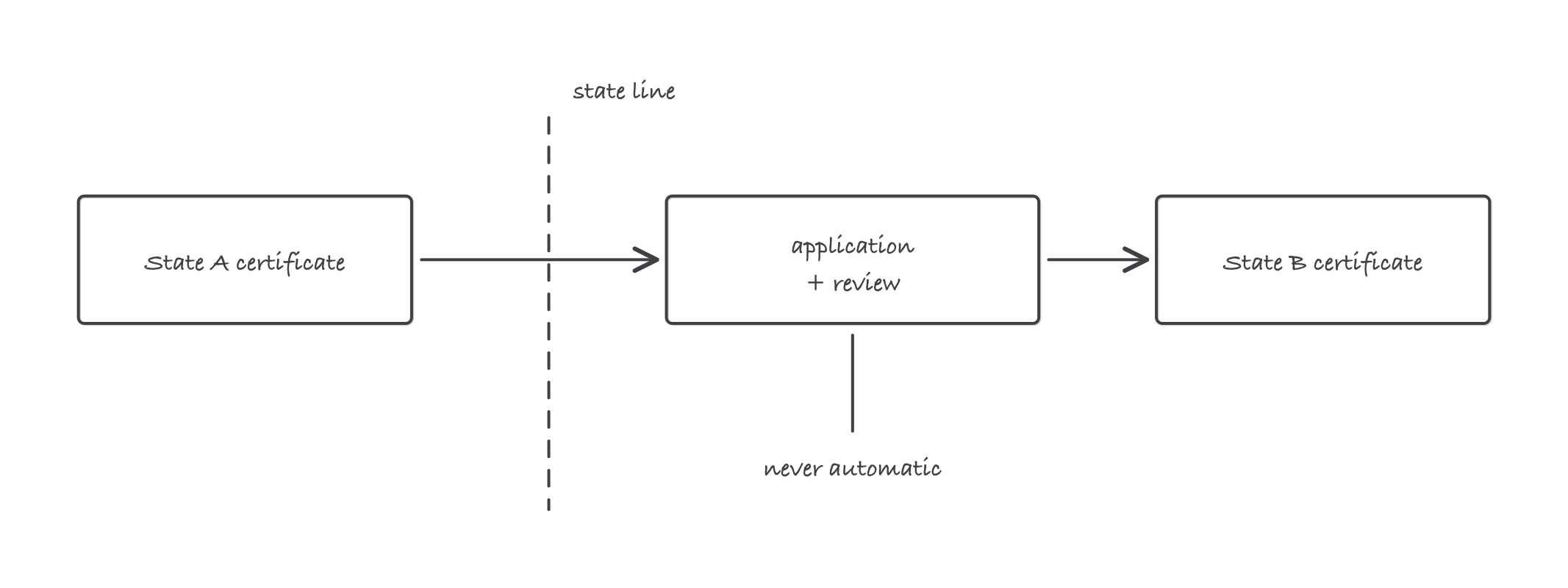
Reciprocity is a second application, not a transfer: the new state reviews your record and issues its own certificate on its own terms
Standardization helps your case. Because many states test from WPI’s shared ABC exam bank, a passed standardized exam is evidence a new state can evaluate, and WPI runs a reciprocity application service to package your record. WPI’s own careful phrasing is the right expectation to carry: its programs give you a better chance of achieving reciprocity, not a guarantee.
Where it bites
- Grade numbers do not translate. A California T3 is not a Texas Class C is not a New York IIA. States map incoming operators onto their own ladders, sometimes a rung lower than you expect.
- Two certificates can hide in one job. In split states, a role covering a plant and its pipes may need both a treatment and a distribution (or collection) certificate. Read postings against your state’s ladder, not the title.
- Program pages move. Go to the issuing agency directly: waterboards.ca.gov for California drinking water, tceq.texas.gov for Texas, health.ny.gov and dec.ny.gov for New York. Old bookmarked URLs, especially dec.state.ny.us, are stale.
Exam relevance
Your state decides which exam you sit, so this lesson is step zero of exam prep: identify your program, its ladder, and whether it uses the ABC standardized exams before you open a study guide.
Verified requirements
| Where | Expires | Renewal | Continuing education |
|---|---|---|---|
| California | Yes | Confirm with issuer | Continuing education required for renewal; approved-provider list and acceptable technical and safety topics published by DWOCP |
| California | Yes | Confirm with issuer | Confirm with issuer |
| Texas | Yes | 3 years | 30 hours of continuing education per 3-year term, including at least 2 hours of approved resiliency training (required for all water operators since April 1, 2024, under Senate Bill 3 after Winter Storm Uri). Class A and B operators may not count the Basic Water course for renewal credit. |
| New York | Yes | 5 years | Renewal training contact hours per 5-year cycle scale with grade: Grade 1/1A 20 hours, Grade 2/2A 40 hours, Grade 3/3A 60 hours, Grade 4/4A 80 hours |
| New York | Yes | Confirm with issuer | Confirm with issuer |
Information comes from issuing-authority sources. Confirm current rules, fees and eligibility with the authority before acting.