Qualifications · Solar
NABCEP Specialist Certifications
Assumes you know: NABCEP PV Associate
NABCEP’s specialist certifications split the PVIP’s territory into three focused Board Certifications: the PV Installer Specialist (PVIS) for the crew leader on the roof, the PV Design Specialist (PVDS) for the person behind the drawings, and the PV Commissioning and Maintenance Specialist (PVCMS) for the one who proves systems work and keeps them working. Each certifies depth in one slice of the project lifecycle, with lighter training-hour requirements than PVIP and project credits earned in its own discipline.
*Learn the Trades is a free study resource. We are not a licensing body, an authorized training provider, or an exam administrator. Reading this page does not award any card, license, or certification. Always verify requirements with the issuing authority linked in the sources.*Why it matters on the job
Solar companies stopped being three-person shops that did everything, and the credentials followed the org chart. A designer who never leads roof crews has no natural path to PVIP’s decision-making installation credits; a service tech’s expertise is commissioning and fault-finding, not design. The specialists let each of those careers certify what it actually does, and let employers advertise certified depth in a specific function.
The three specialists side by side
All three are Board Certifications on NABCEP’s standard pattern: verified training, documented project experience in a responsible role, and a proctored exam, with a 3-year certification cycle. Each requires 24 hours of advanced training, of which 6 hours must be NEC-focused. Where they differ is the experience and the safety card:
- PVIS (Installer Specialist): 6 project credits in a decision-making role on installations, plus the OSHA 10 construction card.
- PVDS (Design Specialist): 12 design project credits, plus the OSHA 10 card.
- PVCMS (Commissioning and Maintenance Specialist): 12 project credits in commissioning and maintenance work, plus the OSHA 30 card, the supervisor-depth requirement that tracks the independence of service work.
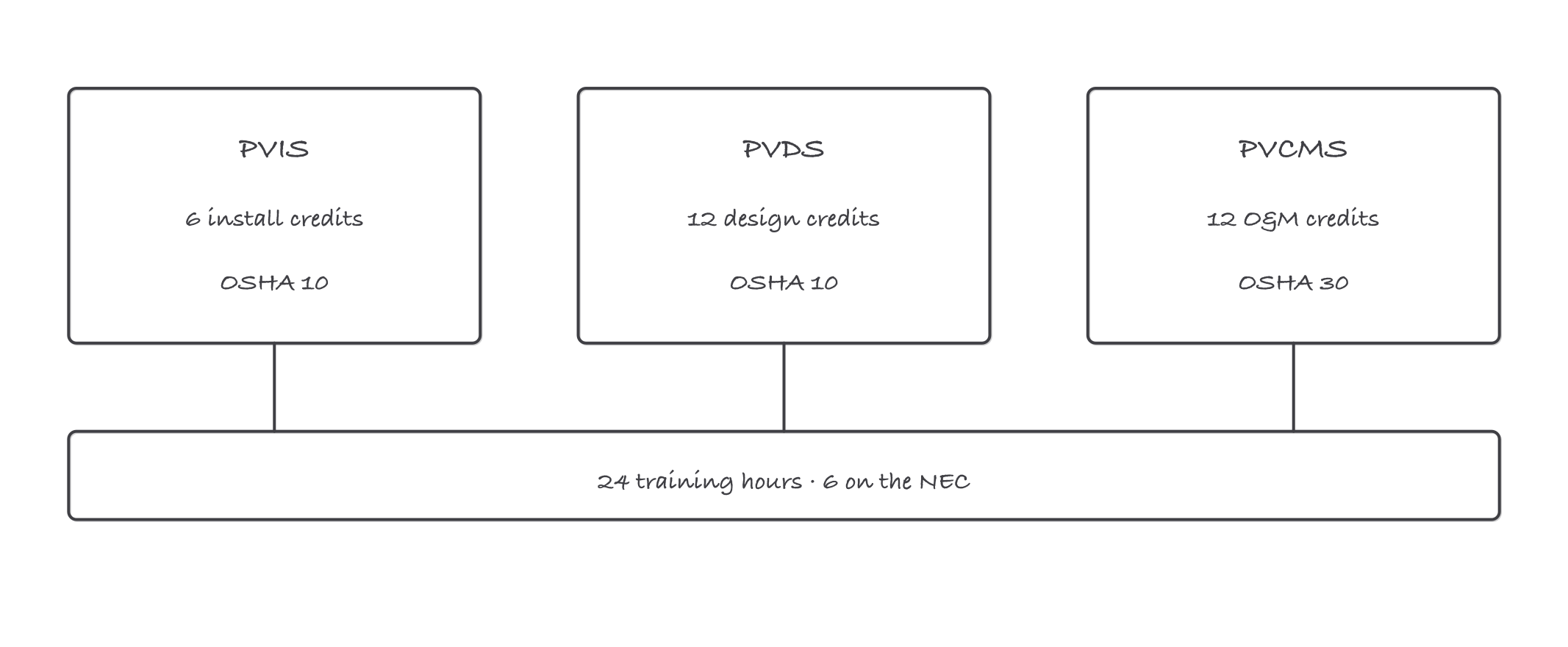
One shared training requirement, three different kinds of proof
How they differ from PVIP
PVIP asks for 58 hours of training and certifies breadth across the whole installation professional role. The specialists ask for 24 hours and certify one function deeply. Project credits count the same way NABCEP always counts them: by system size tier, not by number of jobs, so a 12-credit requirement is a portfolio of documented systems, not 12 site visits. Documentation runs through the authority having jurisdiction as usual: permits and final approved inspections, not site plans or applications.
Worked example: which specialist fits
A tech spent three years commissioning and servicing residential systems: she runs the tests, signs the commissioning reports, and owns the service tickets. For PVCMS she needs 12 project credits from that commissioning and maintenance work in a responsible role, the 24 training hours including the 6 NEC hours, and an OSHA 30 card; her existing OSHA 10 does not satisfy it, so a 30-hour course goes on the plan. Her design colleague, targeting PVDS with 12 design credits, keeps his OSHA 10 and counts drawings instead of service reports. Same company, two different evidence trails.
Where it bites
- The wrong OSHA card. PVCMS wants the 30-hour card where the other two accept the 10-hour. Discovering that at application time costs a course and a delay.
- Credits from the wrong discipline. Design credits do not feed PVIS; installation credits do not feed PVDS. The credential certifies the role you documented, not the role you want next.
- Assuming specialist means junior. These are board-level certifications with board-level exams. The 24-hour training requirement is lighter than PVIP’s 58; the exam rigor is not.
- Undocumented responsibility. “I was effectively in charge” does not survive an application audit. The paper trail naming your role is the requirement.
Exam relevance
Each specialist exam concentrates on its function: PVIS on installation practice and code compliance in the field, PVDS on the design and sizing content in this curriculum’s design group, PVCMS on the commissioning and O&M lessons. The shared 6-hour NEC training requirement is a hint about all three exams: code questions are everyone’s problem.