Qualifications · Solar
NABCEP Energy Storage Installation Professional
Assumes you know: Battery Storage Systems
The Energy Storage Installation Professional, ESIP, is NABCEP’s Board Certification for the people who install battery systems: the storage-side sibling of PVIP, built on the same skeleton of safety card, advanced training, project credits, and a 4-hour exam, with every requirement re-cut for batteries. The tell is in the units: where PV certifications measure project experience in kilowatts of array, ESIP measures it in kilowatt-hours of storage.
*Learn the Trades is a free study resource. We are not a licensing body, an authorized training provider, or an exam administrator. Reading this page does not award any card, license, or certification. Always verify requirements with the issuing authority linked in the sources.*Why it matters on the job
Storage is where solar careers are widening. Batteries attach to new installs and retrofit onto old ones, and the work is its own discipline: DC systems that are always energized, multi-source lockout, and commissioning that a PV-only background does not fully cover. You saw the technology in Batteries and Storage; ESIP is the industry’s way of certifying the person trusted to install it, and employers hiring for storage crews increasingly write it into the senior roles.
The requirements
ESIP follows the NABCEP board pattern with three storage-specific twists:
- OSHA 30, not OSHA 10. The supervisor-depth 30-hour construction card, the same requirement NABCEP applies to its commissioning and maintenance track. Storage work carries responsibility that the 10-hour card does not certify.
- 58 hours of advanced energy-storage training. The same hour count as PVIP, but the content is storage: the handbook governs what qualifies.
- Project credits measured in kWh. Documented energy-storage installations where you held the decision-making role, with credits tiered by system capacity in kilowatt-hours rather than array kilowatts. The documentation standard is NABCEP’s usual: verifiable records through the permitting authority.
The exam is the standard board format: 70 multiple-choice questions, 60 of them scored, in a 4-hour sitting. Certification runs the 3-year cycle with 30 hours of continuing education to recertify.
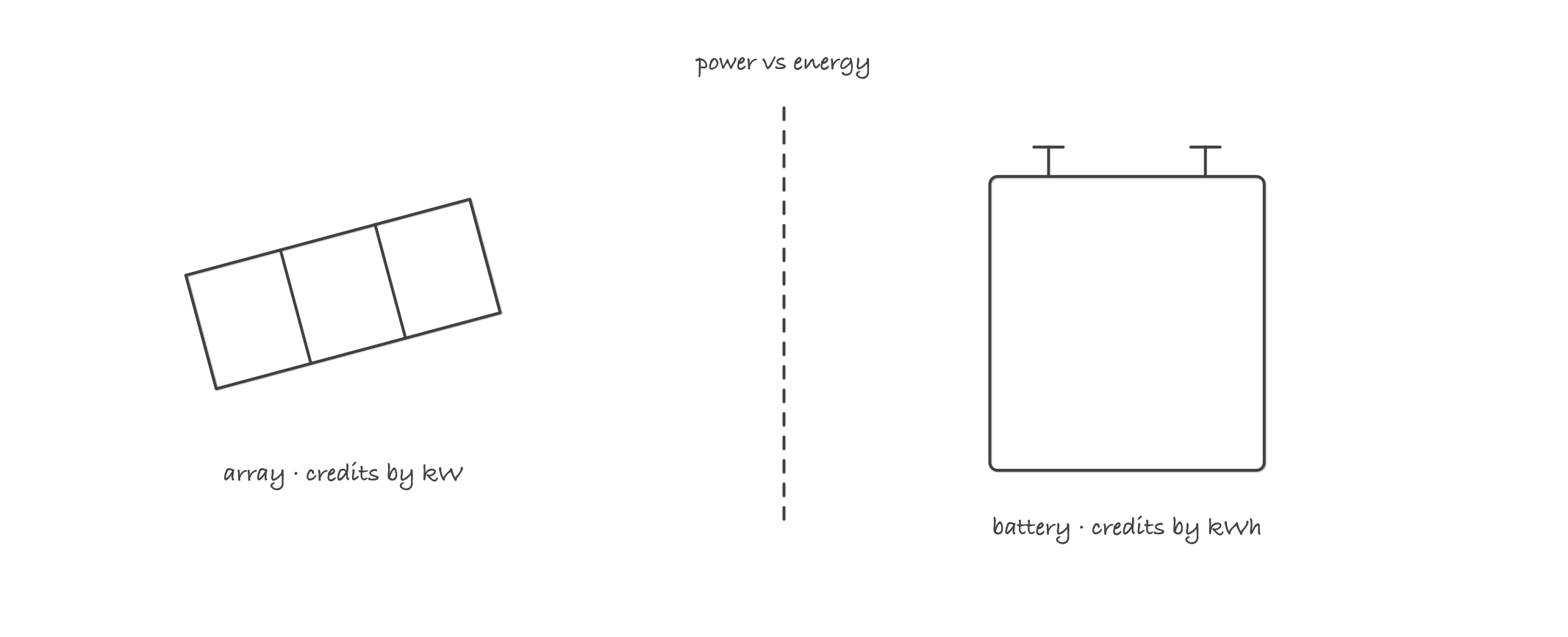
The unit is the point: arrays are rated in kW, storage in kWh, and each credential counts its own
Worked example: the kW versus kWh trap
An installer’s resume says “installed 400 kW of solar-plus-storage.” For an ESIP application, that number is unusable as written. The 400 kW describes array power. What ESIP counts is the storage: if those jobs included, say, 30 battery systems averaging 13.5 kWh each, the storage experience is 30 × 13.5 = 405 kWh of installed capacity, documented system by system, with his role on each. Two systems of identical array size can carry wildly different storage capacity, which is exactly why NABCEP tiers ESIP credits on the kWh number. Keep storage records in storage units from the first job.
Where it bites
- kW on a kWh application. The classic unit confusion of the whole industry, embedded in a certification requirement. Array size proves nothing about storage experience.
- An OSHA 10 card where a 30 is required. The gap is a multi-day course; find out before the application, not during it.
- PV training hours offered for the ES requirement. The 58 hours must be energy-storage training that meets the handbook’s definition, not a rebadged PV course.
- Assuming ESIP covers the licensing question. Battery installation scopes are the most actively shifting boundary in trade licensing. The certification is portable; the legal permission to do the work is state by state.
Exam relevance
The ESIP exam is the credential’s gate, in the standard 70-question, 4-hour board format. Its territory is the storage curriculum: battery chemistry and behavior from the fundamentals group, multi-source safety from the safety group, and the interconnection and code lessons, since storage inverters answer to the same Article 705 arithmetic as PV.