Qualifications · Solar
NABCEP PV Associate
Part of NABCEP PV Associate Prep · step 19 of 21 · next: NABCEP PVIP: The Gold Standard
In learning paths: NABCEP PV Associate Prep
The NABCEP PV Associate is the entry credential of the North American solar industry: a two-hour, 70-question exam that shows you understand how PV systems actually work. It sits at the bottom of NABCEP’s ladder on purpose. It is a credential, not a Board Certification; NABCEP reserves that second term for its professional level, and mixing the two up is the most common mistake made about it.
*Learn the Trades is a free study resource. We are not a licensing body, an authorized training provider, or an exam administrator. Reading this page does not award any card, license, or certification. Always verify requirements with the issuing authority linked in the sources.*Why it matters on the job
Solar hiring managers see a stack of resumes that all say “hard worker, fast learner.” The PV Associate is the line that says the fundamentals are already done: this candidate knows modules from arrays, kW from kWh, and which way current flows before the first day on the roof. It does not authorize you to install anything; state licensing law decides who may do the work, and the licensing lesson later in this path covers that. What it buys you is a verified starting point that employers across the country recognize.
Three pathways to the exam
You qualify to sit the exam through one of three routes:
- Education: complete a qualifying course through a NABCEP Registered Training Provider.
- Experience: 6 months of full-time-equivalent solar work, defined as 910 hours.
- Veterans: a pathway that credits documented military training and experience.
On the experience pathway the combined application and exam fee is $150. Fees and provider arrangements change, so confirm current numbers in NABCEP’s Associate candidate handbook before you apply.
The exam itself
70 multiple-choice questions, 60 of them scored and 10 unscored pilot questions, in a 2-hour sitting. Scoring is scaled; a scaled score of 65 passes. The questions draw from five content domains: PV Application, Sales and Economics, Design, Installation, and Operations and Maintenance. That spread is the point. The Associate is a breadth check, not a depth check.
Once approved you get a 2-year eligibility window. You can attempt the exam up to 6 times in a year, with a 14-day wait between attempts.
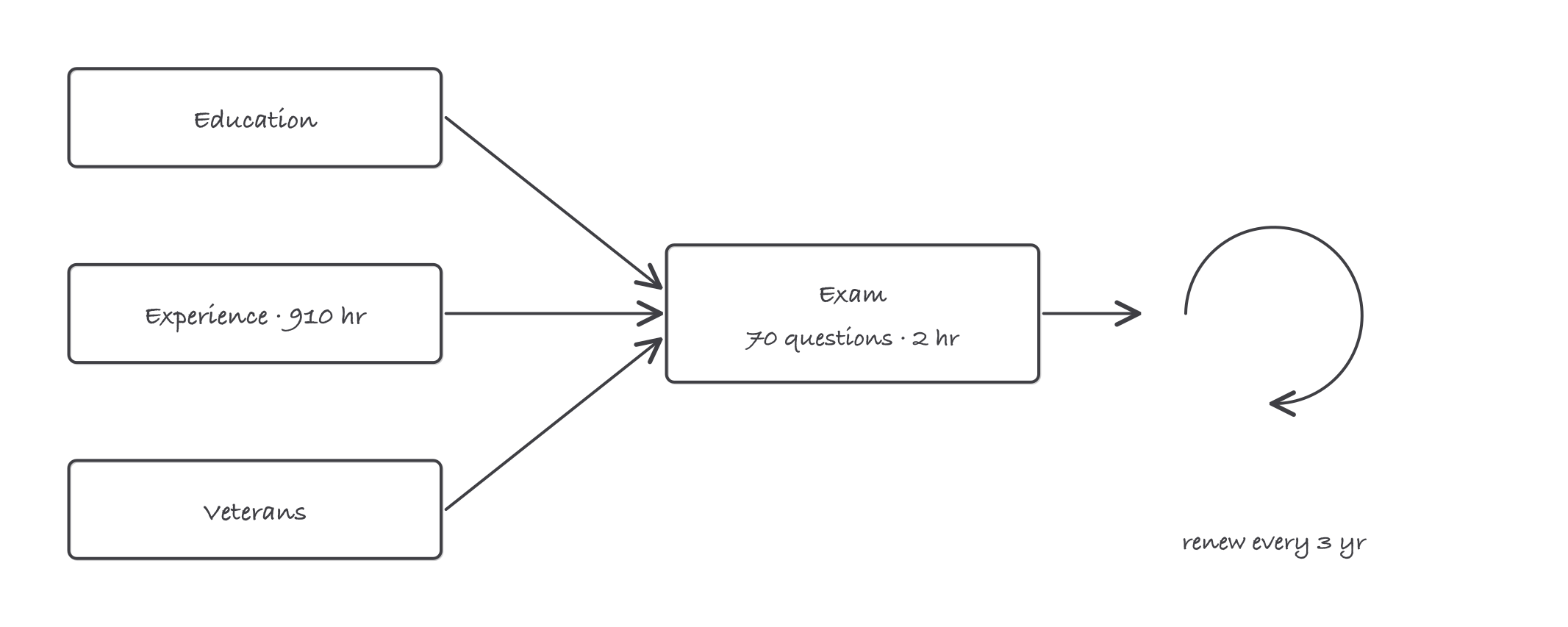
Three ways in, one exam, and a 3-year renewal loop
Keeping it current
The credential is valid for 3 years. You renew it either by documenting 12 continuing-education contact hours or by retaking the current version of the exam.
Worked example: the experience pathway
An installer joins a residential crew working a standard 35-hour week. NABCEP’s 910-hour requirement is exactly 6 months of that: 35 hours × 26 weeks = 910 hours. She applies with her documented hours, pays the $150 combined fee, and her 2-year eligibility window opens. She books the exam for month two, leaving herself room for up to 6 attempts in each year of the window, 14 days apart, if the first sitting goes badly. One sitting is the plan; the window is the insurance.
Where it bites
- “NABCEP certified” on an Associate resume. The Associate is not a certification, and NABCEP polices its credential language. Write “NABCEP PV Associate” and nothing grander.
- Treating it as a license. It has no legal force. Who may install solar is a state licensing question, covered in Solar Licensing by State.
- Letting the window lapse. The 2-year eligibility clock runs whether or not you book the exam. Apply when you are ready to study, not years before.
- Burning attempts. Six attempts per year sounds generous; the 14-day cooling-off between them means a string of rushed retakes can eat months.
Exam relevance
This lesson describes the exam itself, and the five domains are a map of the solar curriculum on this site: fundamentals lessons feed PV Application, the design and sizing group feeds Design, the installation group feeds Installation, and the maintenance group feeds Operations and Maintenance. If you can work through those lesson groups without stumbling, the Associate breadth check is doing its job.